Bangladesh Garment Sourcing Case Study: How a German Mid-Market Retailer Fixed MOQs, Quality, Compliance and Missed Deadlines
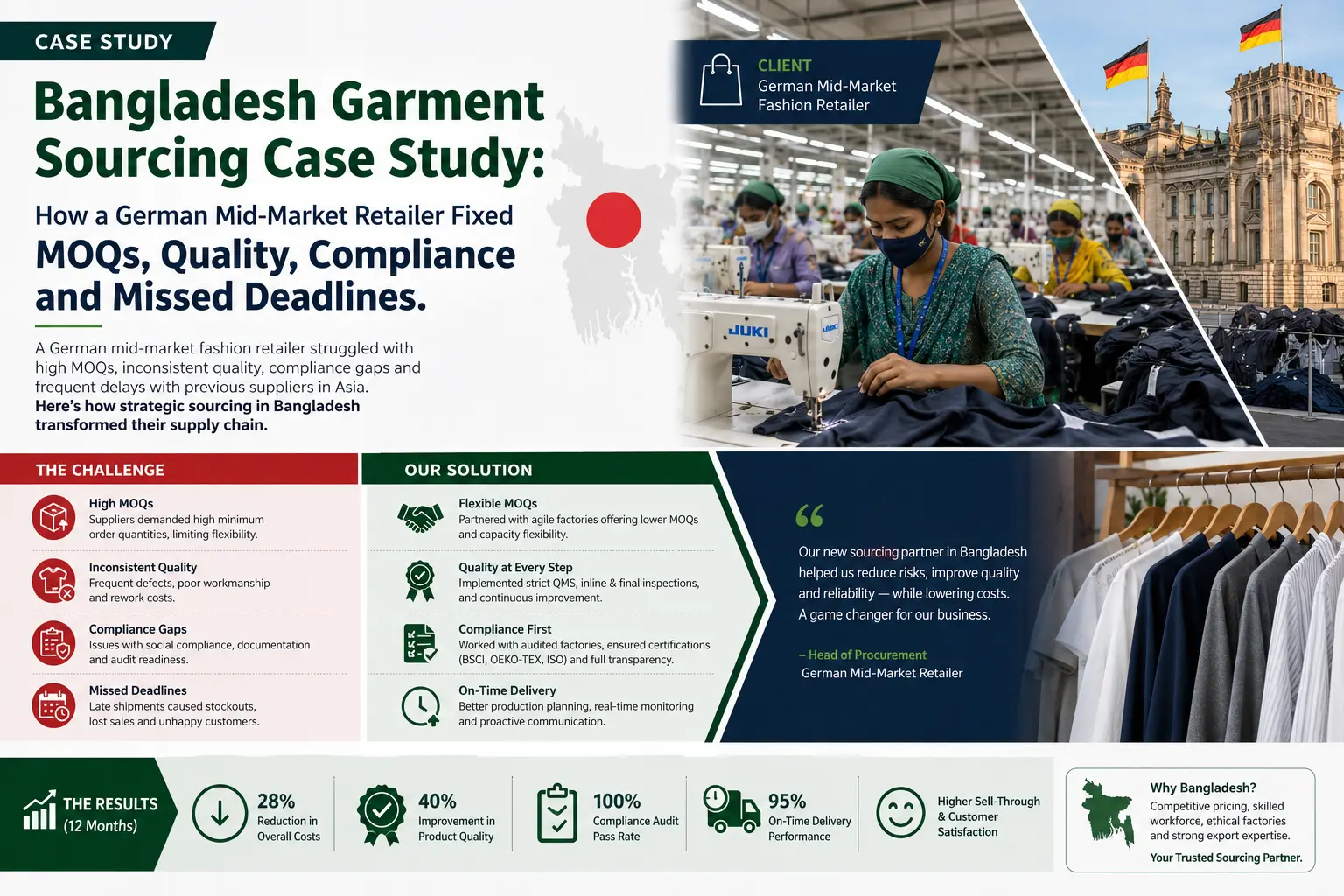
A German mid-market fashion retailer came to Milky Fashions after a previous supplier left them with high minimum order quantities, inconsistent product quality, missing compliance documentation, and repeatedly missed delivery dates. By switching to a managed buying-house model, they secured workable MOQs, passed quality inspection, received complete compliance evidence, hit their agreed lead time, and reduced their landed cost — then became a repeat client. This is how that turnaround happened, stage by stage.
Most garment sourcing companies tell you what they would do. This is a record of what we actually did. The client is anonymised at their request, but every problem and outcome below is real. If you are a European brand frustrated with an existing supplier — or nervous about choosing your first one — this case study shows what a properly managed garment sourcing partnership in Bangladesh looks like in practice, and why the buying-house model exists.
The Client: A German Mid-Market Retailer Under Pressure
The client is a mid-market fashion retailer based in Germany, selling Sleepwear across physical stores and e-commerce. They are exactly the kind of brand Bangladesh should serve well — large enough to need reliable volume, but not large enough to command the attention that giants like H&M or Inditex receive from the biggest factories.
That in-between position is precisely where sourcing goes wrong. The brands at the very top get white-glove treatment; the smallest brands accept whatever they are given. Mid-market retailers like this client fall into the gap — too small to be a priority for a large factory, too large to tolerate amateur mistakes. They had been sourcing directly, and it was not working. For context on why this segment struggles, see our analysis of why small and mid-sized fashion brands fail at Bangladesh sourcing.
The Four Problems They Arrived With
When the client first contacted us, they were dealing with four compounding problems — each common on its own, and crippling in combination.
| Problem | What it looked like in practice |
|---|---|
| High MOQs | Their previous supplier demanded minimums far above what their order volumes justified, forcing overstock |
| Quality issues | Inconsistent make, off-spec measurements, and product that did not match the approved sample |
| Missing compliance docs | No reliable audit trail or certificates — a serious problem under German law |
| Missed deadlines | Repeated late deliveries that threatened their retail launch windows |
Let us look at why each one matters, because they map directly onto the questions every European buyer should be asking.
Problem 1: Minimum Order Quantities They Couldn’t Justify
Their previous supplier enforced an MOQ of 5000 per style — well beyond what their sell-through supported. The result was predictable: overstock, tied-up cash, and end-of-season markdowns that ate their margin. High minimums are one of the most common pain points for mid-market brands, and they are usually a sign that the supplier is structured for much larger buyers. Our MOQ guide for Bangladesh sourcing explains how minimums actually work and where the flexibility lies.
Problem 2: Quality That Didn’t Match the Sample
Bulk production was coming back inconsistent — variation in measurements, finishing, and fabric that did not match the approved pre-production sample. With no one inspecting on the ground, problems were only discovered after the goods reached Germany, when it was far too late and far too expensive to fix. This is the classic failure mode of direct sourcing without local quality control, and exactly why we wrote our guides on how to vet a Bangladesh garment factory and how to vet a Bangladesh buying house.
Problem 3: Missing Compliance Documentation
This was the most dangerous problem, and the client knew it. As a German company, they operate under the country’s Supply Chain Due Diligence Act, the LkSG, which makes brands legally responsible for human rights and environmental standards at their suppliers. Their previous supplier could not produce reliable audit reports or current certifications — leaving the client exposed to fines and reputational risk. Without a documented, certified supply chain, they could not satisfy their own legal obligations. Our wider guides to EU apparel compliance and EU supply chain compliance for Bangladesh sourcing explain why this documentation is now non-negotiable.
Problem 4: Repeatedly Missed Deadlines
Finally, deliveries kept slipping. In fashion retail, a late delivery does not just inconvenience — it can miss an entire selling season. The client had already lost full-price sell-through to late stock, and could not plan their range with confidence. Understanding realistic timelines is critical here, which is why we maintain a detailed Bangladesh garment lead time guide.
What Milky Fashions Did: The Solution, Stage by Stage
We approached the turnaround the same way we approach every order — by taking the entire process off the client’s desk and managing it on the ground. Here is exactly what we did.
Stage 1: Factory Selection Matched to Their Volumes
Rather than force the client into a factory built for giants, we selected a partner factory from our vetted network that was the right scale for their order volumes — one running a production system capable of handling their quantities without inflating the MOQ. This single decision solved the minimums problem at its root. We matched the client to capacity that fit them, dropping their workable minimum to 3000 per style. For brands weighing this structural choice, our comparison of a buying house versus a direct factory explains why factory-matching matters so much.
Stage 2: Disciplined Sampling Before Any Bulk Commitment
We ran a proper sampling process — development sample, then a pre-production (PP) sample signed off as the binding quality standard before a single unit of bulk was cut. This is the step the previous supplier had rushed. By locking the PP sample as the contractual benchmark, we gave the factory an unambiguous target and gave the client confidence that bulk would match what they approved. The discipline here connects directly to building a proper tech pack for garment manufacturing, which we also refined with the client.
Stage 3: On-the-Ground Quality Control
This is where the buying-house model earns its value. We conducted inline inspection during production and a final inspection against the internationally recognised AQL standard before the goods were packed — physically checking the client’s Sleepwear against the approved PP sample. Defects were caught and corrected in the factory, not discovered in a warehouse in Germany. The 12000-unit order passed final inspection, and DEFECT/RETURN RATE — returns on the order were negligible. Our overview of how to source garments from Bangladesh sets out where QC sits in the full process.
Stage 4: Complete Compliance Documentation
We sourced exclusively from certified factories holding current BSCI, WRAP, SEDEX, GOTS, GRS, and OEKO-TEX accreditation, and we assembled the full documentation package the client needed for their LkSG due diligence file — audit reports, valid certificates, and a clear supplier trail. For a deeper explanation of how these audit schemes map to legal requirements, see our BSCI vs WRAP vs SEDEX vs amfori compliance decoder and our guide to REACH and OEKO-TEX chemical compliance. The client could finally satisfy their German legal obligations with confidence.
Stage 5: Active Lead-Time Management
Instead of leaving the timeline to chance, we managed it actively — running sampling, fabric booking, and trims in parallel, chasing each production stage daily, and planning around Bangladesh’s seasonal pressure points. The order shipped on its agreed 75 days timeline, and the client had stock in Germany in time for their launch window.
The Results
The turnaround delivered on every one of the four original problems.
| Original problem | Outcome with Milky Fashions |
|---|---|
| High MOQs | Reduced to a workable [NEW MOQ] per style through factory-matching |
| Quality issues | Order passed AQL final inspection against the approved PP sample |
| Missing compliance docs | Complete certified audit trail delivered for LkSG due diligence |
| Missed deadlines | Shipped on the agreed [LEAD TIME] timeline, in time for launch |
| Cost | Landed cost reduced by approximately [COST SAVING %] versus the previous supplier |
Most tellingly, the client did not treat this as a one-off. They came back. Over 10000 pcs, they placed repeat orders and moved from a nervous, burned buyer to a confident, relational one — the kind of long-term sourcing relationship that produces the best pricing and reliability for both sides. That shift from spot buying to a managed, relational partnership is exactly what turns Bangladesh from a risk into a competitive advantage.
Why This Outcome Was Possible: The Buying-House Difference
None of this required a miracle. It required someone on the ground in Dhaka doing the unglamorous work — vetting the right factory, enforcing the sampling discipline, inspecting the goods, assembling the documentation, and chasing the timeline daily. That is the entire reason the garment buying house model exists.
A direct factory sells you capacity and leaves the rest to you. A buying house manages the whole order so a mid-market brand without a Dhaka office gets the oversight a giant retailer would have in-house. For German brands in particular, with LkSG obligations to meet, that local management is the difference between a compliant, reliable supply chain and a constant source of risk. It is also why we built dedicated guidance for German fashion brands sourcing from Bangladesh.
Five Lessons European Buyers Can Take From This
You do not need to be in the same situation to learn from it. These are the transferable lessons every European brand sourcing from Bangladesh — whether from Germany, the UK, France, the Netherlands, Spain, Italy, Denmark, or Poland — can apply immediately.
Match the factory to your volume, not your ambition. The right factory for a mid-market order is rarely the biggest one. A factory built for million-piece buyers will quote punishing MOQs and deprioritise your order. Matching scale is the single most effective fix for high minimums.
Never approve bulk without a binding pre-production sample. The PP sample is your contract for quality. If a supplier wants to skip it or rush it, treat that as a warning sign. A signed-off PP sample is the standard every garment in your bulk run is measured against.
Inspect on the ground, before the goods ship. Quality control discovered in a European warehouse is quality control that has already failed. Inline and final AQL inspection in the factory is what catches defects while they are still fixable and cheap.
Treat compliance documentation as a legal asset, not paperwork. For German brands under LkSG — and increasingly for all EU brands under the wider digital product passport and due diligence framework — a certified, documented supply chain is a legal requirement. Build it in from order one, not after a problem arises.
Manage the timeline actively, every week. A lead time is a promise that only holds if someone is chasing it. Passive sourcing produces missed deadlines; active, daily management produces reliable delivery.
How This Fits the Bigger Bangladesh Sourcing Picture
This case study is one example of a pattern we see constantly: European brands burned by unmanaged sourcing, who assume the problem is Bangladesh when the real problem is the absence of management. Bangladesh remains one of the world’s strongest sourcing destinations — duty-advantaged for the EU, deep in knitwear and denim capacity, and home to one of the highest concentrations of certified factories in Asia. The country is not the risk. Unmanaged sourcing is.
The brands that win in Bangladesh are simply the ones who source it with discipline — the right factory, proper sampling, real quality control, complete compliance, and active timeline management. That is the entire job of a buying house, and it is what turned this German retailer’s experience around.
Could This Be Your Brand?
If any of the four problems in this case study sound familiar — punishing MOQs, quality you cannot trust, compliance gaps that worry your legal team, or deliveries that keep slipping — the solution is not to give up on Bangladesh. It is to source it properly.
Milky Fashions has been managing exactly this kind of turnaround for European brands since 2002, as a BGBA-registered buying house (Member M-0357). We work with fashion brands, retailers, and importers across Germany, the UK, France, the Netherlands, Spain, Italy, and Poland, producing private label collections and sustainable garments from certified factories.
Contact us for a free, no-obligation consultation and tell us what is going wrong with your current sourcing. We will tell you honestly whether we can fix it. You can also learn more about our buying house and read why Bangladesh remains a leading sourcing destination when it is managed correctly.
Frequently Asked Questions
Why do mid-market fashion brands struggle to source from Bangladesh?
Mid-market brands often fall into a gap: they are too small to be a priority for the largest factories, yet large enough that amateur mistakes hurt. This frequently leads to high minimum order quantities, inconsistent quality, weak compliance documentation, and missed deadlines. A buying house solves this by matching the brand to an appropriately sized factory and managing the order on the ground.
How can a buying house reduce minimum order quantities?
A buying house can reduce effective MOQs by matching a brand to a factory whose capacity and production system fit the brand’s order volumes, rather than forcing the brand into a factory built for giant retailers. It can also consolidate orders. In this case study, factory-matching brought the client’s workable minimum down to a level their sell-through could support.
How does a buying house fix garment quality problems?
A buying house enforces a disciplined sampling process — locking a pre-production sample as the binding quality standard — and then conducts inline and final AQL inspection on the ground before goods ship. Defects are caught and corrected in the factory rather than discovered after the goods reach Europe, which is the most common and most expensive failure mode of unmanaged direct sourcing.
What compliance documentation do German retailers need from a Bangladesh supplier?
Under Germany’s LkSG supply chain law, German retailers need current social compliance audits (such as amfori BSCI or SEDEX SMETA), factory safety certificates, chemical compliance evidence, and a clear supplier audit trail for their due diligence file. A buying house that works only with certified factories can assemble this documentation package on the brand’s behalf.
How long does a typical first order from Bangladesh take?
A typical first order takes around 90 to 130 days from enquiry to delivery in Europe, including sampling, bulk production, quality control, and roughly three to four weeks of sea freight. Active lead-time management — running stages in parallel and planning around peak season and Eid — is what keeps that timeline reliable, as it did for the client in this case study.
Is it worth switching garment suppliers if my current one is underperforming?
If your supplier is delivering high MOQs, inconsistent quality, weak compliance documentation, or late shipments, switching to a managed buying-house model can resolve all four, as this case study shows. The key is not abandoning Bangladesh but sourcing it with proper on-the-ground management. A free consultation is the simplest way to assess whether a switch would help your brand.
Tell Us What’s Going Wrong
Every brand in this position thinks their sourcing problems are unique. Almost always, they are the same four problems — and they are fixable. If punishing minimums, unreliable quality, compliance gaps, or missed deadlines sound familiar, get in touch for a free consultation. We will give you an honest assessment and a realistic plan, the same way we did for the German retailer in this case study. You can also explore how to order garments from Bangladesh to see our full process, or browse our FAQ page for the questions European buyers ask most.

Director and Head of Merchandising at Milky Fashions, a BGBA-registered garment buying house in Bangladesh since 2002. Specialises in knitwear sourcing, factory compliance, and European buyer relations.