BSCI vs WRAP vs SEDEX vs amfori 2.0: The Complete Compliance Decoder for European Fashion Buyers
If you have ever tried to shortlist a garment factory in Bangladesh, you have seen the acronyms: BSCI, WRAP, SEDEX, amfori, SMETA, OEKO-TEX, GOTS. Every supplier lists them. Most buyers nod along without being entirely sure what each one means, which ones actually matter, and whether having one is as good as having another.
This guide ends that confusion.
At Milky Fashions, we have been sourcing certified garments from Bangladesh since 2002. We work with fashion brands across the UK, Germany, Italy, France, the Netherlands, Spain, and Poland — and compliance certification is one of the first things every buyer asks us about. This is the most complete, practical breakdown of the four major social and ethical auditing frameworks — BSCI, WRAP, SEDEX, and amfori 2.0 — written specifically for small and mid-sized European fashion brands.
By the end of this guide, you will know exactly which certifications to require from your Bangladesh supplier, what each audit actually checks, and how Milky Fashions ensures every factory in our network meets the compliance standards your European buyers, retailers, and CSR teams demand.
Why Compliance Certification Matters More Than Ever for European Fashion Brands
The European fashion market has fundamentally changed in the last five years. Sustainability legislation, retailer requirements, and consumer expectations have all tightened simultaneously.
The EU Corporate Sustainability Due Diligence Directive (CSDDD) — now in force — requires companies above certain thresholds to identify, prevent, and address adverse human rights and environmental impacts across their supply chains. Even if your brand is below the initial threshold, your retail partners almost certainly are not. If you supply to any major European retailer, their compliance requirements flow directly down to you and your factory partners.
Beyond legislation, the reputational risk is real. A single sourcing scandal — a factory fire, a wage theft exposure, a child labour allegation — can end a brand. For small and mid-sized fashion companies that lack the legal and PR resources of large corporations, this risk is existential, not manageable.
Compliance certification is not bureaucracy. It is evidence. It is the documented proof that the factory making your garments has been independently audited against internationally recognised labour, safety, and environmental standards. When a retailer, a journalist, or a regulator asks you what you know about your supply chain, certification is your answer.
The question is: which certification, and what does it actually prove?
BSCI — Business Social Compliance Initiative
What It Is
BSCI is a supply chain management system developed by amfori, a global trade association of over 2,000 retail, import, and brand companies. It is one of the most widely recognised compliance frameworks in European fashion and retail.
BSCI uses a single audit — conducted by an accredited third-party auditor — to assess a factory against the amfori BSCI Code of Conduct. The Code covers eleven performance areas: social management systems, workers’ involvement and protection, freedom of association, prohibition of discrimination, fair remuneration, decent working hours, occupational health and safety, prohibition of child labour, prohibition of forced labour, protection of the environment, and ethical business behaviour.
How the Audit Works
An accredited BSCI auditor visits the factory for one to two days. They inspect facilities, review payroll records, check working hour logs, interview workers, and assess management systems. The audit produces a score across five grades: Outstanding (A), Good (B), Acceptable (C), Insufficient (D), and Unacceptable (E).
Factories with a C grade or above are considered compliant. Factories scoring D or E must complete a corrective action plan and be re-audited.
Who Recognises It
BSCI is the dominant compliance standard across European retail. If you supply to German, Dutch, Belgian, French, or Scandinavian retailers, there is a high probability they require BSCI. It is the most widely required single certification in the European fashion supply chain.
What It Does Not Cover
BSCI is a social compliance audit. It does not assess product safety, chemical compliance, or environmental performance at the product level. For that, you need OEKO-TEX or GOTS in addition.
Milky Fashions and BSCI
All Milky Fashions factory partners hold current BSCI certification. We verify audit validity dates before placing any order and request updated audit reports as part of our factory onboarding process.
WRAP — Worldwide Responsible Accredited Production
What It Is
WRAP is an independent, objective, non-profit organisation dedicated to the certification of lawful, humane, and ethical manufacturing throughout the world. It was established in 2000 and is one of the largest apparel certification programmes globally, with certified facilities across over 50 countries.
WRAP certification is based on twelve production standards covering compliance with laws and workplace regulations, prohibition of forced labour, prohibition of child labour, prohibition of harassment or abuse, compensation and benefits, hours of work, prohibition of discrimination, health and safety, freedom of association, environment, customs compliance, and security.
How the Audit Works
WRAP uses a self-assessment questionnaire completed by the factory, followed by an on-site audit by an accredited independent monitoring organisation (IMO). The audit assesses the factory against all twelve standards and can result in Platinum (three-year certification), Gold (two-year), or Silver (one-year) certification levels.
WRAP certification is factory-specific — it certifies the production facility, not individual products or brands.
Who Recognises It
WRAP is widely recognised across North American and European markets. It is particularly common in the US market but is accepted by many European importers and retailers as an equivalent to BSCI. Some European retailers accept WRAP as a standalone certification; others prefer BSCI or SEDEX. Check your specific retail partner requirements.
Key Difference from BSCI
WRAP is self-assessment led — the factory completes the initial questionnaire before the external audit. BSCI is entirely third-party led from the outset. Some compliance teams in Europe view BSCI as more rigorous for this reason, though both are internationally respected frameworks.
Milky Fashions and WRAP
Selected Milky Fashions factory partners hold WRAP certification, particularly those producing for North American and UK buyers. We can confirm WRAP status for any factory in our network upon request.
SEDEX and SMETA — Supplier Ethical Data Exchange
What It Is
SEDEX is a not-for-profit membership organisation that operates a secure online platform for sharing supply chain data. It is important to understand that SEDEX itself is not an audit standard — it is a data platform. What most buyers mean when they say “SEDEX certified” is that the factory has completed a SMETA audit (Sedex Members Ethical Trade Audit) and uploaded the results to the SEDEX platform.
SMETA is one of the most widely used social audit formats in the world. It was developed by the SEDEX Stakeholder Forum and is based on the ETI (Ethical Trading Initiative) Base Code and local law.
SMETA 2-Pillar vs 4-Pillar
SMETA audits come in two formats. The 2-Pillar audit covers Labour Standards and Health & Safety. The 4-Pillar audit adds Environment and Business Ethics to these two pillars.
Most European fashion brands and retailers now require the 4-Pillar SMETA. If you are working with UK supermarkets, major European apparel chains, or any retailer with a published CSR policy, the 4-Pillar SMETA is the standard you should require.
How SEDEX / SMETA Works
The factory registers on the SEDEX platform and shares its audit data with its buyers. You as a buyer can access the factory’s SMETA audit report, corrective action tracking, and compliance history directly through the SEDEX platform — without needing to request documents from the factory manually. This transparency is one of SEDEX’s significant advantages.
Who Recognises It
SEDEX / SMETA is the preferred framework for UK retailers and is widely accepted across European fashion supply chains. Marks & Spencer, NEXT, Primark, ASOS, H&M, and many other European retailers require SMETA for their supply chain partners.
Milky Fashions and SEDEX
Milky Fashions factory partners with SEDEX registration are available for buyers whose retail partners require SMETA audit access. We can connect you with SEDEX-registered factories and provide shared platform access where required.
amfori 2.0 — The Evolution of BSCI
What It Is
amfori 2.0 is the updated framework from amfori — the same organisation that developed BSCI. In recent years, amfori has been transitioning from the BSCI framework toward an enhanced due diligence model called amfori BEPI (Business Environmental Performance Initiative) and a revised social standard.
For practical purposes, when buyers and factories refer to amfori 2.0, they are referring to the updated amfori social compliance framework that builds on BSCI with greater emphasis on:
- Human rights due diligence aligned with the UN Guiding Principles on Business and Human Rights
- Environmental performance at factory level (BEPI)
- Continuous improvement rather than pass/fail audit outcomes
- Integration with the EU CSDDD requirements
What Changes from BSCI to amfori 2.0
The core audit methodology remains recognisable, but amfori 2.0 places greater emphasis on documented management systems, worker voice mechanisms, and environmental data collection. Factories that hold current BSCI certification are in the best position to transition to amfori 2.0 compliance.
Why It Matters for European Buyers Now
If you source from Bangladesh for European markets, amfori 2.0 is the direction of travel. As EU due diligence legislation tightens, frameworks like amfori 2.0 that align with CSDDD requirements will become the baseline expectation, not a premium add-on. Working with a buying house whose factory partners are already operating under amfori / BSCI gives you a head start on compliance readiness.
Side-by-Side Comparison: BSCI vs WRAP vs SEDEX vs amfori 2.0
| Framework | Type | Geographic Preference | Audit Led By | Environmental Coverage | EU Retailer Acceptance |
|---|---|---|---|---|---|
| BSCI | Social compliance | Europe (dominant) | Third-party | No (social only) | Very high |
| WRAP | Social compliance | Global / North America | Self + third-party | No (social only) | High |
| SEDEX / SMETA | Data platform + audit | UK / Europe | Third-party | Yes (4-Pillar) | Very high |
| amfori 2.0 | Due diligence framework | Europe | Third-party + self-assessment | Yes (BEPI) | Growing |
Which Certifications Should You Require from Your Bangladesh Supplier?
The answer depends on where you sell.
If you sell to EU continental retailers (Germany, Netherlands, France, Belgium, Scandinavia): Require BSCI as your minimum. SMETA 4-Pillar is a valuable addition.
If you sell to UK retailers: SMETA 4-Pillar (via SEDEX) is typically the primary requirement. BSCI is widely accepted alongside it.
If you sell to North American retailers or have US distribution: WRAP is frequently required. Confirm with your US retail partner.
If you are a brand with your own CSR policy and direct consumer sales: BSCI plus SMETA 4-Pillar plus either OEKO-TEX or GOTS (depending on your sustainability claims) gives you a comprehensive compliance stack.
If you are a smaller brand without specific retailer requirements: BSCI is the most practical starting point. It covers the broadest range of European buyer and retailer expectations with a single audit.
At Milky Fashions, we work with European buyers sourcing across the UK, Germany, Italy, France, Netherlands, Spain, and Poland markets. Each market has slightly different retailer and compliance expectations, and we advise our buyer partners on the right certification stack for their specific distribution channels.
Beyond Social Compliance: OEKO-TEX and GOTS
Social audits cover how garments are made — the working conditions, wages, and labour practices inside the factory. But European fashion brands increasingly need to demonstrate what garments are made of — specifically, that they are free from harmful chemicals and produced using sustainable materials.
Two certifications cover this:
OEKO-TEX Standard 100: Certifies that every component of a garment — fabric, thread, buttons, zips, labels — has been tested for and found free from harmful substances. This is the baseline product safety certification for European fashion. If you sell childrenswear or any product with skin contact, OEKO-TEX is essential.
GOTS — Global Organic Textile Standard: Certifies that garments are made from organic fibres (minimum 70% certified organic) and produced under environmentally and socially responsible conditions throughout the supply chain. GOTS is the gold standard for brands making organic or sustainable product claims.
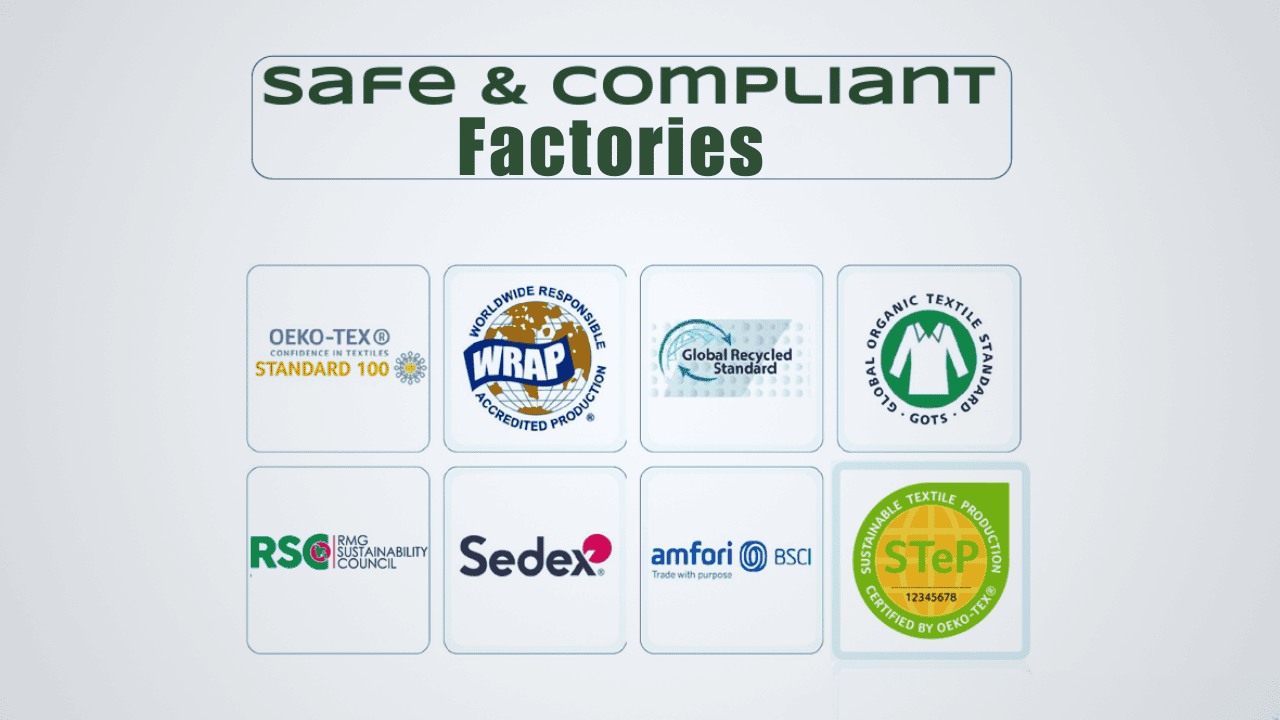
All Milky Fashions certified factory partners hold current BSCI certification, with selected factories also holding WRAP, SEDEX, GOTS, OEKO-TEX, and GRS (Global Recycled Standard) certification depending on product category and buyer requirements.
How Milky Fashions Manages Compliance for Your Supply Chain
Managing compliance documentation from a factory thousands of miles away is genuinely difficult. Audit certificates expire. Corrective action plans need tracking. New retailer requirements appear. Factory circumstances change.
This is precisely the operational function a buying house performs on your behalf.
At Milky Fashions, our compliance management process covers:
Factory vetting: Every factory in our network is vetted against our compliance checklist before we place a single order. Current audit status, audit grade, corrective action status, and upcoming renewal dates are all verified.
Audit calendar management: We track certification expiry dates across our factory network and flag renewals proactively. You never receive a shipment from a factory whose certification has lapsed.
Retailer compliance matching: When you brief us on a new product or buyer, we match your order to a factory whose certification stack meets that buyer’s specific requirements. You do not need to research this yourself.
Documentation provision: We provide copies of all relevant compliance certificates for your orders upon request — in the format required by your retailer, logistics partner, or CSR team.
Escalation management: If an audit result requires corrective action, we manage the factory’s corrective action plan and verify closure before continuing to place orders.
For small and mid-sized European fashion brands without a dedicated compliance officer, this operational support is invaluable. It is the difference between managing compliance as a reactive fire-fighting exercise and embedding it as a proactive, documented part of your sourcing process.
Your Compliance Checklist When Sourcing from Bangladesh
Before placing your first order with any Bangladesh factory or buying house, verify the following:
- Current BSCI audit certificate — check the grade (C or above) and expiry date
- SMETA audit report on SEDEX if your retail partners require it
- WRAP certificate if you have North American distribution
- OEKO-TEX certificate if your products include childrenswear or sensitive skin contact items
- GOTS certificate if you are making organic product claims
- GRS certificate if you are making recycled fibre claims
- Factory trade licence and export registration — basic legal compliance verification
- Fire safety and building safety certificates — non-negotiable post-Rana Plaza
If a factory or sourcing agent cannot provide current documentation for all of the above that are relevant to your product, do not place an order. The reputational and legal risk to your brand is not worth any price saving.
Frequently Asked Questions
Q1: Is BSCI the same as amfori? BSCI was developed by amfori and is often referred to interchangeably with amfori. amfori 2.0 represents the evolved version of the framework with additional due diligence and environmental components. For practical purposes, a current BSCI certificate issued by amfori satisfies most European retailer requirements that reference either name.
Q2: Can one factory hold multiple certifications simultaneously? Yes. Many of Bangladesh’s leading export factories hold BSCI, WRAP, SEDEX, OEKO-TEX, and GOTS simultaneously. Each certification covers a different dimension of compliance, and holding multiple certifications is standard practice for factories supplying to multiple international markets.
Q3: How often do these certifications need to be renewed? BSCI audits are typically valid for one to two years depending on the grade achieved. SMETA audits are generally valid for two years. WRAP certifications range from one to three years. OEKO-TEX and GOTS certifications are renewed annually. Always verify current validity dates — an expired certificate is not a compliant certificate.
Q4: Who pays for compliance audits — the buyer or the factory? Typically the factory bears the cost of social compliance audits as part of their export readiness investment. Product certifications like OEKO-TEX and GOTS involve per-unit licensing fees that may be reflected in FOB pricing. Your buying house should be transparent about how certification costs are structured in their factory pricing.
Q5: What is the difference between SEDEX and SMETA? SEDEX is the data-sharing platform. SMETA is the audit methodology. A factory uploads its SMETA audit results to the SEDEX platform, which is then accessible to its buyers. When buyers say they require SEDEX, they typically mean they want their supplier registered on the SEDEX platform with a current SMETA audit on record.
Q6: Do I need compliance certification if I sell my own brand direct to consumers online? Increasingly, yes. EU consumer protection regulations, platform marketplace requirements (Amazon, Zalando, ASOS Marketplace), and your own brand liability exposure all create strong reasons to have documented compliance. Even without a retail partner mandate, BSCI certification provides documented evidence of due diligence that protects your brand in the event of a supply chain allegation.
Milky Fashions is a licensed apparel buying house and garment sourcing company based in Dhaka, Bangladesh, operating since 2002. BGBA Member M-0357. Our factory network holds current BSCI, WRAP, SEDEX, GOTS, OEKO-TEX, and GRS certifications. For a compliance consultation or factory sourcing enquiry, contact us through our website.

Director and Head of Merchandising at Milky Fashions, a BGBA-registered garment buying house in Bangladesh since 2002. Specialises in knitwear sourcing, factory compliance, and European buyer relations.