EU Textile Regulations and Bangladesh Sourcing Compliance — A Practical Guide for European Fashion Brands
The regulatory environment for European fashion brands has fundamentally changed. Between 2024 and 2030, a wave of EU legislation — covering supply chain due diligence, product sustainability, environmental claims, and traceability — will restructure how garments are designed, sourced, manufactured, and sold across all seven of your key markets: the UK, Germany, the Netherlands, France, Italy, Spain, and Poland.
For brands sourcing garments from Bangladesh, the question is no longer whether compliance matters. It is whether your current supply chain — and your current sourcing partner — can demonstrate it.
Milky Fashions is a BGBA-registered Bangladesh garment buying house (Member No. M-0357) that has worked with European fashion brands since 2002. This page explains every major EU textile regulation currently affecting your supply chain, what each one requires from your Bangladesh sourcing programme, and how our certified factory network already meets those requirements.
The EU Textile Regulatory Landscape — What Is Changing and Why
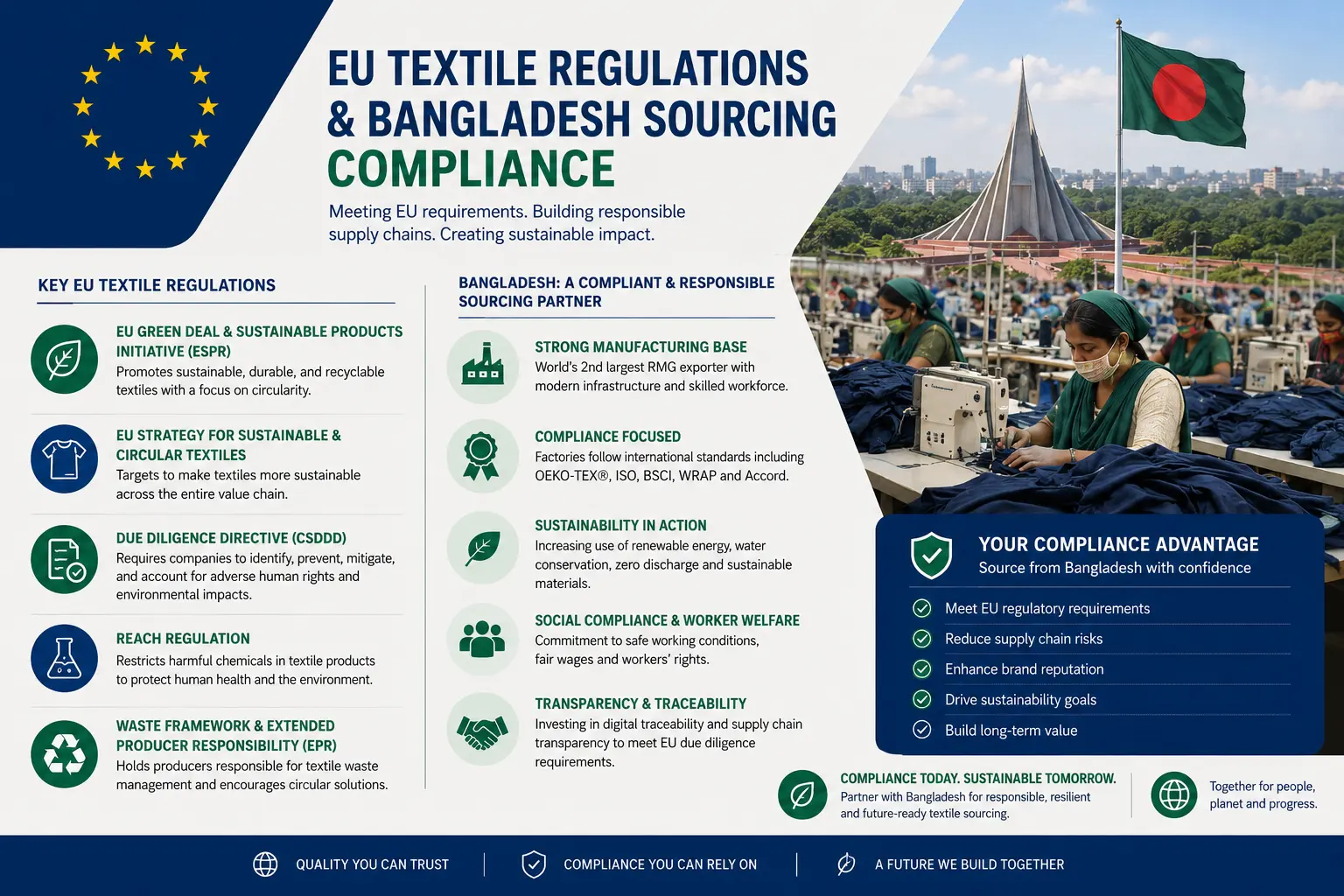
The European Commission has identified the textile and apparel sector as one of the most environmentally and socially harmful industries in the EU economy. The legislative response is the most comprehensive textile regulatory overhaul in European history — not a single law, but an interconnected framework of directives and regulations designed to eliminate greenwashing, enforce supply chain transparency, and accelerate the shift to circular fashion.
For European brand buyers and sourcing managers, this framework creates five direct obligations:
Demonstrate your supply chain is ethically compliant. Substantiate any environmental claim you make about your products. Prepare for digital traceability of every garment you sell. Manage your textile waste under Extended Producer Responsibility rules. Meet country-specific due diligence laws in Germany, France, and the UK.
Each of these obligations has a specific regulatory mechanism — and each maps to a specific certification or documentation process that Milky Fashions manages on your behalf.
The Seven EU Textile Regulations You Must Understand
1. CSDDD — Corporate Sustainability Due Diligence Directive
The Corporate Sustainability Due Diligence Directive (CSDDD) requires companies within its scope to identify, prevent, and address adverse human rights and environmental impacts across their own operations and direct supply chain partners. For garment brands, this means your Bangladesh factory relationships are within scope — and you must demonstrate active due diligence, not just passive certification.
Following the Omnibus I Simplification Package approved in December 2025, the CSDDD now applies to companies with over 5,000 employees and €1.5 billion or more in net annual turnover, including non-EU companies with equivalent EU revenue. Application is expected from 2028. However, preparation — supply chain mapping, supplier auditing, and documentation systems — must begin now for companies to be compliant on time.
What it requires from your Bangladesh sourcing: valid third-party social compliance audits (BSCI, WRAP, or SMETA) from every factory in your supply chain, documented before production begins.
2. ESPR — Ecodesign for Sustainable Products Regulation
The ESPR came into force on 18 July 2024, replacing the older Ecodesign Directive. It sets mandatory sustainability requirements for products sold in the EU, covering durability, repairability, recyclability, and recycled content. Textiles are a priority category. The textile-specific delegated acts are targeted for 2027, with mandatory compliance to follow.
One immediately enforceable element: from 19 July 2026, large companies are banned from destroying or disposing of unsold clothing, accessories, and footwear. Medium-sized businesses become subject to this ban from 2030.
The ESPR also introduces the Digital Product Passport — covered separately below.
What it requires from your Bangladesh sourcing: factories able to provide material composition data, certification documentation, and product lifecycle information that will feed into DPP compliance.
3. The Green Claims Directive
The Green Claims Directive (GCD) is moving through final legislative stages, with EU member states required to transpose it into national law by 2027 and begin applying it from 2029. It prohibits four categories of misleading environmental claims: self-certified environmental labels, unsupported sustainability claims, exaggerated environmental benefits, and carbon-neutral claims based solely on offsetting.
In practice: if your brand sells a garment described as “organic,” “sustainable,” “eco-friendly,” or “made with recycled fibres” without verifiable third-party certification, that claim will become illegal. France is already enforcing precursor legislation (AGEC) with similar intent.
What it requires from your Bangladesh sourcing: GOTS certification (with Transaction Certificates per shipment) for organic claims, GRS certification for recycled-content claims, and OEKO-TEX Standard 100 for chemical-safety claims.
4. The Digital Product Passport (DPP)
The Digital Product Passport is a verifiable digital record of a product’s material composition, manufacturing origin, chemical content, certification status, and end-of-life guidance — accessible via a QR code or NFC tag on every garment sold in the EU. Textile-specific DPP requirements are targeted for 2027, with a compliance window following.
The DPP will require brands to work with manufacturers who can provide structured, traceable production data. A Bangladesh factory that cannot provide fibre composition documentation, country-of-origin certification, and audit reports will not be DPP-ready.
What it requires from your Bangladesh sourcing: factories with structured data systems, certification documentation, and a buying house that can consolidate compliance records for your DPP requirements.
5. EPR for Textiles — Extended Producer Responsibility
Textile EPR schemes are mandatory across the EU by June 2027, requiring brands to register with a Producer Responsibility Organisation (PRO), pay fees based on the quantity of garments placed on each national market, and support collection, reuse, and recycling infrastructure. Member states are currently defining their national EPR scheme details, with rules transposed into national law by April 2028.
For brands selling across multiple EU markets — the UK, Germany, Netherlands, France, Italy, Spain, and Poland — EPR compliance will require market-by-market registration and reporting. France already has a mandatory national scheme. Others are following.
What it requires from your Bangladesh sourcing: accurate product-weight and fibre-composition data per garment style for EPR fee calculations.
6. CSRD — Corporate Sustainability Reporting Directive
The Corporate Sustainability Reporting Directive requires companies within its scope to disclose climate and sustainability data including Scope 1, 2, and where applicable, Scope 3 greenhouse gas emissions — which includes your supply chain. Under the Omnibus I Simplification Package, the rollout has been adjusted, with the first mandatory reports from in-scope EU companies covering financial year 2027.
For brands under CSRD, your Bangladesh factory carbon footprint data and supply chain emissions will be required disclosures. Scope 3 reporting means the emissions from your garment production in Bangladesh are part of your published sustainability report.
What it requires from your Bangladesh sourcing: factory-level emissions data, energy source documentation, and a sourcing partner who supports your Scope 3 reporting.
7. Country-Specific Regulations — Germany, France, and the UK
Three of your seven key markets have enacted or are enforcing national supply chain legislation that applies now, not in 2028:
Germany — Supply Chain Due Diligence Act (LkSG)
Germany’s Lieferkettensorgfaltspflichtengesetz (LkSG) requires companies with 1,000 or more employees in Germany to conduct human rights and environmental due diligence across their direct suppliers. For German fashion brands sourcing from Bangladesh, a current BSCI or SMETA audit report from your Bangladesh factory is the most direct way to satisfy your LkSG documentation requirement. Our network includes factories with current amfori BSCI audit grades, available before you commit to production.
France — AGEC Law and Environmental Cost Label
France’s AGEC law (Anti-Waste for a Circular Economy) is already in force and actively challenging unsubstantiated environmental claims. From October 2026, France’s Environmental Cost label becomes mandatory if brands communicate any other environmental score publicly. GOTS and GRS certifications with chain-of-custody Transaction Certificates are the documentation standard that satisfies French regulatory scrutiny for organic and recycled claims.
United Kingdom — Modern Slavery Act
UK companies with an annual turnover above £36 million must publish an annual Modern Slavery Act statement covering their supply chains. For UK fashion brands sourcing from Bangladesh, a BSCI or SMETA audit demonstrating no forced labour, no child labour, and safe working conditions in your Bangladesh factory is the foundational document for your Modern Slavery Act compliance file.
EU Textile Regulations Compliance Timeline
This table maps when each regulation becomes enforceable so you can prioritise your compliance preparation:
| Regulation | Key Date | What Becomes Mandatory |
|---|---|---|
| Germany LkSG | Now (in force) | Social due diligence for 1,000+ employee German companies |
| France AGEC | Now (in force) | No unsubstantiated green claims; EPR already active |
| UK Modern Slavery Act | Now (in force) | Annual supply chain statement for qualifying companies |
| ESPR — unsold goods ban | July 2026 | Large companies cannot destroy unsold clothing |
| France Environmental Cost label | October 2026 | Mandatory if any environmental score communicated publicly |
| CSDDD | From 2028 | Supply chain due diligence for 5,000+ employee companies |
| Digital Product Passport | From 2027–2029 | QR-accessible product data for all EU garments |
| EPR Textiles (all EU) | By June 2027 | PRO registration and reporting across all EU markets |
| CSRD (wider rollout) | From 2028 | Scope 3 emissions disclosure for in-scope companies |
| Green Claims Directive | From 2029 | Verified substantiation of all environmental claims |
Which Certification Covers Which Regulation — Quick Reference
| If Your Regulation Requires… | You Need This Certification |
|---|---|
| Social due diligence (CSDDD, LkSG, UK MSA) | BSCI, WRAP, or SMETA/SEDEX audit report |
| “Organic” product claims (Green Claims, AGEC) | GOTS — Scope Certificate + Transaction Certificate |
| “Recycled content” claims (Green Claims, ESPR) | GRS — Scope Certificate + Transaction Certificate |
| Chemical safety (REACH, consumer safety) | OEKO-TEX Standard 100 |
| Scope 3 emissions reporting (CSRD) | Factory energy + emissions data from your Bangladesh supplier |
| DPP material traceability (ESPR) | Structured fibre composition + certification documentation |
How Milky Fashions Makes Your Bangladesh Sourcing EU-Compliant
As a BGBA-registered buying house with 24 years of Bangladesh sourcing experience, Milky Fashions bridges the gap between EU regulatory requirements and Bangladesh factory compliance — so your sourcing programme is protected before production begins.
Pre-Production Compliance Mapping
Before recommending any factory, we map your programme’s regulatory requirements — BSCI for LkSG compliance, GOTS for organic claims, GRS for recycled content — against our certified factory network. You receive compliance documentation before you commit to a single order.
Audit Documentation for Your Due Diligence File
We provide current BSCI audit grades, SMETA reports, GOTS Scope Certificates, GRS Scope Certificates, and OEKO-TEX certificates as a standard part of our buying house service — not as an additional request. This gives your compliance team the documentation needed for LkSG, CSDDD, and Modern Slavery Act files.
Chain-of-Custody Management for Green Claims
For brands making organic or recycled-content claims, we manage GOTS and GRS Transaction Certificate issuance per shipment — giving you the per-order documentation that French AGEC enforcement and the Green Claims Directive now require.
Factory Data for CSRD Scope 3 Reporting
As CSRD Scope 3 reporting requirements expand, we work with factory partners to collect and provide the energy source and production data your sustainability team needs for annual disclosures.
Frequently Asked Questions
Does the CSDDD apply to my brand if I source from Bangladesh?
If your company has over 5,000 employees and €1.5 billion or more in net annual turnover, the CSDDD will require you to conduct and document supply chain due diligence from 2028. Even below this threshold, German LkSG and French AGEC apply now for brands in those markets. BSCI, WRAP, or SMETA audit reports from your Bangladesh factory are the starting point for demonstrating compliance.
What is the Digital Product Passport and when does it apply to textiles?
The Digital Product Passport is a verifiable digital record of a garment’s materials, origin, certifications, and environmental data, accessible via QR code on the product. Textile-specific requirements are targeted for 2027 under the ESPR, with a compliance window following adoption. Brands should begin building structured product data systems now to avoid a 2029 scramble.
Does Germany’s LkSG apply to my Bangladesh garment supplier?
Germany’s LkSG places the due diligence obligation on the German company, not the Bangladesh factory. However, to meet your LkSG obligation, you must monitor and document working conditions at your direct Bangladesh suppliers. A current BSCI or SMETA audit report from the factory is the most practical way to satisfy this requirement.
How do I substantiate an “organic” or “recycled” claim under the Green Claims Directive?
An “organic” claim requires a GOTS Scope Certificate from the factory plus a GOTS Transaction Certificate for every individual shipment. A “recycled content” claim requires the equivalent GRS documentation. Neither OEKO-TEX nor a generic “we use organic cotton” statement will satisfy the Green Claims Directive or France’s AGEC enforcement.
Is Bangladesh garment sourcing compatible with EU compliance requirements in 2026?
Yes. Bangladesh’s major certified factories are well-prepared for EU compliance requirements. BSCI, WRAP, GOTS, GRS, and OEKO-TEX certifications are widely available across Bangladesh’s garment sector. The key is working with a buying house that verifies certification status before production and manages compliance documentation throughout — rather than relying on a factory to self-report.
Source EU-Compliant Garments from Bangladesh
EU textile regulations are not going away — they are accelerating. The brands that build compliant Bangladesh sourcing programmes now will have a structural advantage over those that scramble to retrofit compliance in 2028 and 2029.
Milky Fashions provides the certified factory network, compliance documentation, and regulatory expertise to make your Bangladesh sourcing programme fully aligned with your EU due diligence obligations — from LkSG today to CSDDD and DPP tomorrow.
Tell us your regulatory requirements — the markets you sell into, the certifications your buyers demand, and the claims you make on your products — and we will match you with the right certified Bangladesh factory within 24 hours.
Request Compliance-Ready Sourcing → Contact
Email : aiman@milkyfashions.com
Related Pages
Also relevant: Factory Certifications Bangladesh | Sustainable Garment Sourcing Bangladesh | Garment Sourcing Services Bangladesh | Private Label Clothing Bangladesh | Knitwear Sourcing Case Study | About Milky Fashions | Aiman Mohd Ahsan

Director and Head of Merchandising at Milky Fashions, a BGBA-registered garment buying house in Bangladesh since 2002. Specialises in knitwear sourcing, factory compliance, and European buyer relations.