
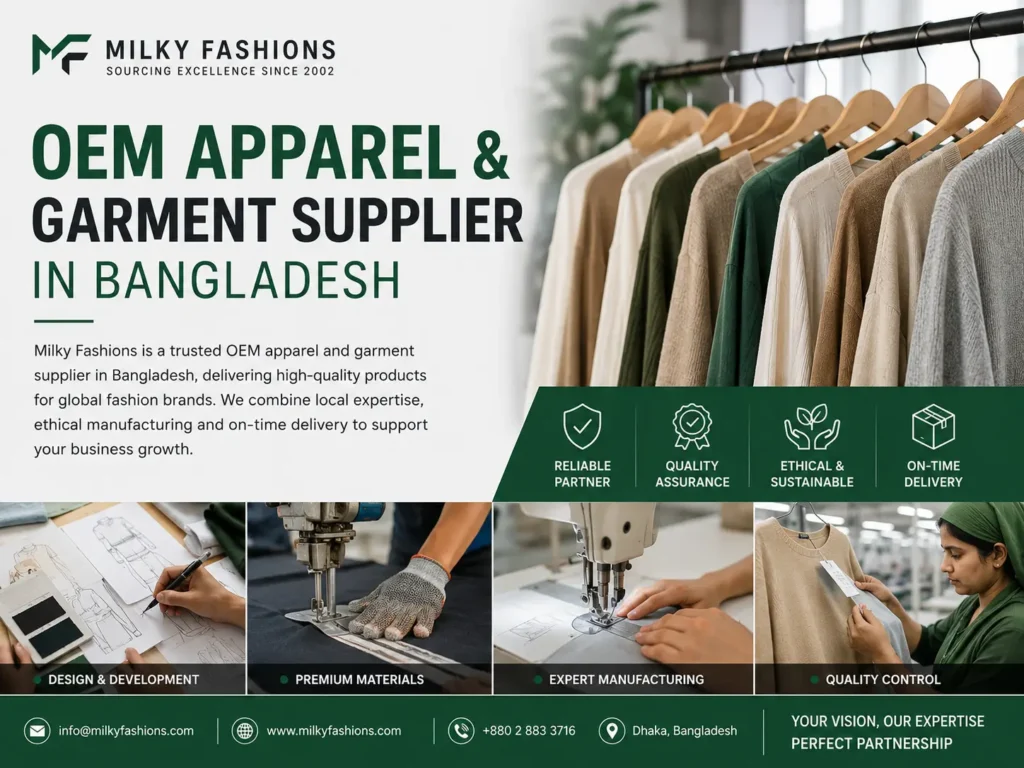
OEM Apparel & Garment Supplier in Bangladesh
Milky Fashions is an OEM apparel and garment supplier in Bangladesh. We turn your designs, tech packs, and specifications into finished, export-ready clothing — manufactured to your exact requirements across audited, compliance-certified factories. As an independent buying house established in 2002, we coordinate OEM production without the capacity bias of any single factory, matching every order to the right production line.
If you have a design and need a partner to build it to spec, protect it, and ship it compliant to Europe and beyond, you are in the right place. This page explains exactly what OEM apparel manufacturing is, how it differs from ODM, private label, and CMT, and how our OEM model gives growing brands factory-grade quality with buying-house flexibility.
What Is an OEM Apparel Manufacturer?
OEM stands for Original Equipment Manufacturer. In the garment industry, an OEM apparel manufacturer produces clothing to a buyer’s own design and specifications. You provide the concept, tech pack, measurements, fabric requirements, and finishing details. The manufacturer sources the materials, builds the samples, and runs bulk production so the finished garment matches your specification exactly.
The defining feature of OEM is simple: the design belongs to you. You are not buying a factory’s existing product and stamping your label on it. You are commissioning your own product, made to your own standards. That distinction matters enormously for brands building a recognisable identity, protecting a unique fit or construction, or meeting a retailer’s precise technical requirements.
In practice, most modern OEM production in Bangladesh is delivered on a full-package (FOB) basis, meaning the manufacturer handles fabric and trim sourcing, production, quality control, and export — so you manage the brand and the design while the supply chain is handled end to end. That is the model we run at Milky Fashions.
OEM vs ODM vs Private Label vs CMT: Know What You’re Actually Buying
Most supplier websites list “OEM, ODM, private label, CMT, FOB” in a single line and never explain the difference. That ambiguity costs buyers money, because each model carries a different level of control, cost, and responsibility. Here is the clear version.
CMT (Cut, Make, Trim). You supply the fabric, trims, and patterns. The factory only cuts, sews, and finishes. Lowest unit cost, maximum control — but you carry the entire sourcing and risk burden. Suited to established brands with their own material supply chains.
OEM (full-package / FOB). You supply the design and specification. The manufacturer sources materials and produces to your spec, then delivers finished goods. You keep design ownership; the supplier carries sourcing and production complexity. This is the sweet spot for most growing brands.
ODM (Original Design Manufacturer). The manufacturer designs the product (or offers ready designs) and you select, tweak, and rebrand it. Fastest route to market, but the originating design is the factory’s, not yours — and your competitors can often buy something near-identical.
Private label. This describes branding, not who designed the garment. A private-label order can be OEM-produced (your design) or ODM-based (the factory’s design) — the common thread is that your brand goes on the finished product.
| Model | Who designs it? | Who sources materials? | Who owns the design | Best for |
|---|---|---|---|---|
| CMT | You | You | You | Brands with their own fabric supply and patterns |
| OEM (FOB) | You | Manufacturer | You | Brands with designs who want sourcing and production handled |
| ODM | Manufacturer | Manufacturer | Manufacturer | Brands wanting ready designs to customise and launch fast |
| Private label | Either | Manufacturer | Varies | Brands focused on putting their label on proven products |
If you want your label on the factory’s existing designs, our private label clothing service is the better fit. If you are bringing your own designs and want them built to spec, OEM — explained on this page — is what you need. Many of our clients use both.
How Milky Fashions Delivers OEM Apparel Production
We are not a single factory, and for OEM that is a genuine advantage. A factory sells you the capacity it already owns — so it will steer your hoodie order onto its hoodie line whether or not that line is the best match for your fabric, finish, or price target. As an independent garment buying house, we have no line to fill and no capacity bias. We match each OEM order to the factory best suited to that specific product, then manage the relationship on your behalf.
Across our vetted network we hold partners specialised in knitwear, woven garments, heavyweight fleece, denim, and technical fabrics. That breadth means your t-shirt programme and your structured outerwear programme each go to a factory that does that product well — rather than both being forced through one facility that is excellent at one and average at the other.
Our apparel sourcing team sits between you and the production floor at every stage: translating your tech pack, negotiating costing, controlling quality, and protecting your timeline. You get one accountable English-speaking point of contact in Dhaka, the country where your goods are actually made — not a layer of intermediaries in another time zone.
The OEM Production Process, Step by Step
A well-run OEM order is predictable. Here is how we take a design from concept to container.
1. Tech pack and specification review. You send your design — sketch, tech pack, reference sample, or measurements. We review it for production feasibility, flag anything that will affect cost or quality, and confirm the full specification before anyone quotes a price.
2. Costing and factory matching. We cost the garment across the right factories in our network and return a transparent FOB price with the fabric, construction, and compliance level fixed. You see what you are paying for.
3. Sampling and approval. We develop a proto and fit sample to your spec. You review, comment, and approve. We do not start bulk until the sample is signed off — so the production garment matches what you approved.
4. Bulk production with inline QC. Once approved, bulk runs with inline quality checks during cutting, sewing, and finishing. Problems are caught on the line, not at final inspection when it is too late and too expensive to fix.
5. Final inspection (AQL). Every order is inspected to an agreed AQL standard before it ships. You receive an inspection report, not just a promise.
6. Export and shipping. We handle documentation and coordinate export so your finished, labelled goods leave the port ready for your market.
Protecting Your Design and Intellectual Property
This is the question serious buyers ask and most supplier sites ignore: if I hand over my design, what stops it being copied or the specification being quietly changed to cut cost?
We take it seriously. OEM means your design stays yours. We work under confidentiality terms, restrict your tech pack to the factory producing your order, and hold production to the approved sample rather than to whatever is cheapest to make that week. Because we represent you and not a factory trying to maximise its own margin, our incentive is aligned with protecting your product and your spec — not substituting materials behind your back. For brands whose fit, construction, or fabric is a competitive edge, that alignment is the entire point of choosing a buying house over a walk-in factory.
Compliance Is the Real OEM Trust Layer
For brands selling into Europe, OEM is not only about whether a garment can be made — it is about whether it can be sold without legal and reputational risk. Compliance is now part of the product.
Every factory in our OEM network operates against recognised social and environmental standards: BSCI, WRAP, SEDEX, GOTS, GRS, and OEKO-TEX. That covers ethical labour auditing, environmental management, certified organic and recycled materials, and tested chemical safety. We confirm certification status before an order is placed — not after a problem appears.
This matters more every year. EU frameworks such as the German Supply Chain Act (LkSG), the Corporate Sustainability Due Diligence Directive (CSDDD), and the Ecodesign for Sustainable Products Regulation (ESPR) with its incoming Digital Product Passport are pushing supply-chain transparency from “nice to have” to “legally required.” Producing OEM apparel through audited, certified factories is how you stay ahead of that — and we build the documentation trail as we go. You can read more about our approach on our sustainable garment sourcing page and review our full certifications.
Product Categories We Produce as an OEM Supplier
We coordinate OEM production across the apparel categories Bangladesh does best:
- Knitwear — t-shirts, polos, sweatshirts, activewear and sportswear, hoodies, sweaters, joggers, fleece, and heavyweight streetwear
- Woven garments — shirts, blouses, dresses, trousers, shorts, and outerwear
- Denim — jeans, jackets, and washed and treated finishes
- Nightwear and loungewear — pyjama sets, robes, and soft separates
- Activewear and performance — technical fabrics and moisture-management constructions
- Private label programmes — your brand applied across any of the above
Whatever the category, the OEM principle holds: your design, your spec, built and inspected to standard. Explore the full range on our products and capabilities overview.
Minimum Order Quantity (MOQ) for OEM Apparel
Our typical OEM MOQ is 3,000 to 8,000 pieces per style, depending on fabric, construction, and finishing. The reason is straightforward: fabric is usually woven or knitted to order for OEM production, and mills set minimum fabric runs. Smaller quantities are sometimes possible on simpler constructions or where stock fabric can be used — we will tell you honestly during costing rather than promising a number we cannot hold. If you are scaling a brand and need a partner who can grow order volumes with you over time, that is exactly the relationship we are built for.
Why Bangladesh for OEM Apparel Manufacturing
Bangladesh is the world’s second-largest apparel exporter, and for OEM production that scale translates into real buyer advantages: deep specialised capacity in both knit and woven, competitive pricing driven by genuine manufacturing efficiency rather than corner-cutting, and one of the most mature compliance ecosystems in global sourcing after a decade of sustained factory investment.
Duty access has historically been strong for European buyers, and while Bangladesh’s graduation from Least Developed Country status (scheduled for late 2026) will change the preference structure, transition arrangements are in place and the country remains highly competitive on landed cost. We track these developments closely so your sourcing strategy stays current rather than relying on assumptions that may shift.
Why Choose Milky Fashions as Your OEM Partner
Three things separate us from a typical factory or broker. First, independence — we match your order to the best factory rather than the one we happen to own, which protects both your quality and your price. Second, a European focus — we work daily with brands across the UK, Germany, and the wider EU, so we understand the compliance, labelling, and quality expectations of those markets. Third, direct communication — one accountable contact in Dhaka who answers fast and tells you the truth about timelines and costs.
Milky Fashions has operated as an independent buying house since 2002. You can learn more about our company and the way we work.
What to Prepare Before Starting an OEM Order
The smoother your OEM order runs, the more you bring to the first conversation. You do not need everything below to start — even a clear sketch is enough for us to begin — but the more of this you have, the faster and more accurate your costing and sampling will be.
- A design or reference. A tech pack is ideal, but a sketch, a photo, or a physical sample we can measure and reverse-engineer all work.
- Target fabric and weight. For example, 180 gsm single jersey for t-shirts or 320 gsm brushed fleece for hoodies. If you are unsure, we will recommend options.
- Key measurements or a size set. Your fit is part of your brand. The earlier we lock it, the better your samples match.
- Quantity and size ratio. Your total units and the split across sizes shape both pricing and fabric planning.
- Target market and compliance needs. Selling into the EU carries different labelling and standards requirements than other markets. Tell us where the goods are going.
- Your timeline. Sampling and bulk both take time. Knowing your launch or delivery date lets us plan backwards realistically.
If you only have an idea and a market, that is still a starting point. Part of our job is turning an early concept into a producible, costed specification — that is what a buying house is for.
We also handle full OEM development for certified workwear and uniforms — hi-vis, flame-resistant, and corporate ranges built to European EN safety standards.
Frequently Asked Questions
What is OEM in clothing manufacturing?
OEM (Original Equipment Manufacturer) means a supplier produces garments to your own design and specification. You own the design; the manufacturer sources materials and builds the product to match your tech pack exactly, usually on a full-package (FOB) basis.
What is the difference between OEM and private label?
OEM describes who designed the garment — in OEM, you do. Private label describes whose brand goes on it. A private-label order can be OEM-produced (your design) or based on a factory’s existing design. If you are bringing your own design, you want OEM.
Do you own your own factory?
No, and that is deliberate. We are an independent buying house. Because we do not own production lines, we have no incentive to push your order onto the wrong factory. We match each OEM order to the partner best suited to that product and manage quality and compliance on your behalf.
What is your minimum order quantity for OEM apparel?
Typically 3,000 to 8,000 pieces per style, depending on fabric and construction. Lower quantities are sometimes possible — we confirm honestly during costing.
Will my design and tech pack be kept confidential?
Yes. We work under confidentiality terms, limit your specification to the factory producing your order, and hold bulk production to your approved sample. Protecting your design is central to how we operate.
Which certifications do your OEM factories hold?
Our partner factories operate against BSCI, WRAP, SEDEX, GOTS, GRS, and OEKO-TEX standards. We verify certification before placing an order.
Can you handle full-package (FOB) production, including fabric sourcing?
Yes. Most of our OEM production is full-package: we source fabric and trims, manufacture to your spec, run quality control, and coordinate export — so you focus on your brand and your market.
Start Your OEM Apparel Production in Bangladesh
If you have a design ready to build, send it over. We will review the specification, cost it across the right factories, and show you exactly what your garment will cost to produce to standard. Tell us what you are making and which market it is for, and we will take it from there.
Get in touch with Milky Fashions to start your OEM apparel order.