
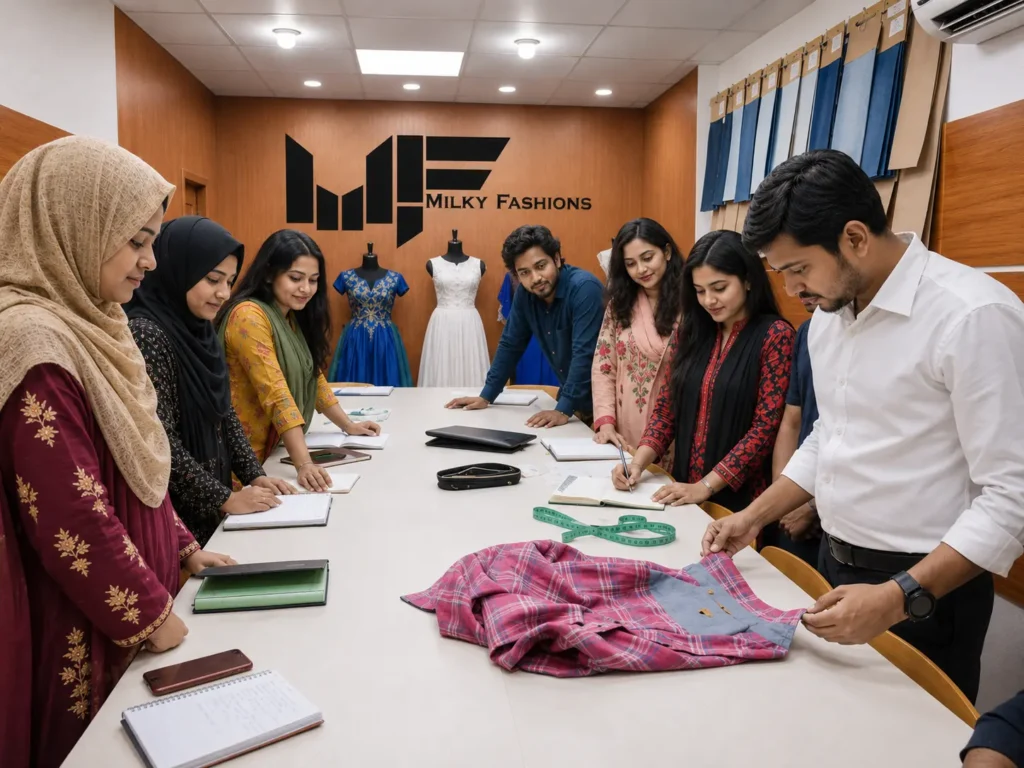
Buying House vs Direct Factory Bangladesh: The Complete 2026 Guide for European Fashion Brands
For European fashion brands sourcing apparel from Bangladesh, one question shapes every other decision: should you work directly with a garment factory, or through an independent garment buying house? It is the difference between two fundamentally different operating models — and getting it wrong costs European brands more in delayed shipments, compliance failures, and rejected goods than the entire margin on a season’s orders.
This guide compares both routes across twelve criteria that actually matter: cost transparency, MOQ flexibility, EU compliance documentation, quality control, communication, lead time control, risk management, and post-LDC graduation tariff exposure. We have stayed honest about when going direct genuinely makes commercial sense — and equally honest about why approximately 70% of Bangladesh garment factory orders flow through buying houses, even today.
Quick Answer: Buying House vs Direct Factory in 30 Seconds
For most European brands, an independent buying house is the better route — it delivers lower true landed cost, MOQ flexibility, and consolidated EU compliance documentation, while a direct factory wins only on headline unit price for very large, simple, repeating orders. This is why, according to the Bangladesh Garment Buying House Association (BGBA), roughly 70% of factory orders in Bangladesh flow through buying houses rather than direct relationships — not because they are cheaper per piece, but because they consolidate market insight, supplier networks, quality control, and compliance documentation into a single accountable partner.
The rest of this guide explains exactly why, and what each route costs you in real terms.
What “Direct Factory” Actually Means in Bangladesh
A direct factory relationship means you, the European brand, contract a Bangladesh clothing manufacturer to produce your apparel — bypassing any intermediary. Bangladesh hosts approximately 7,000 compliance-certified garment factories plus 2,500 smaller export-oriented units, concentrated in Dhaka, Gazipur, Narayanganj, and Chattogram (Chittagong). They fall into four main types: vertical composite factories (knitting, dyeing, and stitching under one roof), specialised woven factories, dedicated denim mills, and sweater factories. Each has its own technical sweet spot, MOQ profile, and certification stack.
Going direct sounds straightforward. In practice, it requires either a dedicated in-country merchandising team in Dhaka, or a willingness to absorb three structural risks: information asymmetry (the factory knows its own capacity, sub-contracting habits, and quality variance — you don’t), accountability gaps (when something goes wrong, the factory’s incentive is to protect its reputation, not your shipment), and compliance burden (you become responsible for every audit, every Tier 1 disclosure, every European due diligence requirement).
What an Independent Buying House Actually Does
A garment buying house Bangladesh is an independent sourcing partner that acts on behalf of the foreign buyer — selecting factories, managing sampling, negotiating pricing, supervising production, conducting quality control inspections, and consolidating compliance documentation. By Bangladeshi commercial law, a buying house typically earns a 5% commission paid by the manufacturer (not by the buyer), with industry standard ranging from 5% to 8% depending on order complexity. Crucially, an independent buying house does not own any factory. This structural independence is what separates a buying house from factory-owned “sourcing arms” or trading companies whose margin is buried in the FOB price.
The buying house is, in effect, your local merchandising, QC, and compliance team — operating in Dhaka time, working across a vetted network of garment factories, and accountable to you as a single point of contact. The 70% figure cited by BGBA leadership reflects a simple commercial reality: foreign buyers, particularly European fashion brands, prefer this consolidated accountability over the alternative of managing 8 to 15 separate factory relationships across product categories.
Buying House vs Direct Factory: 12-Point Comparison
The table below compares both routes across the criteria European apparel buyers raise most often. We have prioritised honesty — direct factory relationships genuinely win on some criteria, and we have flagged where.
| Criterion | Direct Garment Factory | Independent Buying House |
|---|---|---|
| FOB unit price | Lower headline, hidden execution costs | 5–8% transparent fee on FOB |
| MOQ flexibility | High MOQ (often 5,000+ per style) | Lower (500–1,000 per style via network consolidation) |
| Quality control | Self-reported, factory-led | In-house QC team, third-party-style inspection |
| EU compliance docs (CSDDD, LkSG) | You aggregate Tier 1 data yourself | Delivered as standard with every shipment |
| Communication accountability | One factory, multiple departments | Single dedicated merchandiser |
| Time zone responsiveness | Bangladesh hours only | Bangladesh + European correspondent offices |
| Lead time control | Limited visibility into machine load | Network capacity visibility |
| Sampling speed | Direct (faster, if factory has capacity) | Same factory, plus oversight |
| Factory neutrality | None — they sell their own capacity | Independent — selects best fit per brief |
| Payment risk | 30/70 T/T or L/C direct to factory | Buying house oversees execution |
| Subcontracting risk | High — undisclosed subcontracting common | Mitigated through approved factory list |
| Scalability across categories | Limited to factory specialisation | Cross-category via network |
The single criterion most underestimated by first-time European buyers is subcontracting risk. A direct factory under capacity pressure routinely subcontracts portions of an order to non-disclosed third-party units. The buyer never sees the actual production floor, the certification chain breaks, and CSDDD or German LkSG due diligence files become unverifiable. A vetted buying house network structurally limits this by working with factories that have signed no-subcontract clauses or pre-approved overflow units.
Skip the Direct-vs-Buying-House Debate — Get a Vetted Factory Quote in 48 Hours
Send Milky Fashions your tech pack, target quantity, certification requirements, and target delivery window. Within 48 hours you receive a confirmed factory match from our vetted network, indicative FOB pricing with transparent buying house fee, and a full EU compliance documentation summary. No factory ownership conflict. No hidden margin.
When Going Direct to a Bangladesh Garment Factory Actually Makes Sense
Going direct to a Bangladesh factory makes sense in three specific situations: when you place very high volumes of a simple, repeating style; when you have your own sourcing and quality-control team on the ground; and when a single factory can meet all your capacity and compliance needs. Outside these conditions, the direct route usually transfers more risk to the brand than it saves in unit price. The three conditions that justify going direct:
First, you have a dedicated in-country merchandising team based in Dhaka — typically two to four full-time staff covering sampling, QC, compliance, and shipping. This headcount runs €120,000 to €180,000 annually loaded, and only makes sense above approximately €10 million annual import volume from Bangladesh.
Second, you have a long-established, exclusive partnership with a specific apparel manufacturer Bangladesh has built around your brand — typically a 5+ year relationship where the factory has dedicated production lines to your seasonal cycles and treats your orders as priority. This is the model H&M, Inditex, and Primark use with their top-tier suppliers.
Third, you are sourcing a single, highly technical product (for example, performance outerwear with specialised lamination) where only one or two factories in Bangladesh have the capability, and the technical relationship with that factory is more valuable than network breadth.
If none of these three conditions apply to your brand, the math typically favours the buying house route. The 5–8% buying house commission is dwarfed by the cost of building in-country capability, the margin lost to subcontracting and compliance failures, and the rejected-shipment risk that direct buyers underestimate consistently in their first three years of sourcing from Bangladesh.
The 6 Hidden Costs European Brands Discover After Going Direct
Independent analysis of apparel sourcing costs has found that FOB unit price represents only 55% to 70% of true landed sourcing cost when risk, compliance, and execution variance are correctly modelled. The remaining 30% to 45% lives in costs that direct-factory buyers consistently underprice in year one:
1. Third-Party Quality Control Costs
Direct factory buyers typically engage SGS, Bureau Veritas, Intertek, or QIMA for pre-shipment inspection. Per-inspection fees run $250 to $450, with a typical apparel order requiring three inspections (initial production, mid-production, final). Add lab testing for fabric composition and chemical compliance — another $180 to $350 per fabric. Cumulative cost on a single order: $1,400 to $2,800. Buying houses absorb this cost into their commission.
2. Compliance Audit Aggregation
For German LkSG and the upcoming EU CSDDD, you need verifiable Tier 1 supplier documentation: current BSCI audit, SEDEX SMETA report, WRAP certificate, and worker grievance mechanism evidence. Going direct, you collate these manually from each factory’s compliance officer. Through a buying house, the file arrives complete with every shipment.
3. Factory Visit Costs
Direct buyers typically visit Bangladesh two to four times per year — flights ($1,200–$2,400 from Western Europe), hotel ($800–$1,500), local transport, interpreter. Loaded cost per visit: €3,500 to €5,500. Annual exposure: €15,000 to €22,000. A buying house provides photo and video documentation, audit reports, and live production updates without requiring you to fly.
4. Subcontracting Surprises
The single highest-frequency direct-factory failure: your approved factory routes 30% of your order to an unapproved subcontractor during peak season capacity squeeze. You discover this only when a buyer’s compliance team audits the chain — and the chain breaks. Re-routing or rejecting the order costs 8% to 15% of order value.
5. Sample Iteration Slippage
Direct factory sample development typically requires 4 to 7 rounds for a first-time brand — each round adding 7 to 14 days. Buying house oversight typically compresses this to 2 to 4 rounds. Lost weeks at the front of a season compound into missed in-store dates and discounted markdowns.
6. Communication Friction Cost
Factory merchandisers handle 8 to 15 buyer accounts simultaneously. Your urgent email about a Pantone deviation sits behind another buyer’s order. A buying house merchandiser typically handles 3 to 6 brands with dedicated daily contact in your time zone — through correspondent offices in London, Calgary, or directly via European-hours WhatsApp and email coverage.
How European Fashion Brands Actually Source from Bangladesh in 2026
Most large European apparel brands use a hybrid model: direct relationships with two or three strategic, high-volume suppliers, combined with a buying house for everything else — fashion-driven items, lower-MOQ collections, and category overflow. Publicly disclosed sourcing data from BGMEA and brand transparency reports confirms that even the largest buyers rarely go fully direct.
Spain — Inditex (Zara, Pull&Bear, Bershka, Stradivarius, Massimo Dutti, Oysho): Sources approximately $1.87 billion in apparel from Bangladesh annually across roughly 250 listed factories. Inditex operates a hybrid model — a local sourcing office in Dhaka for top-tier strategic suppliers, plus buying house relationships for category-specific overflow. Smaller Spanish brands without Inditex-scale infrastructure source predominantly through buying houses.
Denmark — Bestseller (Vero Moda, Only, Jack & Jones, Selected): One of the top ten buyers from Bangladesh globally, with Danish-headquartered Bestseller maintaining a substantial Dhaka office while also working with buying agents on specific categories. Other Danish brands (Ganni, Samsøe Samsøe, By Malene Birger) overwhelmingly use the buying house route given Denmark’s compliance-heavy regulatory environment.
France — major buyers and SMEs: French apparel brands face the AGEC law (Anti-Waste for a Circular Economy) and France’s mandatory environmental labelling rules from 2026. The compliance complexity drives French buyers — from Camaïeu and Etam to smaller contemporary labels — toward buying house partners who consolidate documentation for AGEC and EU EPR scheme reporting.
Poland — LPP (Reserved, Sinsay, Cropp, House, Mohito) and Pepco: Both rank in the global top ten of Bangladesh buyers. LPP operates a Dhaka office; Pepco sources heavily through buying house networks. Mid-sized Polish brands scaling rapidly across CEE markets almost exclusively use the buying house route to manage MOQ pressure and EU customs compliance.
UK — Marks & Spencer, Next, Primark: All three rank in Bangladesh’s top ten foreign buyers, all operate Dhaka offices for strategic supplier management while still working with buying agents for category overflow. Mid-tier UK brands operating in the £5M–£50M revenue band typically source 80%+ of Bangladesh production through buying houses.
Germany — C&A and SME brands: C&A (Netherlands-headquartered but with major German operations) is a top-ten Bangladesh buyer with extensive direct factory relationships. German SME brands face LkSG due diligence requirements from the 1,000-employee threshold downward (via indirect supplier pressure) and almost universally choose buying houses to consolidate Tier 1 documentation.
The consistent pattern: brands above approximately €500 million revenue often operate hybrid models with both direct and agent routes. Brands below that threshold — which is the vast majority of European fashion businesses — work predominantly through buying houses because the unit economics of building in-country capability simply don’t work.
EU Compliance: The Decisive Difference Most European Brands Underestimate
On EU compliance, the buying house route has a decisive advantage: it consolidates due-diligence documentation for CSDDD, LkSG, and the Digital Product Passport into a single file per order, whereas going direct means assembling the same evidence factory by factory. In 2026, three frameworks define what “good sourcing” means for European brands — and how you source materially changes how hard each one is to satisfy.
EU Corporate Sustainability Due Diligence Directive (CSDDD) entered into force in finalised Omnibus I form on 18 March 2026. First application is 26 July 2029 for EU companies above 5,000 employees and €1.5 billion net worldwide turnover. SME brands feel indirect CSDDD pressure as Tier 1 suppliers to in-scope retailers — which most European fashion brands ultimately are. A buying house aggregates the Tier 1 disclosure file required to demonstrate due diligence; a direct factory delivers fragments only.
German Supply Chain Due Diligence Act (Lieferkettengesetz / LkSG) has applied since 1 January 2024 to German companies with 1,000+ employees. The Act requires documented due diligence on direct suppliers — including human rights risk assessment, grievance mechanisms, and annual public reporting. Milky Fashions delivers LkSG-ready documentation as standard.
Country-specific layers for your market: France’s AGEC law and mandatory environmental cost labelling (effective from October 2026 if any environmental score is communicated publicly); Denmark’s strict alignment with EU Green Deal circularity requirements; the EU’s textile EPR scheme rolling out across member states by mid-2027; the Digital Product Passport rollout for textiles from 2026–2027. Spanish brands navigating both EU and post-Brexit UK supply chains face dual customs documentation that buying houses are structurally built to handle.
Why 70% of Bangladesh Garment Orders Flow Through Buying Houses
The Bangladesh Garment Buying House Association (BGBA) data is unambiguous: approximately 70% of factory orders in Bangladesh come through buying houses, not direct factory relationships. This is despite three decades of e-commerce, despite the rise of B2B sourcing platforms, despite every prediction that direct-to-factory models would dominate. The reason is structural, not nostalgic.
A buying house consolidates four functions that direct factory sourcing forces the European buyer to build in-house: deep market intelligence on which factory genuinely fits which brief, an audited network that bypasses the cold-start risk of working with an unknown manufacturer, compliance and quality control infrastructure that meets European due diligence standards out of the box, and a single point of accountability operating in your time zone.
Milky Fashions has operated this independent buying house model since 2002 — twenty-four years of continuous trading through every shift the Bangladesh garment industry has navigated. We are registered with the BGBA (Member No. M-0357). Our certified factory network is audited under BSCI, SEDEX, WRAP, GOTS, OEKO-TEX, and GRS. Our correspondent offices in London and Calgary keep European buyers in their own working hours. We maintain dedicated country desks for UK, Germany, France, Spain, Italy, Netherlands, and Poland, with growing coverage for Denmark and the broader Nordic market.
We do not own a single garment factory. That structural independence is the entire point.
Frequently Asked Questions
Is a buying house cheaper or more expensive than a direct factory in Bangladesh?
On headline FOB unit price, a direct factory often quotes lower. On true landed cost — including third-party QC, compliance audit aggregation, factory visit travel, subcontracting risk, and sample iteration time — independent industry analysis finds FOB represents only 55% to 70% of total sourcing cost. The 5% to 8% buying house commission typically lands inside that delta.
What is the standard buying house commission in Bangladesh?
By Bangladeshi commercial practice, 5% of order value is the legal standard, paid by the manufacturer rather than the buyer. Industry range is 5% to 8% depending on order complexity, certification requirements, and product category. Milky Fashions states its fee transparently on every quotation.
Can I use both a buying house and direct factory relationships?
Yes, and most European brands above €50 million revenue do. The common pattern is direct relationships with two or three strategic top-tier suppliers (typically your largest-volume basics like t-shirts or denim), combined with a buying house for category overflow, fashion-driven items, and lower-MOQ private label collections.
Will a direct factory work with a smaller European brand?
Most established Bangladesh garment factories have minimum order quantities of 3,000 to 5,000 pieces per style and prioritise large-volume clients. Smaller European brands typically cannot access tier-one Bangladesh factories directly. A buying house aggregates orders across its network to deliver MOQ from 500 to 1,000 pieces per style.
How does buying house vs direct factory affect EU CSDDD due diligence?
Under CSDDD, in-scope companies must document supply chain due diligence including Tier 1 supplier identification, social and environmental risk assessment, and grievance mechanisms. A buying house provides this as a consolidated file per order. Going direct, you collate the same evidence factory by factory, audit by audit — significantly higher administrative load and higher risk of documentation gaps.
Are buying houses just middlemen adding margin?
A trading company adds margin without transparent service. A freelance agent earns a finder’s fee. A registered buying house under BGBA — like Milky Fashions — operates a documented service model with merchandising, QC, compliance, and execution oversight, billed at a transparent commission. The distinction matters: ask any provider for their BGBA registration number before engaging.
Do buying houses own factories?
Independent buying houses do not. Some factory groups have created in-house “sourcing arms” to capture additional margin while pushing their own capacity — these are structurally not independent buying houses. Milky Fashions does not own any garment factory.
How do I verify a Bangladesh buying house before working with them?
Five checks: BGBA registration number (verifiable on association records); years of continuous trading (avoid agencies founded after 2020 for high-value orders); current references from existing European clients; published trade license and Export Registration Certificate; and willingness to state their commission structure in writing before sampling begins.
What if my preferred factory is already on the buying house’s approved list?
Then you have the best of both routes — access to that factory through a relationship the buying house already manages, including compliance documentation, QC protocols, and pricing benchmarks. Milky Fashions regularly takes over existing factory relationships from European brands seeking better oversight without disrupting the production unit.
How does the buying house vs direct factory decision change after LDC graduation in November 2026?
The LDC graduation grace period extends EU duty-free EBA access to November 2029. After 2029, without GSP+ status, Bangladesh apparel could face approximately 11.5% to 12% average EU duty. A buying house provides ongoing tariff scenario modelling and the ability to shift factory allocation as the post-2029 landscape clarifies. Direct factory relationships are locked to that factory’s response.
Can a buying house help with Spanish, French, or Danish market-specific compliance?
Yes. Milky Fashions delivers compliance documentation calibrated to country-specific frameworks — France‘s AGEC law and environmental labelling, Denmark’s Climate Act and EU Green Deal alignment, Spain‘s dual EU and post-Brexit UK customs requirements, Germany’s LkSG documentation, and Poland‘s EU customs and EPR scheme reporting.
What is the right way to start if I’m a European brand new to Bangladesh sourcing?
Start with a single product category, a defined MOQ, and a written brief including target FOB, certification requirements, and delivery window. Send it to two or three buying houses for comparison. Verify BGBA registration and trading history. Place a trial order of 500 to 1,500 pieces with the buying house whose quotation, references, and communication quality you trust most. Scale from there.
Ready to Source from Bangladesh the Right Way?
Stop choosing between direct factory risk and trading company opacity. Milky Fashions is an independent garment buying house registered with BGBA since 2002 (Member No. M-0357), with correspondent offices in London and Calgary, serving European fashion brands across the UK, Germany, France, Spain, Italy, Netherlands, Poland, and Denmark.
Send your tech pack, target quantity, certification requirements, and delivery window. Within 48 hours you receive a confirmed factory match, indicative FOB pricing with transparent buying house fee, and a complete EU compliance documentation summary.
Get a Vetted Factory Quote in 48 Hours
Related Reading
Garment Sourcing Services Bangladesh | Factory Certifications | EU Textile Regulations Guide | Knitwear Sourcing Bangladesh | Our Product Range | About Milky Fashions