
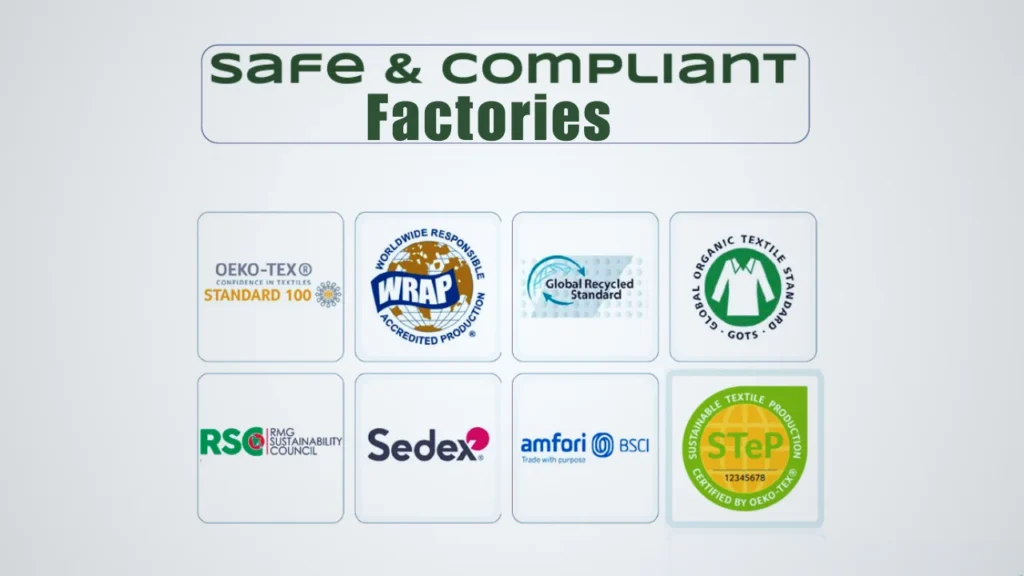
Certified Garment Factories in Bangladesh
Milky Fashions works exclusively with Bangladesh garment factories that hold internationally recognised compliance and sustainability certifications. As a registered buying house with the Bangladesh Garment Buying Agents Association (BGBA Member No. M-0357), we verify every certification on your behalf — so the factories we recommend already meet the social, environmental, and chemical-safety standards that European fashion brands are now legally required to demonstrate.
This page explains each of the six certifications our partner factories hold — BSCI, WRAP, SEDEX, GOTS, OEKO-TEX, and GRS — what each one actually covers, and which EU regulation makes it a requirement for your supply chain. If you need audit reports or certification documentation for your due diligence file, we provide them on request before you place a single order. For a broader view, see our Bangladesh Supplier Compliance Report 2026. Wondering how Bangladesh’s compliance standards compare to other sourcing countries? See our Bangladesh vs Vietnam vs China compliance comparison.
Why Factory Certifications Matter for European Brands in 2026
For European fashion brands, factory certifications are no longer a marketing badge — they are a legal and commercial necessity. A wave of EU supply chain legislation has shifted the burden of proof onto brands and importers:
- The Corporate Sustainability Due Diligence Directive (CSDDD) requires companies to identify and address human rights and environmental risks across their supply chains.
- Germany’s Supply Chain Due Diligence Act (LkSG) obliges companies to monitor working conditions at their overseas suppliers.
- The EU Green Claims Directive prohibits unsubstantiated environmental claims — meaning “organic” or “recycled” labels now require verifiable certification.
- France’s AGEC law and broader EU green-claims enforcement actively challenge unsupported sustainability marketing.
A single compliance failure — child labour, unsafe conditions, a chemical violation, or an unverifiable “organic” claim — can cost a brand millions in recalls, fines, and reputational damage. Sourcing through a BGBA-registered buying house that verifies certifications before production is the most reliable way to protect your brand.
See our complete guide to EU textile regulations and how each certification maps to your compliance obligations.
BSCI — Business Social Compliance Initiative
BSCI, operated by the Brussels-based amfori association, is the social compliance benchmark most widely demanded by European retailers. It assesses factories against a code of conduct built on International Labour Organization (ILO) conventions, covering thirteen performance areas including workers’ rights, fair remuneration, occupational health and safety, no child labour, no forced labour, freedom of association, and protection of the environment.
BSCI audits grade factories from A (outstanding) through to E (unacceptable). Reputable factories maintain at least a C grade, and the system is built around continuous improvement rather than a one-time pass. Because amfori is a European organisation, a current BSCI audit is one of the strongest signals a Bangladesh factory can offer to a brand sourcing for the EU market.
For your compliance file, BSCI directly supports your obligations under the CSDDD and Germany’s LkSG. When a German or Dutch buyer asks us to demonstrate social due diligence, a valid amfori BSCI audit report is the first document we provide. Every BSCI-certified factory in our network can share its current audit report and grade for your records before you commit to production.
GOTS — Global Organic Textile Standard
GOTS is the leading standard for organic textiles and the only certification that allows you to legally market a garment as “organic” in the EU. It certifies the entire supply chain — from organic fibre harvesting through spinning, knitting, dyeing, and garment manufacturing — against both stringent environmental and social criteria. To carry the GOTS “organic” label, a product must contain at least 95% certified organic fibres; the “made with organic” grade requires a minimum of 70%.
Crucially, GOTS operates a chain-of-custody system. A factory holds a Scope Certificate confirming it is GOTS-certified, but each individual shipment requires a Transaction Certificate (TC) documenting the organic fibre flow for that specific order. Under the EU Green Claims Directive and France’s AGEC law, this per-shipment documentation is exactly what regulators now demand to substantiate an “organic” claim. An OEKO-TEX label or a vague “we use organic cotton” statement is no longer sufficient.
For European brands building certified organic collections, we work with GOTS-certified factories that provide full Scope Certificates and per-shipment Transaction Certificates — giving you the documentation chain you need to make organic claims with confidence.
OEKO-TEX Standard 100
OEKO-TEX Standard 100 certifies that a textile product has been tested for harmful substances and is safe for human contact. Importantly, every component of the finished garment is tested independently — the fabric, sewing thread, buttons, zips, prints, and trims must all pass. This makes it one of the most rigorous chemical-safety certifications available.
OEKO-TEX classifies products into four classes by intended use, with Product Class I (articles for babies and toddlers up to three years) subject to the strictest thresholds, followed by next-to-skin, away-from-skin, and furnishing categories. Certification is renewed annually, ensuring ongoing compliance rather than a one-time test.
It is important to understand what OEKO-TEX does and does not certify: it confirms chemical safety, but it does not certify that cotton is organic or that polyester is recycled. OEKO-TEX supports your compliance with EU REACH chemical regulations and is essential for any brand selling babywear, childrenswear, or next-to-skin garments. We ensure OEKO-TEX certification is in place wherever your product category and target market require it.
SEDEX — Supplier Ethical Data Exchange
SEDEX, run by Sedex, is not a certification in itself — it is the world’s largest collaborative platform for sharing ethical supply chain data. Factories registered on SEDEX undergo a SMETA audit (Sedex Members Ethical Trade Audit), the most widely used ethical audit format globally. SMETA audits are conducted on either two pillars (Labour Standards and Health & Safety) or four pillars (adding Environment and Business Ethics), based on the Ethical Trading Initiative (ETI) Base Code and local law.
The practical advantage of SEDEX for buyers is efficiency. Once a factory completes a SMETA audit, the report can be shared directly with multiple buyers through the platform — eliminating duplicate audits and giving you transparent, verifiable access to a factory’s ethical performance data. For brands managing several suppliers, SEDEX membership simplifies the due diligence required under the CSDDD.
When you source through Milky Fashions, we can request a factory’s full SMETA report through SEDEX and review it against your specific requirements before recommending the factory for your programme.
GRS — Global Recycled Standard
GRS, managed by Textile Exchange, is the leading certification for recycled-content textiles and the standard that substantiates “recycled” claims under EU green-claims rules. It verifies recycled content while also applying social, environmental, and chemical criteria across the supply chain. A product must contain at least 20% recycled material to be GRS-certified, and 50% or more to carry the GRS logo on-product.
Like GOTS, GRS uses a chain-of-custody system with Scope Certificates at factory level and Transaction Certificates documenting the recycled fibre flow for each shipment. This traceability is what allows a brand to credibly claim recycled content under the EU Green Deal, the forthcoming Ecodesign for Sustainable Products Regulation (ESPR), and the Green Claims Directive.
As European demand for recycled polyester, recycled cotton, and circular fashion grows, we connect brands with GRS-certified Bangladesh factories that provide the full chain-of-custody documentation needed to back sustainability claims without greenwashing risk.
WRAP — Worldwide Responsible Accredited Production
WRAP, administered by the WRAP organisation, is the world’s largest independent facility-certification programme for the apparel and sewn-products sector. Where BSCI is European-led, WRAP is widely recognised by North American and global buyers, making it valuable for brands selling across multiple markets. It certifies factories against twelve principles covering compliance with local laws, prohibition of forced and child labour, prohibition of harassment and abuse, fair compensation and working hours, freedom of association, health and safety, environmental responsibility, and customs and security compliance.
WRAP certification is awarded at three levels based on a factory’s degree of compliance: Platinum (valid two years), Gold (valid one year), and Silver (valid six months). A Gold or Platinum certificate signals a factory with mature, consistently applied compliance systems — not a one-off effort to pass an audit.
Many of our partner factories hold both BSCI and WRAP, giving brands that sell into both European and North American markets a single supply chain that satisfies buyers on both continents. We confirm the certification level and validity date of every WRAP-certified factory we recommend.
Which Certification Do You Actually Need?
Different claims require different certifications. Choosing the wrong one — or assuming one covers everything — is the most common compliance mistake we see European brands make. This is a quick reference:
| If you want to… | You need… |
|---|---|
| Demonstrate ethical labour & social compliance | BSCI, WRAP, or SMETA/SEDEX |
| Label a product “organic” | GOTS (with Transaction Certificate per shipment) |
| Label a product “recycled” | GRS (with Transaction Certificate per shipment) |
| Confirm the garment is free from harmful chemicals | OEKO-TEX Standard 100 |
| Satisfy German LkSG / EU CSDDD due diligence | BSCI or SMETA audit reports |
| Substantiate green claims under EU / France AGEC | GOTS or GRS (chain-of-custody documents) |
If you are unsure which certifications your specific programme and target market require, this is precisely where a buying house adds value — we map your compliance needs to the right certified factory before production begins.
How Milky Fashions Manages Your Compliance
Holding certifications is one thing; verifying and maintaining them throughout production is another. Our compliance process protects your brand at every stage:
Before factory selection
We screen every partner factory against your required certifications — BSCI, WRAP, GOTS, OEKO-TEX, SEDEX, or GRS — and confirm that audit reports and certificates are current, not expired. We match your brand’s ethical standards to the right certified factory, not the other way around.
During production
Our quality and compliance teams conduct in-line inspections and monitor adherence to audit requirements throughout the production run, ensuring standards are maintained on the floor — not just on paper.
Before shipment
Final inspection includes a compliance documentation review, laboratory test results, and packaging compliance checks. Where chain-of-custody certifications apply, we ensure the correct Transaction Certificates are issued for your shipment.
Buyers We Serve
Our certified factory network regularly supplies garments to brands and retailers across the UK, Germany, Italy, the Netherlands, France, Spain, and Poland. Whether you need fast-fashion basics from BSCI-audited factories or certified organic collections backed by GOTS Transaction Certificates, we have the right compliant factory partner for your programme.
Your BSCI, WRAP, and SEDEX audits are the evidence base for CSDDD supply-chain due diligence — see how compliant sourcing supports the EU directive.
Frequently Asked Questions
What is BSCI certification?
BSCI (Business Social Compliance Initiative), run by the European association amfori, is a social compliance audit that assesses garment factories against thirteen performance areas including workers’ rights, fair pay, health and safety, and no child or forced labour. Factories are graded A to E. It is the most widely demanded social audit for brands sourcing for the European market.
What is the difference between GOTS and OEKO-TEX?
GOTS certifies that textiles are organic and produced to strict environmental and social standards across the whole supply chain — it is the only standard that lets you legally market a garment as “organic” in the EU. OEKO-TEX Standard 100 only certifies that a product has been tested for harmful chemicals and is safe for skin contact. OEKO-TEX does not confirm organic or recycled content. Many brands use both.
Which certification do I need to claim my product is organic?
You need GOTS. Under the EU Green Claims Directive and France’s AGEC law, an “organic” claim must be backed by a GOTS Scope Certificate plus a Transaction Certificate for each shipment. An OEKO-TEX label or an unsupported “organic cotton” statement is not sufficient to substantiate the claim.
Is BSCI enough to meet EU due diligence requirements?
A current BSCI audit is a strong foundation for demonstrating social due diligence under the CSDDD and Germany’s LkSG, but the right combination depends on your product and claims. Social compliance (BSCI, WRAP, or SMETA) covers labour standards; environmental and product claims require GOTS, GRS, or OEKO-TEX. We help you assemble the right set for your specific obligations.
What is a GOTS Transaction Certificate?
A GOTS Scope Certificate confirms a factory is certified, but a Transaction Certificate (TC) documents the organic fibre content of one specific shipment. EU regulators increasingly require a TC per shipment to substantiate organic claims. The same chain-of-custody logic applies to GRS for recycled-content claims.
Request Your Compliance Documentation
Before you place an order, we provide the full compliance portfolio for your recommended factory — audit reports, certificates, validity dates, and chain-of-custody documentation — for your due diligence file. Verifying compliance before production is the single most effective way to protect your brand from supply chain risk.
Tell us your product, target market, and the certifications your programme requires, and we will respond within 24 hours with a matched, fully compliant factory recommendation.
Request Compliance Documentation → Contact
[H2 — small, bottom of page] Related Pages
Also relevant: Garment Sourcing Services Bangladesh | Sustainable Garment Sourcing Bangladesh | Private Label Clothing Bangladesh | Knitwear Sourcing Bangladesh | Denim Supplier Bangladesh | About Milky Fashions | Aiman Mohd Ahsan — Sourcing Expert
Contact us today to request our full compliance documentation. aiman@milkyfashions.com
 +8801741764508
Request Compliance Documentation
Contact us to receive our full factory compliance
portfolio, audit reports, and certification
documentation for your due diligence process.