
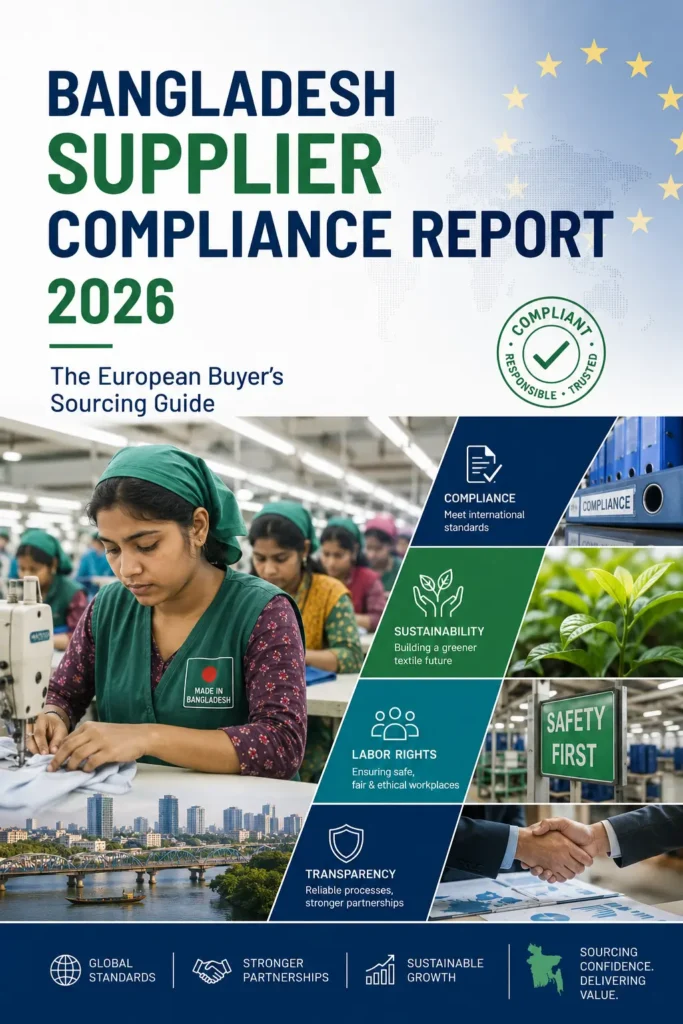
Bangladesh Supplier Compliance Report 2026: The European Buyer’s Sourcing Guide
Bangladesh apparel sourcing in 2026 is defined by two facts every European fashion brand must reconcile: it is the most cost-competitive, sustainability-credentialled garment supply base in the world, and it is entering the most demanding regulatory window the EU has ever imposed on textiles. This report sets out the verifiable data, the compliance timeline, and the practical sourcing decisions that European buyers — from Paris to Stockholm — need to make this year. It is published by Milky Fashions, an independent garment buying house in Bangladesh operating since 2002.
Where competitor sourcing pages offer marketing, this report offers numbers, dates, and sources. Every figure below is attributed and current to mid-2026. Use it to brief your sourcing team, benchmark your suppliers, and de-risk your Bangladesh apparel sourcing strategy before the regulatory deadlines arrive.
Why this report exists
European brands are being squeezed from two directions at once. On the supply side, Bangladesh offers unmatched value in cotton knitwear, sweaters, and denim, backed by the world’s largest base of certified green factories. On the demand side, France’s PFAS ban, the EU’s anti-greenwashing directive, mandatory textile Extended Producer Responsibility (EPR), and the coming Digital Product Passport are converting “sustainability” from a marketing preference into a documented legal obligation.
The brands that win in this environment will be those that pair a low-cost, compliant supply base with a sourcing partner that captures the data each new regulation demands. That is the entire thesis of this report — and the reason apparel sourcing from Bangladesh through a documentation-led buying house is now a strategic advantage rather than a cost decision.
Bangladesh garment industry: the 2026 data
Bangladesh remains the world’s second-largest apparel exporter. The numbers below are drawn from the Export Promotion Bureau, BGMEA, the WTO, and USGBC, current to mid-2026.
Export performance
- Total RMG exports (FY2024-25): US$39.35 billion, up 8.84% year-on-year — about 81.5% of national merchandise exports.
- Knitwear: US$21.16 billion (+9.73%).
- Woven garments: US$18.19 billion (+7.82%).
- Global share: 6.90% of the US$557.5 billion global apparel market in 2024 (WTO), ranking second behind China (29.64%) and ahead of Vietnam (6.09%).
- Workforce: Approximately 4 million workers across roughly 3,500–4,000 export-oriented factories, the majority of them women.
A note on the often-quoted “US$47 billion” figure: that reflects a different period and basis. The most recent fiscal-year number is US$39.35 billion for FY2024-25. Both are accurate for their respective periods; brands should not conflate them when benchmarking.
European market dependence
The EU is Bangladesh’s single largest regional market, taking US$19.71 billion — 50.1% of RMG exports in FY2024-25. The leading European destinations:
| EU market | FY2024-25 RMG imports from Bangladesh | Notable trend |
|---|---|---|
| Germany | US$4.95 billion | Largest EU buyer |
| Spain | US$3.40 billion | Second-largest EU buyer |
| France | US$2.16 billion | Strictest regulatory regime |
| Netherlands | US$2.09 billion | +21.21% growth |
| Poland | US$1.70 billion | Fast-rising hub |
| Italy | US$1.54 billion | Design-led woven demand |
| Denmark | US$1.04 billion | High sustainability bar |
Sweden grew 16.41% year-on-year. This concentration matters: half of Bangladesh’s export base is already structured around EU buyers, which means its leading factories are already building toward EU compliance rather than retrofitting to it.
Bangladesh’s green factory leadership
This is the single most under-reported advantage in global sourcing, and the data is unambiguous. As of May 2026, Bangladesh holds 284 LEED-certified garment factories — more than any country on earth.
- 121 Platinum, 144 Gold, 15 Silver, 4 Certified (BGMEA / USGBC).
- 52 of the world’s top 100 highest-rated LEED factories are in Bangladesh.
- A record 38 certifications were added in 2025 — the most in any single year — with around 500 more factories reportedly in the pipeline.
- HAMS Garments Ltd (Gazipur) scored 108 out of 110 under LEED v4 in January 2026 — the highest score ever recorded for a garment factory anywhere in the world.
For a European brand, this means the sustainability infrastructure your regulators now demand already exists at scale in Bangladesh. The challenge is not finding compliant factories; it is verifying and documenting them — which is precisely where a buying house earns its place.
The 2026–2029 EU regulatory timeline
This is the heart of the report. European brands sourcing from Bangladesh face a stacked sequence of binding rules. The table below is the fastest way to see what lands when; the detail follows.
| Regulation | Key date | Who it hits |
|---|---|---|
| France PFAS ban (clothing & footwear) | In force 1 January 2026 | All brands selling apparel in France |
| France Environmental Cost label | Live Oct 2025; third-party publication Oct 2026 | All apparel on the French market |
| EU Empowering Consumers (ECGT) greenwashing ban | Applies 27 September 2026 | All brands making green claims in the EU |
| Omnibus I (CSRD/CSDDD revisions) | In force 18 March 2026 | Large brands; cascades to suppliers |
| Textile EPR (Revised Waste Framework Directive) | Schemes operational by April 2028 | All producers placing textiles on EU market |
| Digital Product Passport (textiles) | Delegated act ~2027; compliance ~2028+ | All textiles sold in the EU |
| CSDDD application | 26 July 2029 | Companies >5,000 staff & >€1.5bn turnover |
| Bangladesh LDC graduation / EBA cliff | Graduation 24 Nov 2026; EBA to Nov 2029 | Tariff exposure for all EU-bound goods |
France’s PFAS ban
France’s PFAS ban (Law 2025-188; Decree 2025-1376) took effect 1 January 2026, prohibiting the manufacture, import, export, and sale of PFAS-containing clothing textiles and footwear. The residual thresholds are strict: 25 parts per billion for any single PFAS, 250 ppb for the sum of PFAS, and 50 mg/kg total fluorine (above which origin must be proven on request). Stock made before 2026 may be sold until 31 December 2026, and from 1 January 2030 the ban widens to all textiles. Sourcing through OEKO-TEX STANDARD 100 factories with lab-backed declarations is the reliable route to compliance. Our France 2026 compliance playbook covers this in full.
France’s Environmental Cost (eco-score)
Live since 1 October 2025 (Decree 2025-957), France’s Environmental Cost label scores garments on a 16-indicator life-cycle basis using the official Ecobalyse methodology. Publication is currently voluntary — but from October 2026, third parties (retailers, NGOs, even competitors) may calculate and publish a score on your behalf using worst-case default data. The only defence is owning your own supply-chain data. This makes accurate material, origin, and processing information from your Bangladesh supplier a direct commercial asset.
EU greenwashing ban (ECGT)
The Empowering Consumers Directive (EU 2024/825) applies from 27 September 2026. It bans generic environmental claims — “eco-friendly,” “green,” “sustainable” — unless backed by recognised proof, and prohibits product-level offset-based “carbon neutral” claims. Penalties reach up to 4% of annual turnover in some member states. For brands sourcing from Bangladesh, this means every sustainability claim must be substantiated by a verifiable certificate — GOTS, OEKO-TEX, GRS — checked by certificate number, not marketing language. Our EU supply chain compliance guide details the documentation required.
CSRD and CSDDD after Omnibus I
The Omnibus I directive (EU 2026/470), in force 18 March 2026, narrowed and delayed both due-diligence laws. CSRD now applies to companies above 1,000 employees and €450 million turnover; CSDDD applies only to companies above 5,000 employees and €1.5 billion turnover, from 26 July 2029. Most independent European brands fall below these thresholds — but their large retail customers do not, and those customers push due-diligence requirements down to every supplier. Holding consolidated BSCI, SEDEX/SMETA, and WRAP documentation for every factory is what lets a brand answer those requests immediately.
Textile EPR
The Revised Waste Framework Directive (EU 2025/1892), in force since 16 October 2025, makes Extended Producer Responsibility mandatory for textiles across all member states. Producers — including non-EU distance sellers — finance collection, sorting, and recycling through eco-modulated fees. Transposition is due by June 2027, with schemes operational by April 2028. Durable, recyclable, certified products attract lower fees, so the quality and traceability of your Bangladesh production directly affects your EPR cost.
Digital Product Passport
Under the Ecodesign for Sustainable Products Regulation (ESPR), textiles are a first-wave priority. The textile delegated act is expected around 2027, with mandatory compliance no earlier than 2028. The DPP will require a QR-accessible record of materials, origin, durability, and recycled content — the same data already needed for the eco-score and EPR. Brands that build this dataset now face a simple export later rather than a scramble.
The LDC graduation cliff
Bangladesh graduates from Least Developed Country status on 24 November 2026. Its duty-free EU access under Everything But Arms (EBA) continues through a transition window to November 2029. After that, without GSP+ or a trade agreement, apparel could face roughly 9.6–12% EU duty. This is the single biggest medium-term variable in any Bangladesh sourcing budget. UK buyers face no equivalent cliff: under the Developing Countries Trading Scheme (DCTS), Bangladesh retains duty-free UK access regardless of graduation.
Bangladesh vs other sourcing destinations
No single country wins on every axis. The comparison below positions Bangladesh honestly against its main alternatives for European buyers.
| Factor | Bangladesh | China | India | Turkey | Vietnam |
|---|---|---|---|---|---|
| Garment minimum wage (monthly) | ~US$113 | US$300–800 | ~US$118 | Mid-range | US$135–204 |
| EU duty access | Duty-free (EBA) to Nov 2029 | MFN (~9.6–12%) | MFN / GSP | 0% (customs union) | Falling to 0% (EVFTA) |
| EU lead time | Longer (sea) | 30–45 days | Longer | 4–6 days (truck) | 60–90 days |
| Typical MOQ | High at tier-1; 1,000 mid-tier | 300–500 | 1,000–3,000 | 500–5,000 | 300–1,000 |
| Compliance maturity | Very deep (post-Accord; most LEED) | Mature; cotton-origin risk | Developing | EU-aligned | High Higg adoption |
| Category strength | Cotton knitwear, sweaters, denim | Complex, technical, scale | Cotton, embroidery | Denim, fast EU replenishment | Performance, outerwear |
The honest read: Bangladesh is the cost-and-compliance leader for high-volume cotton knitwear, sweater manufacturing, and increasingly denim sourcing. Turkey wins on EU speed; Vietnam on technical and performance wear; China on complex fast-fashion at scale; India on cotton and embroidery. For European brands whose core is jersey basics, knitwear, sweaters, and denim — and who need EU sustainability documentation — Bangladesh is structurally the strongest option through 2029.
What European buyers actually need from a Bangladesh supplier in 2026
Every regulation above resolves to the same underlying requirement: verifiable supply-chain data. A compliant 2026 supplier relationship delivers the following as standard, with the order, not on request after a problem.
- Chemical compliance — OEKO-TEX STANDARD 100 certification and PFAS-free lab declarations for France-bound goods.
- Social and ethical audits — current BSCI, SEDEX/SMETA, or WRAP reports for every producing factory, plus subcontractor disclosure.
- Sustainable-material certificates — GOTS (organic), GRS and RCS (recycled), OCS (organic content), verified by certificate number for substantiated green claims.
- Traceability data — material composition, fibre origin, manufacturing location, and weight per style, ready for the eco-score and Digital Product Passport.
- Tier mapping — Tier 1 factory plus Tier 2 mill and Tier 3 yarn visibility where buyers require CSDDD evidence.
- Documentation in one file — consolidated per order, so compliance is a single export rather than a scramble across suppliers.
This is exactly what an independent buying house is built to deliver. Because Milky Fashions owns no factory, it selects the best-fit certified factory for each order and assembles this documentation as part of normal production management. See our textile certifications and quality control process for detail.
EU market-by-market notes
Compliance is EU-wide, but buyer behaviour is national. A quick orientation for the ten markets that matter most.
- France — the strictest regime: AGEC, the PFAS ban, and the eco-score. Expect demands for PFAS-free lab reports and Ecobalyse-ready data.
- Germany — the largest EU buyer (US$4.95bn). LkSG due-diligence expectations persist via detailed supplier questionnaires even as reporting bureaucracy eases. See our Germany sourcing page.
- Netherlands — fastest-growing EU market (+21.21%); mature e-commerce; active in textile EPR.
- Belgium — an EPR pioneer; buyers are well ahead on circularity documentation.
- Denmark — among the first to restrict PFAS nationally; high sustainability expectations on a US$1.04bn base.
- Sweden — +16.41% growth; ambitious textile-waste reduction targets driving EPR readiness.
- Norway — outside the EU but aligning via the EEA; expect EU-equivalent textile rules.
- Finland — smaller market; EU rules apply in full.
- Spain — second-largest EU buyer (US$3.40bn); ECGT applies from September 2026 regardless of national transposition timing.
- Italy — US$1.54bn; strong design-led woven demand; textile EPR organisation established.
European brands in any of these markets can start with our dedicated apparel sourcing for France and broader EU compliance resources.
Case study: how a European brand de-risks Bangladesh sourcing
Consider a mid-sized French knitwear brand preparing for the 2026 rules — a composite of the scenarios Milky Fashions manages for European clients.
The challenge. The brand sells organic-cotton sweaters and jersey basics in France and Germany. It faces three immediate problems: PFAS compliance on water-repellent finishes, a credible eco-score before October 2026, and substantiation for its “sustainable” marketing under the September 2026 greenwashing ban.
The approach. Working through an independent buying house, the brand is matched to a GOTS- and OEKO-TEX-certified, LEED-rated factory. Every order ships with PFAS-free lab declarations, BSCI and SEDEX audit reports, GOTS and GRS certificates verified by number, and a complete material-composition dataset formatted for Ecobalyse.
The outcome. The brand self-declares an accurate eco-score rather than accepting a penalising third-party default, replaces generic “eco-friendly” claims with certificate-backed GOTS labelling, and holds a single compliance file per style ready for any retailer due-diligence request. Sourcing cost stays competitive because production runs through Bangladesh’s cost-efficient knit base — while the compliance burden is absorbed by the buying house rather than the brand’s small team.
This is the model that turns 2026 regulation from a threat into a moat: the brands with documented, certified, traceable Bangladesh supply chains can make claims their competitors legally cannot.
Why choose Milky Fashions
Milky Fashions has operated as an independent, BGBA-registered garment buying house since 2002 — more than two decades of merchandising experience for European brands. The company’s position is built on three things competitors cannot easily match:
- Independence. Milky Fashions owns no factory, so it selects the best-fit certified factory for each order rather than filling its own lines — the structural definition of working in the buyer’s interest.
- Compliance depth. Practical, current command of AGEC, PFAS, the eco-score, CSRD/CSDDD, ECGT, EPR, and the Digital Product Passport, with sourcing exclusively through certified factories.
- Capability across categories. Knitwear sourcing, sweaters and cardigans, denim, casualwear, trousers, outerwear, and children’s wear, supported by product development, sourcing, quality control, compliance monitoring, and logistics coordination.
The company serves European brands across the UK, Germany, France, Netherlands, Italy, Spain, Poland, Scandinavia, and beyond, with correspondent offices in London and Calgary for time-zone-aligned communication. Learn more about Milky Fashions or explore the difference between a buying house and a direct factory.
Frequently asked questions
Is Bangladesh apparel sourcing compliant with EU regulations in 2026?
Yes, when you source through certified factories and obtain the right documentation. Bangladesh holds the world’s largest base of LEED-certified factories and deep BSCI, SEDEX, WRAP, OEKO-TEX, and GOTS penetration. A buying house assembles the chemical, social, environmental, and traceability data that EU rules — PFAS, eco-score, ECGT, CSDDD, EPR, and DPP — now require.
What is the minimum order quantity for sourcing from Bangladesh?
Tier-one Bangladesh factories often require several thousand pieces per style, but working through a buying house, minimums typically start from around 300 pieces per style by aggregating orders across a factory network. This makes Bangladesh accessible to smaller European brands, not just large retailers.
How does France’s PFAS ban affect clothing imported from Bangladesh?
Since 1 January 2026, clothing containing PFAS above residual thresholds (25 ppb per PFAS, 250 ppb total, 50 mg/kg total fluorine) cannot be sold in France. Garments from Bangladesh must be produced with PFAS-free finishes and supported by accredited lab declarations. Sourcing through OEKO-TEX certified factories is the most reliable route to compliance.
Which certifications should a Bangladesh apparel supplier hold?
For EU buyers, the baseline is BSCI, SEDEX/SMETA, or WRAP (social/ethical), plus OEKO-TEX STANDARD 100 (chemical safety). For sustainable lines, add GOTS (organic), GRS and RCS (recycled), and OCS (organic content). Always verify each certificate by number against the issuing body, as OEKO-TEX and GOTS certificates require annual renewal.
Is Bangladesh a sustainable place to manufacture clothing?
Bangladesh leads the world in LEED-certified garment factories — 284 as of May 2026, including the highest-scoring garment factory ever certified. Combined with widespread organic and recycled-material certification, this makes certified Bangladeshi factories among the best-documented sustainable production options for European brands.
What happens to Bangladesh duty-free access after LDC graduation?
Bangladesh graduates from Least Developed Country status on 24 November 2026, but its EU duty-free access under Everything But Arms continues through a transition window to November 2029. After that, GSP+ or a trade agreement is needed to avoid roughly 9.6–12% EU apparel duty. UK duty-free access under DCTS is unaffected by graduation.
How is sourcing from Bangladesh different from China or Vietnam?
Bangladesh leads on cost for cotton knitwear, sweaters, and denim and offers EU duty-free access through 2029 plus the deepest green-factory base. China offers scale and complex production but faces higher costs and cotton-origin scrutiny; Vietnam leads on technical and performance wear. For EU brands focused on knit basics and denim with sustainability documentation, Bangladesh is structurally strongest.
What is the Digital Product Passport and does it apply to Bangladesh-made clothing?
The Digital Product Passport is a QR-accessible record of a garment’s materials, origin, durability, and recycled content, required under the EU’s ESPR. The textile delegated act is expected around 2027 with compliance from approximately 2028. It applies to all textiles sold in the EU regardless of where they are made, so Bangladesh-sourced garments are in scope.
Do small European brands need to comply with CSDDD?
Most small European brands are not directly in scope of CSDDD, which after Omnibus I applies only to companies above 5,000 employees and €1.5 billion turnover from 2029. However, the PFAS ban, eco-score, and greenwashing ban apply regardless of size, and large retail customers cascade due-diligence requests to smaller suppliers.
What is OEM garment manufacturing and does Milky Fashions offer it?
OEM (Original Equipment Manufacturer) garment manufacturing means producing garments to a brand’s own designs and specifications. Milky Fashions offers both OEM and ODM development — producing from your tech pack, or developing a product from concept — including fabric sourcing, trims, and full sampling through certified factories.
How long does production take when sourcing from Bangladesh?
Standard production lead times run approximately 60 to 90 days from order confirmation to shipment, depending on product category, fabric, and volume, with sampling typically two to three weeks beforehand. Sea freight to European ports adds roughly three to four weeks; air freight is available for urgent orders.
Can a buying house help with EU due diligence and supply chain transparency?
Yes. A buying house provides consolidated Tier 1 audit documentation and can map Tier 2 mills and Tier 3 yarn sources to support CSDDD and CSRD due diligence. Because all the major EU frameworks rely on the same underlying factory data, consolidating production through one buying house turns supply-chain transparency into a single, manageable process.
What types of garments can I source from Bangladesh through Milky Fashions?
Milky Fashions sources knitwear, sweaters and cardigans, denim, casualwear, trousers, outerwear, and children’s wear. The company covers product development, sourcing, manufacturing oversight, quality control, compliance monitoring, and logistics coordination through certified factories.
How do I start sourcing apparel from Bangladesh?
Send a brief including your product category, target order quantity, target price, certification requirements, and delivery window. Milky Fashions responds with a quotation and can begin sampling, so you can evaluate quality, compliance documentation, and communication before committing to a bulk order. You can contact Milky Fashions to begin.
Why use a buying house instead of sourcing direct from a Bangladesh factory?
An independent buying house selects the best-fit certified factory rather than filling its own lines, manages quality and compliance, supports lower MOQs by aggregating orders, and consolidates the documentation EU rules require. Going direct can offer a lower unit price but transfers all vetting, quality, and compliance risk to the brand.
Conclusion: source compliant, source ahead
The 2026 data tells a clear story. Bangladesh combines the lowest mainstream-Asia labour cost, the world’s deepest base of certified green factories, EU duty-free access through 2029, and a supply base already half-structured around European buyers. At the same time, the EU’s PFAS ban, greenwashing rules, EPR, and Digital Product Passport are turning documentation into the deciding factor in who can sell — and what they can claim.
The European brands that act now — building PFAS-proof, certified, traceable Bangladesh supply chains before the deadlines — will hold a documented advantage their competitors cannot quickly copy. That is the opportunity this report is written to help you capture.
If you are a European fashion brand that needs compliant, certified, fully documented apparel sourcing from Bangladesh, contact Milky Fashions — an independent buying house serving European brands since 2002.
This report is compiled from publicly available data published by the Export Promotion Bureau, BGMEA, the WTO, USGBC, the European Commission, and the French government, current to mid-2026. Figures are attributed to their periods and bases; regulatory timelines remain subject to amendment. It is provided for general guidance and does not constitute legal advice.