How to Order Garments from Bangladesh: A Step-by-Step Guide for European Brands Placing a First Order
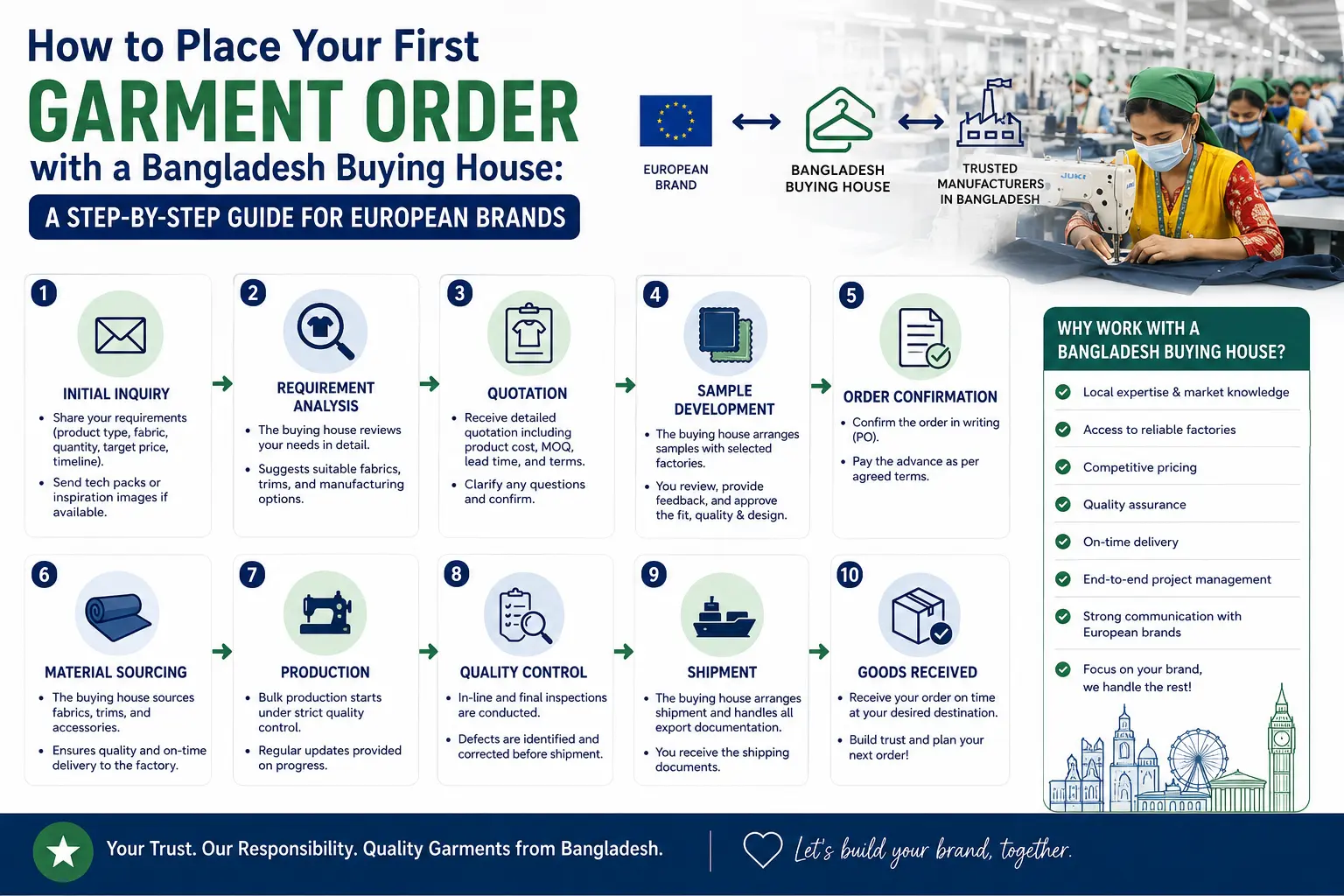
To order garments from Bangladesh, you follow eight stages: define your product with a tech pack, choose a supplier or buying house, request a quotation, approve samples, confirm the order with a deposit, oversee bulk production and quality control, arrange shipping under agreed Incoterms, and clear customs in Europe. A typical first order takes 90 to 130 days from enquiry to delivery and is usually paid via a 30% deposit with the balance against shipping documents.
That is the whole process in one paragraph. But a first order is where most European brands lose money — not because Bangladesh is difficult, but because nobody explained the steps that sit between “I have a design” and “the stock is in my warehouse.” This guide closes that gap. It is written by Milky Fashions, a BGBA-registered garment buying house in Bangladesh that has placed and managed first orders for European brands since 2002, so every stage below reflects what actually happens — including the payment terms, Incoterms, and sample stages most online guides skip entirely.
Before You Start: What You Need Ready
Before you contact a single supplier, get three things in order. Brands that arrive prepared get faster quotes, better samples, and lower prices. Brands that arrive vague overpay and resample repeatedly.
1. A clear product specification (ideally a tech pack). At minimum, you need fabric type and weight (GSM), exact measurements, colours with Pantone references, construction notes, and your branding and label details. If you do not have a tech pack, a good buying house can help you build one — but the more precise your starting point, the more accurate everything downstream becomes.
2. A realistic quantity. Know your order volume per style and per colour. This drives your minimum order quantity discussion and your price. If you are a startup or small brand, read our MOQ guide for Bangladesh sourcing before you set numbers, so your expectations match what factories will accept.
3. A target landing price and delivery date. Work backwards from the price you need to hit your retail margin, and the date you need stock on the shelf. These two numbers shape every decision that follows.
With those ready, here is the full process.
Step 1: Define Your Product and Build a Tech Pack
Everything starts with the tech pack — the technical blueprint that tells the factory exactly what to make. It removes guesswork, and guesswork is what makes first orders go wrong.
A complete tech pack includes flat sketches, a bill of materials (fabric, trims, labels, packaging), a measurement specification with tolerances, construction and stitching notes, colourways with standardised colour codes, and packaging instructions. Without it, the factory fills the gaps with its own assumptions, quotes high to cover the unknowns, and the first sample comes back wrong.
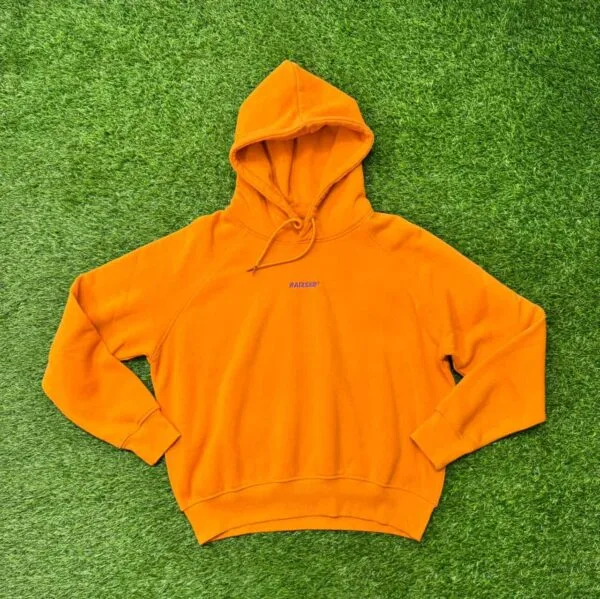
If you are sourcing a specific product, our category guides explain what each one needs: knitwear, T-shirts, polo shirts, hoodies, and denim each carry their own specification points. You can also browse our full product range to see what we produce for European brands.
Step 2: Choose Your Supplier — Direct Factory or Buying House
This is the single most consequential decision of your first order, and it determines how much risk you personally carry.
A direct factory sells you production capacity. You manage everything else yourself: vetting, sampling coordination, quality control, compliance documentation, and problem-solving — from outside the country, often in a different time zone, with no one on the ground.
A buying house manages the entire order on your behalf. It selects pre-vetted, certified factories, runs the sampling, conducts in-person quality control, handles documentation, and is your single accountable point of contact. For a first-time buyer with no Dhaka office, this dramatically reduces risk.
We lay out the full trade-offs in our comparison of a buying house versus direct factory sourcing. Whichever route you choose, vet the partner properly first — use our checklists for vetting a Bangladesh garment factory and vetting a Bangladesh buying house. A word of caution: avoid sourcing blind through open marketplaces where you cannot verify certifications or audit history — it is the most common way first orders go wrong.
Step 3: Request a Quotation
With your tech pack ready and a shortlisted supplier, request a detailed quotation. A professional quote should specify the unit price, the Incoterm it is based on (usually FOB), the minimum order quantity, the lead time, the payment terms, and what is included (sampling, inspection, packaging).
Be specific in your request: state your fabric, GSM, quantity per colour, target price, and delivery date. Vague enquiries get vague quotes. Compare quotations on a like-for-like basis — the same Incoterm, the same quality level — because the cheapest headline price often hides a lower fabric grade or excluded costs. For the full cost picture, see our breakdown of garment sourcing costs in Bangladesh.
Step 4: Approve Your Samples
Never confirm bulk production without approving a physical sample. Sampling protects you, and it happens in stages.
| Sample type | Purpose | Typical timing |
|---|---|---|
| Development / fit sample | Checks fit, construction, overall look | 7–14 days |
| Pre-production (PP) sample | The final approved standard for bulk — matches fabric, colour, trims | 7–12 days |
| Size set | Confirms fit across the full size range | Optional, +5–7 days |
| Top-of-production (TOP) sample | Pulled from the actual bulk run to confirm consistency | During production |
The PP sample is the one that matters most: it becomes the contractual standard your bulk production is measured against. Approve it carefully, and approve it quickly — slow sample approval is the most common cause of missed delivery dates, and it is entirely within your control. Sampling sits inside your overall timeline, which we map fully in our Bangladesh garment lead time guide.
Step 5: Confirm the Order and Understand Payment Terms
Once your PP sample is approved, you confirm the order with a proforma invoice and a deposit. This is where many first-time buyers feel uncertain, so here is how it actually works.
The standard payment structure for a first order is a 30% deposit to begin production, with the remaining 70% paid against shipping documents once the goods are produced and inspected. As trust builds over repeat orders, terms often become more favourable.
| Payment method | How it works | Best for |
|---|---|---|
| TT (bank transfer) | 30% advance, 70% before/against shipment | Most first orders |
| Letter of Credit (L/C) | Bank-guaranteed payment on meeting documented terms | Larger orders, added security |
| Escrow / platform terms | Funds released on milestones | Smaller trial orders |
A Letter of Credit offers the most protection for both sides on a larger first order, because payment is released only when documented conditions are met. A buying house can guide you on which structure fits your order size and risk appetite. Never pay 100% upfront to an unverified supplier — staged payment tied to production and inspection is your protection.
Step 6: Bulk Production and Quality Control
With the deposit paid, bulk production begins: fabric knitting or weaving and dyeing, cutting, sewing, and finishing. This is the longest phase, and it is where on-the-ground oversight earns its value.
Quality control should happen during production, not only at the end. Best practice includes inline inspection while sewing is underway and a final inspection against the internationally recognised AQL (Acceptable Quality Limit) standard, typically AQL 2.5 for general apparel, before goods are packed. Catching a defect mid-production is fixable; discovering it after the container arrives in Europe is not.
This is the core reason European brands work through a buying house: someone is physically in the factory checking your goods against the approved PP sample before they ship. Without that, you are trusting a supplier’s self-inspection sight unseen.
Step 7: Shipping and Incoterms
Once production passes final inspection, goods are shipped. Understanding Incoterms here protects you from unexpected costs, because the Incoterm defines exactly where the supplier’s responsibility ends and yours begins.
| Incoterm | What it means | Who handles freight & duty |
|---|---|---|
| FOB (Free On Board) | Supplier delivers to the port, loaded | You arrange sea freight & import |
| CIF (Cost, Insurance, Freight) | Supplier covers freight to your port | You handle import clearance & duty |
| DDP (Delivered Duty Paid) | Supplier delivers to your door, duties paid | Supplier handles everything |
Most experienced buyers order on FOB and use their own freight forwarder, which gives control and visibility over shipping costs. New buyers sometimes prefer CIF or DDP for simplicity on a first order. Sea freight from Chittagong to major European ports such as Hamburg, Rotterdam, or Felixstowe takes roughly 21 to 25 days.
On duty: Bangladesh has enjoyed duty-free access to the EU under the Everything But Arms scheme, though this status is changing as the country graduates from Least Developed Country status. Understand the implications before you commit by reading our guide to Bangladesh’s LDC graduation in 2026.
Step 8: Customs Clearance and Compliance
When your goods reach Europe, they clear customs in your country. You will need a commercial invoice, packing list, bill of lading, and a certificate of origin, with correct HS (Harmonized System) codes on your documentation.
Beyond customs paperwork, your products must meet EU regulatory requirements — chemical safety, labelling, and increasingly supply chain due diligence. This is not optional, and it starts with your supplier holding the right certifications. Our guides to EU apparel compliance, EU textile regulations for Bangladesh sourcing, and, for German brands specifically, LkSG supply chain due diligence explain what your products and your supplier must satisfy. Sourcing from properly certified factories is what makes this stage straightforward rather than stressful.
The First-Order Timeline at a Glance
Here is how the eight steps add up for a typical first order.
| Phase | Duration |
|---|---|
| Tech pack & supplier selection | 1–3 weeks |
| Quotation & negotiation | 1 week |
| Sampling & approval | 3–5 weeks |
| Order confirmation & deposit | A few days |
| Bulk production & QC | 5–8 weeks |
| Shipping to Europe (sea) | 3–4 weeks |
| Total enquiry to delivery | ~90–130 days |
Plan your launch backwards from this, and add a two-week buffer if your production overlaps Bangladesh’s Q3 peak season or an Eid holiday period.
Common First-Order Mistakes to Avoid
Drawing on two decades of first orders, these are the errors that cost European brands the most:
Sending an incomplete tech pack, then changing the design after fabric is cut. Approving samples slowly and blowing the timeline. Choosing the cheapest quote without checking what fabric grade or costs it excludes. Paying 100% upfront to an unverified supplier. Skipping inspection until the final day. Ignoring EU compliance until the goods are already at port. Every one of these is avoidable with preparation and the right sourcing partner.
How Milky Fashions Manages Your First Order
As a BGBA-registered buying house (Member M-0357) operating from Dhaka since 2002, Milky Fashions handles every step above on your behalf — from helping build your tech pack to placing your goods on the ship, with quality control and compliance documentation managed on the ground throughout. For European brands without a presence in Bangladesh, that turns an intimidating first order into a routine, well-supported process.
We work with fashion brands, retailers, and importers across the UK, Germany, France, the Netherlands, Italy, Spain, Poland, and Scandinavia, sourcing private label collections from certified, sustainable factories. If you are ready to place your first order — or just want a realistic quote and timeline for your product — contact us for a free, no-obligation consultation. You can also learn more about our buying house and how we support European buyers from first enquiry to delivery.
Frequently Asked Questions
How do I place my first garment order with a Bangladesh supplier?
Start by preparing a tech pack that defines your product, then choose a vetted supplier or buying house and request a detailed quotation. Approve a pre-production sample, confirm the order with a deposit (typically 30%), oversee bulk production with quality inspection, and ship under an agreed Incoterm such as FOB. A first order usually takes 90 to 130 days from enquiry to delivery.
What is the minimum order quantity for a first order from Bangladesh?
Minimum order quantities typically range from 300 to 1,000 pieces per style and colour, though some factories accept lower volumes for startups and others require more for complex items. MOQ depends on fabric, product type, and factory. A buying house can often consolidate orders to help smaller brands meet factory minimums.
How much deposit do I pay when ordering from Bangladesh?
The standard structure is a 30% deposit to begin production, with the remaining 70% paid against shipping documents once goods are produced and inspected. Larger first orders are often handled by Letter of Credit for added security on both sides. You should never pay 100% upfront to an unverified supplier.
What does FOB mean when ordering garments from Bangladesh?
FOB (Free On Board) means the supplier delivers your goods to the port of shipment, loaded onto the vessel, and from that point you arrange and pay for sea freight, insurance, and import into Europe. Most experienced buyers order on FOB because it gives them control over shipping costs through their own freight forwarder.
How long does a first garment order from Bangladesh take?
A typical first order takes around 90 to 130 days from initial enquiry to delivery in Europe. This includes tech pack and supplier selection, quotation, sampling and approval, bulk production with quality control, and roughly 21 to 25 days of sea freight. Add a two-week buffer if production overlaps Q3 peak season or an Eid holiday.
Do I need a tech pack to order from Bangladesh?
A tech pack is strongly recommended because it tells the factory exactly what to make, leading to accurate quotes and fewer sampling errors. If you do not have one, a buying house can help you create it from your design, sketch, or a reference garment. Ordering without clear specifications usually results in higher prices and rejected samples.
Is it safe to order garments from Bangladesh as a small European brand?
Yes, provided you work with a vetted, certified supplier and use staged payment terms tied to production and inspection. The main risks come from choosing an unverified supplier, paying fully upfront, or skipping quality control. Working through an established buying house removes most of these risks by managing vetting, inspection, and documentation on the ground.
Ready to Place Your First Bangladesh Order?
Ordering garments from Bangladesh is not complicated once you understand the eight steps — it is a clear, repeatable process. The brands that succeed are simply the ones who arrive prepared and work with a partner who manages the detail on the ground for them.
Milky Fashions has guided European brands through exactly this process for over two decades. Whether you are placing your very first order or scaling an existing programme, we can give you an honest quote, a realistic timeline, and full management from enquiry to delivery. Get in touch for a free consultation, or read our complete guide on how to source garments from Bangladesh for the wider strategic picture. Our FAQ page also answers the most common questions European buyers ask before they begin.

Director and Head of Merchandising at Milky Fashions, a BGBA-registered garment buying house in Bangladesh since 2002. Specialises in knitwear sourcing, factory compliance, and European buyer relations.