How to Vet a Bangladesh Garment Factory: The Complete 2026 Guide
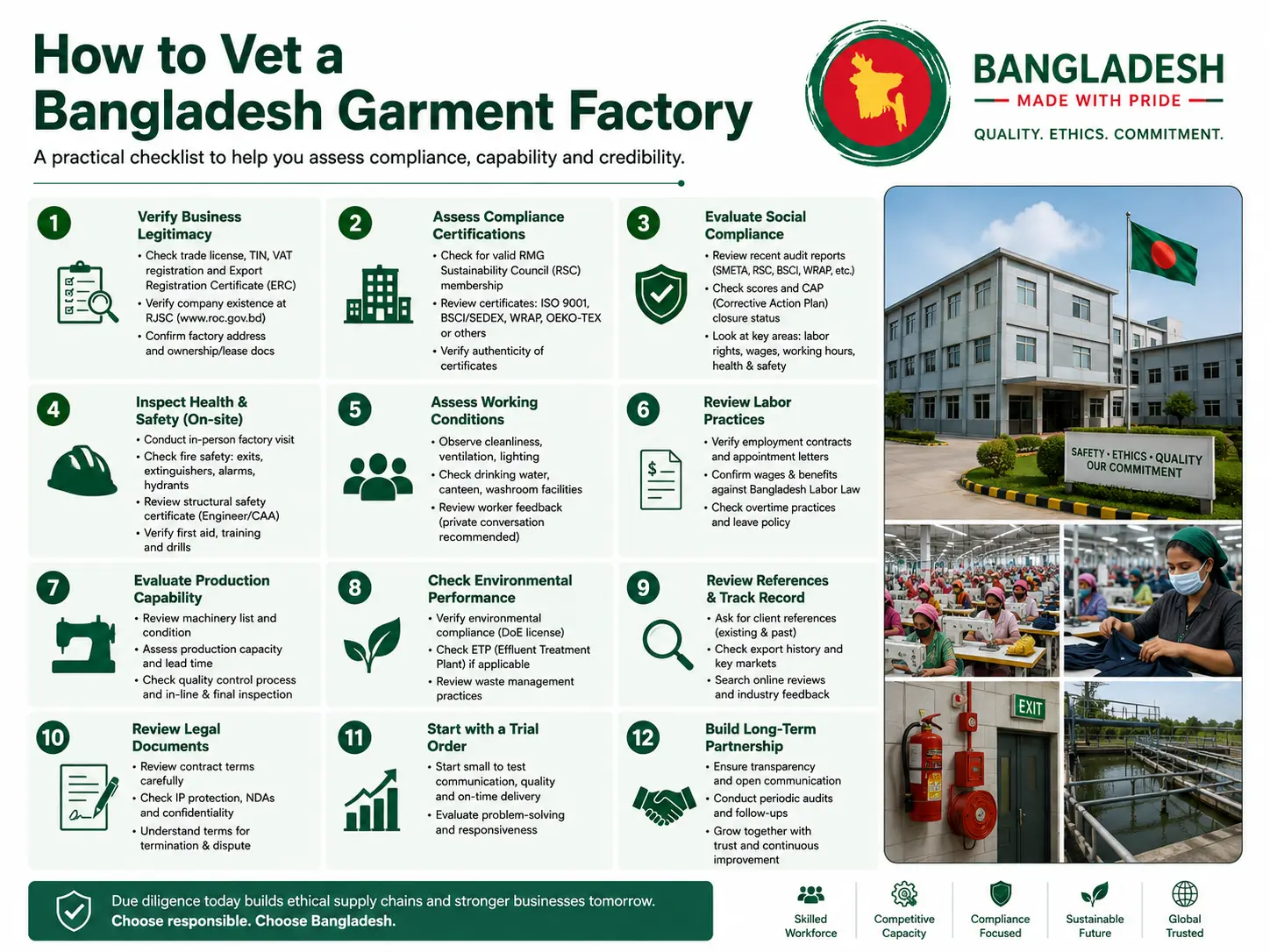
To vet a Bangladesh garment factory, verify four things: its legitimacy (confirm it is a real factory, not a trading company), its compliance certifications (BSCI, WRAP, SEDEX, GOTS, OEKO-TEX, checked against the issuing body), its production capability (capacity, equipment, and track record), and its quality systems (in-line and pre-shipment inspection to AQL standards). The safest approach is independent verification before any payment — through a factory audit, certificate cross-checking, and ideally a trusted in-country partner. This guide gives you the complete step-by-step framework.
Quick Answer: How to Vet a Bangladesh Garment Factory
Follow these core verification steps:
- Confirm it’s a real factory — Many “factories” are trading companies or middlemen. Verify physical production capability.
- Check BGMEA membership — The Bangladesh Garment Manufacturers and Exporters Association directory confirms a factory’s credentials.
- Cross-check certifications — Verify BSCI, WRAP, SEDEX, GOTS, OEKO-TEX directly on the issuing body’s website, not just from a PDF.
- Request a recent audit report — A legitimate factory readily provides social compliance and quality audit documentation.
- Conduct a factory audit — A process audit (not just a product inspection) before production.
- Use a pre-shipment inspection — Independent AQL inspection before goods leave Bangladesh.
- Secure payment terms — Use a Letter of Credit (L/C) rather than large upfront transfers.
- Verify references — Ask for and contact existing clients.
Key principle: Never rely on the factory’s own word. Legitimate factories welcome verification — if they resist, walk away.
Why Vetting a Bangladesh Factory Matters
Bangladesh is home to thousands of garment factories ranging from world-class export houses to small unverified units. The quality and reliability gap between them is enormous — and the consequences of choosing wrong are serious.
Two risks make vetting essential:
First, financial fraud. Sourcing scams are real. In one 2017 case, 26 Bangladeshi exporters were defrauded of around Tk 600 crore by buying houses that disappeared without paying. In 2012, 22 small exporters lost $5 million when an overseas retailer defaulted. Fraud runs in both directions — buyers can be scammed by fake suppliers, and suppliers by fake buyers. Verification protects you.
Second, compliance and ethics. The 2013 Rana Plaza disaster, which killed over 1,100 garment workers, transformed how the industry approaches factory safety and compliance. For brands selling into the EU, sourcing from a non-compliant factory is now not just an ethical failure but a legal one under due diligence laws like the CSDDD and Germany’s LkSG.
Step 1: Confirm It’s a Real Factory, Not a Trading Company
The single most common sourcing trap is mistaking a trading company for a factory. Many suppliers that present themselves as manufacturers are actually middlemen who subcontract your order to an unknown factory — adding cost, removing your visibility, and creating quality risk.
Industry data shows identity fraud is the leading cause of cross-border trade disputes. To confirm a real factory:
- Ask for the factory’s BGMEA or BKMEA membership number and verify it.
- Request photos and video of the actual production floor, not stock images.
- Ask specific technical questions about machinery, line capacity, and processes.
- Cross-check the business address on Google Maps against the claimed factory location.
- Confirm the legal entity name matches export and certification documents.
A trading company is not always wrong — some buying houses and exporters legitimately coordinate production. The danger is a middleman who hides that fact. Transparency about who actually makes your goods is non-negotiable.
Step 2: Verify BGMEA / BKMEA Membership
The Bangladesh Garment Manufacturers and Exporters Association (BGMEA) and the Bangladesh Knitwear Manufacturers and Exporters Association (BKMEA) maintain directories of registered factories. Membership is a baseline credential signal.
A factory listed in the BGMEA member directory is a registered, recognised manufacturer. While membership alone does not guarantee quality, its absence is a warning sign for a company claiming to be an established exporter. Confirm the membership number rather than accepting a logo on a website.
For buying houses specifically, the equivalent is the Bangladesh Garment Buying Agents Association (BGBA) — a buying house’s BGBA membership confirms it is a registered, accountable agent.
Step 3: Cross-Check Compliance Certifications
Certifications are only meaningful if they are real and current. Fake or expired certificates are a known tactic. The certifications European and UK buyers should verify:
| Certification | What It Covers | Verify At |
|---|---|---|
| BSCI (amfori) | Social compliance / labour | amfori.org |
| WRAP | Ethical, safe production | wrapcompliance.org |
| SEDEX / SMETA | Ethical audit data | sedex.com |
| GOTS | Organic textile claims | global-standard.org |
| GRS | Recycled content | textileexchange.org |
| OEKO-TEX | Chemical safety | oeko-tex.com |
| ISO 9001 | Quality management | Certifying body |
The rule: cross-check every certificate on the issuing body’s official website using the certificate number. Do not accept a PDF at face value. A legitimate factory’s certificates will validate; a fraudulent one’s will not. As the industry saying goes — if they can’t prove it, don’t buy it.
Step 4: Conduct a Factory Audit (Process, Not Just Product)
A factory audit verifies a supplier’s true capabilities before you commit. The critical distinction many buyers miss is between a process audit and a product inspection:
- A process audit evaluates the factory’s systems — capacity, equipment, quality management, labour practices, and safety — before production. It tells you whether the factory can deliver.
- A product inspection checks finished goods against your standard. It tells you whether a specific batch is acceptable.
You need both, but the process audit comes first. It is your primary defence against production errors and delays. A professional audit assesses seven core areas: production capacity, equipment, quality systems, labour practices, workplace safety, environmental compliance, and management systems.
You can commission an independent audit from third-party inspection firms operating in Bangladesh (such as SGS, Bureau Veritas, Intertek, or specialist local inspectors), or have a trusted in-country partner conduct it.
Step 5: Use Pre-Shipment Inspection to AQL Standards
Before any goods leave Bangladesh, an independent pre-shipment inspection verifies the finished order against the approved sample and your quality standard. This uses the AQL (Acceptable Quality Limit) system — typically AQL 1.5 or 2.5 for garments — to statistically sample the order and determine pass or fail.
A pre-shipment inspection is the last point at which you can catch a defective order before it ships. Skipping it means discovering quality problems only after goods arrive in Europe — when remediation is slow and expensive. For any new factory, an independent pre-shipment inspection is essential, not optional.
Step 6: Secure Your Payment Terms
How you pay is as important as who you pay. The safest payment structures protect you against non-delivery:
- Letter of Credit (L/C) — The bank releases payment only when shipping and documentation conditions are met. This is the standard, safest method for garment trade.
- Avoid large upfront transfers — Never pay a large deposit by irreversible wire transfer to an unverified supplier.
- Milestone-based payments — Tie payments to verified production stages.
- Get everything in writing — A clear purchase agreement with delivery schedules, quality standards, and penalties for non-compliance.
Scammers rely on irreversible upfront payments. Structured, condition-based payment removes their leverage.
Step 7: Verify Track Record and References
A factory’s history is one of the strongest reliability signals. Before committing:
- Ask how long the factory has been in business.
- Request references from existing or past clients — and actually contact them.
- Ask which brands and markets they currently supply.
- Request batch-specific documentation and lab reports from recent production.
Great factories provide references willingly. Reluctance to share a track record is a meaningful red flag.
Red Flags: Warning Signs of an Unreliable Factory
Watch for these warning signs during vetting:
| Red Flag | Why It Matters |
|---|---|
| Prices far below market | Often signals corner-cutting or a scam |
| Refuses factory audit or visit | Legitimate factories welcome verification |
| Certificates that won’t validate | Fake or expired compliance documents |
| No verifiable BGMEA membership | Questionable legitimacy for a claimed exporter |
| Vague about who makes the goods | Hidden subcontracting or trading-company front |
| Demands large irreversible upfront payment | Classic fraud structure |
| No references or client history | Unproven reliability |
| Stock photos instead of real factory images | May not have a real facility |
| Poor or evasive communication | Predicts production problems |
The Smart Shortcut: How a Buying House De-Risks Vetting
Vetting a factory properly — audits, certificate checks, inspections, payment structuring — is time-consuming and requires in-country presence. This is precisely the function of a buying house.
A reputable buying house has already vetted its factory network: verified legitimacy, confirmed certifications, assessed capacity, and built relationships over years. It conducts in-line and pre-shipment quality control on your behalf and manages payment and documentation. In effect, the buying house is your standing verification layer in Bangladesh.
But this raises an honest point: you must also vet the buying house. Apply the same principles — confirm BGBA registration, check its track record and references, verify it provides genuine compliance documentation, and confirm transparent pricing. A trustworthy buying house will welcome that scrutiny.
How Milky Fashions Approaches Factory Vetting
Milky Fashions is a BGBA-registered buying house (Member No. M-0357) that has built and verified its Bangladesh factory network since 2002. Every factory we work with is confirmed legitimate, holds current BSCI, WRAP, GOTS, or OEKO-TEX certification cross-checked against the issuing body, and is subject to our in-line and pre-shipment quality control.
We provide compliance documentation for your due diligence file, structure payments securely, and are transparent about exactly which factory produces your goods. We invite the same scrutiny we apply to factories — verify our BGBA membership, ask for references, and test our transparency.
To understand the certifications we verify, see our certifications guide. To see how this vetting works in a real programme, read our Polish brand case study. To understand the EU laws driving compliance requirements, see our EU textile regulations guide.
Frequently Asked Questions
How do I know if a Bangladesh garment factory is legitimate?
Verify it is a real factory (not a trading company) by confirming BGMEA or BKMEA membership, requesting real production-floor photos and video, cross-checking the address on Google Maps, and confirming the legal entity matches its export and certification documents. Legitimate factories welcome verification; evasiveness is a warning sign.
How do I avoid sourcing scams in Bangladesh?
Avoid scams by verifying the supplier’s legitimacy before payment, cross-checking certifications on issuing-body websites, using a Letter of Credit rather than large upfront transfers, getting all terms in writing, and ideally working through a vetted in-country partner. Real fraud cases exist in both directions, so structured, condition-based payment is essential.
What is the difference between a factory and a trading company?
A factory physically manufactures your garments; a trading company is a middleman that subcontracts your order to a factory, often without disclosing this. A trading company adds cost and removes your visibility and control. Some intermediaries are legitimate (such as transparent buying houses), but a middleman hiding that it doesn’t make the goods is a serious red flag.
How do I verify a factory’s BSCI or GOTS certification?
Cross-check the certificate number directly on the issuing body’s official website — amfori.org for BSCI, global-standard.org for GOTS, oeko-tex.com for OEKO-TEX. Do not accept a PDF at face value, as fake and expired certificates are common. A genuine certificate will validate against the official database.
What is a factory audit and do I need one?
A factory audit is an independent assessment of a factory’s production capacity, equipment, quality systems, labour practices, and safety before you commit. Yes, for any new factory you need one — specifically a process audit, which verifies the factory can deliver, not just a product inspection of finished goods. It is your primary defence against production failures.
What is AQL and why does it matter?
AQL (Acceptable Quality Limit) is the statistical sampling system used to inspect garment orders, typically at AQL 1.5 or 2.5. An inspector samples a portion of the order and the number of defects found determines pass or fail. A pre-shipment inspection to AQL standards is the last chance to catch a defective order before it ships from Bangladesh.
What certifications should a Bangladesh factory have?
For European and UK buyers, look for BSCI or WRAP (social compliance), SEDEX (ethical audit), GOTS (organic), GRS (recycled), and OEKO-TEX (chemical safety), plus ISO 9001 for quality management. The specific certifications you need depend on your product and market claims, but social compliance certification is a baseline for EU due diligence.
Is BGMEA membership enough to trust a factory?
No. BGMEA membership is a baseline credential that confirms a registered manufacturer, but it does not guarantee quality, capacity, or current compliance. Use it as a first filter, then verify certifications, conduct an audit, check references, and inspect production. Membership absence, however, is a strong warning sign for a claimed exporter.
How should I pay a Bangladesh factory safely?
Use a Letter of Credit (L/C), where your bank releases payment only when shipping and documentation conditions are met. Avoid large irreversible upfront wire transfers to unverified suppliers. Tie payments to verified production milestones and document all terms in a clear purchase agreement with penalties for non-compliance.
Can a buying house vet factories for me?
Yes. This is a core buying house function. A reputable buying house maintains a pre-vetted factory network — verified legitimacy, confirmed certifications, assessed capacity — and conducts quality control and secure payment management on your behalf. It acts as your standing verification layer in Bangladesh. You should still vet the buying house itself, including its BGBA registration.
How do I vet a buying house?
Apply the same standards you would to a factory: confirm BGBA registration, check track record and ask for references you actually contact, verify it provides genuine compliance documentation cross-checked against issuing bodies, and confirm it discloses pricing transparently and tells you which factory makes your goods. A trustworthy buying house welcomes this scrutiny.
What are the biggest red flags when sourcing from Bangladesh?
The biggest red flags are: prices far below market, refusal to allow a factory audit or visit, certificates that don’t validate, no verifiable BGMEA membership, vagueness about who actually makes the goods, demands for large irreversible upfront payment, and an inability to provide client references. Any one of these warrants caution; several together mean walk away.
Conclusion
Vetting a Bangladesh garment factory comes down to one principle: verify everything, trust nothing on its word alone. Confirm the factory is real, cross-check its certifications on official databases, audit its process, inspect before shipment, and structure payment securely. Done properly, this protects you from both quality failures and fraud — and Bangladesh’s best factories will welcome every step.
For most brands, the most efficient way to apply this entire framework is through a vetted buying house that already maintains a verified factory network. Milky Fashions has done exactly this since 2002. Send us your sourcing requirements and we’ll show you how we verify every factory before your goods go into production — and invite you to verify us in turn.
Source with Confidence → Contact
Related Reading
What Is a Garment Buying House? | Factory Certifications | Bangladesh MOQ Guide | Garment Sourcing Cost Bangladesh | EU Textile Regulations | Polish Brand Case Study

Director and Head of Merchandising at Milky Fashions, a BGBA-registered garment buying house in Bangladesh since 2002. Specialises in knitwear sourcing, factory compliance, and European buyer relations.