How Much Does It Cost to Source Garments from Bangladesh in 2026?
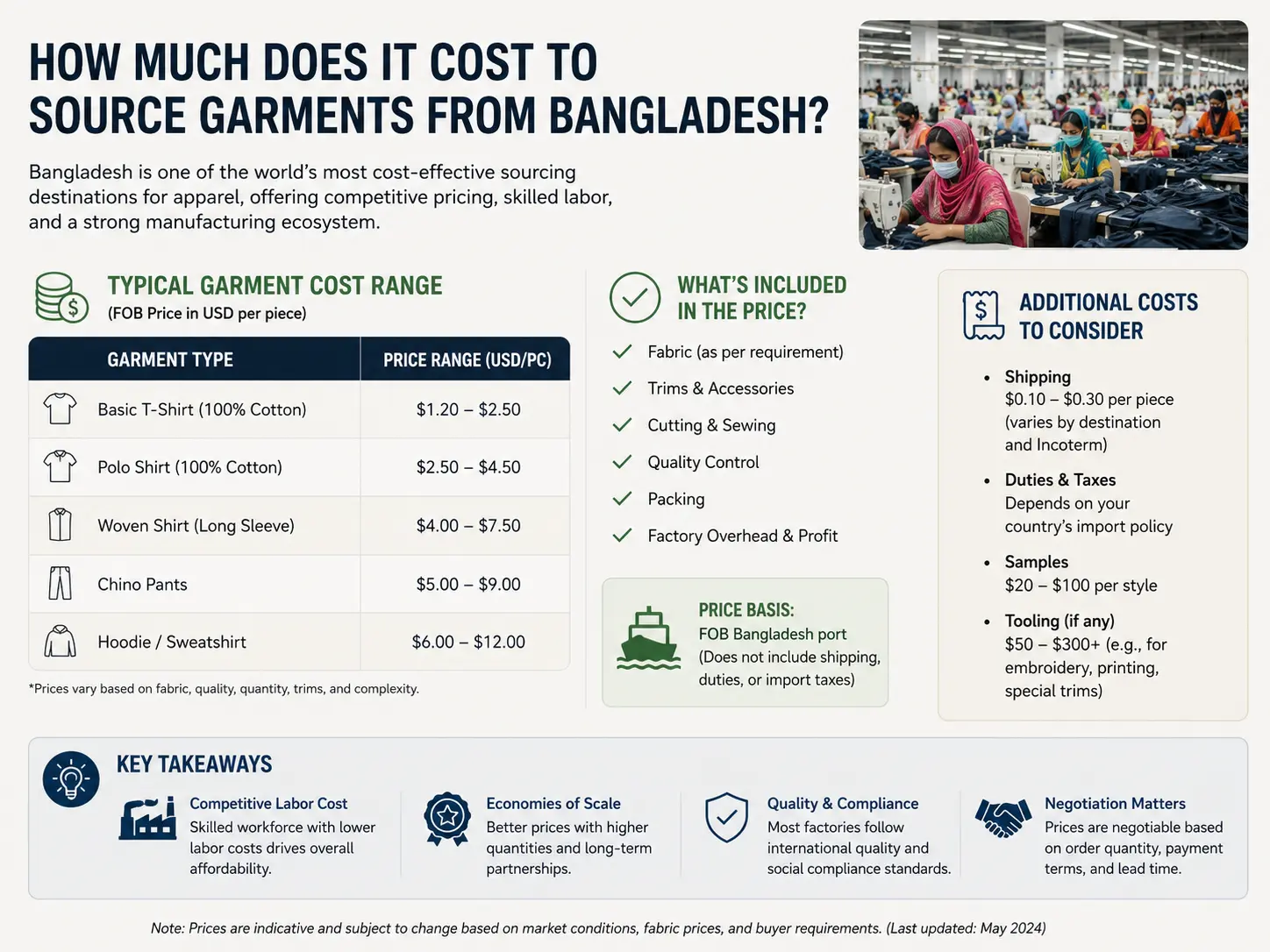
Sourcing garments from Bangladesh in 2026 typically costs between $2.50 and $8.00 FOB per unit for standard knitwear and casualwear, depending on product type, fabric, and order volume. Add a buying house commission of 5–10%, ocean freight of approximately $0.35–0.50 per unit to Europe, and 0% EU import duty under the EBA scheme, and the total landed cost per basic t-shirt to a European warehouse runs approximately $3.50–5.50. This guide breaks down every cost element so you can budget accurately before you source.
For a full FOB pricing breakdown by product, see our Bangladesh manufacturing cost guide.
Quick Answer: What Does Bangladesh Garment Sourcing Cost?
Here are the key cost benchmarks for 2026:
- Basic cotton t-shirt FOB: $2.50–$3.60 per unit
- Mid-range premium t-shirt FOB: $4.00–$5.50 per unit
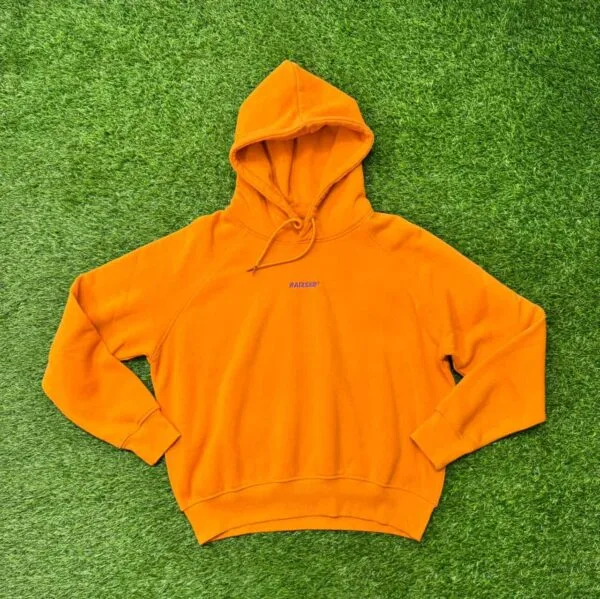
- Basic hoodie FOB: $6.00–$9.00 per unit
- Knitwear (sweater/cardigan) FOB: $7.00–$14.00 per unit
- Polo shirt FOB: $4.50–$7.00 per unit
- Denim jeans FOB: $8.00–$14.00 per unit
- EU import duty: 0% (EBA/DCTS — Bangladesh is duty-free)
- Buying house commission: 5–10% of FOB value
- Ocean freight to Europe: ~$0.35–0.50 per unit
- Sampling cost: $50–$200 per style (deducted from bulk order on confirmation)
Total landed cost to a European warehouse is typically FOB price + 15–25%.
Understanding Bangladesh Garment Pricing: What You Are Actually Buying
The FOB (Free On Board) price is the standard benchmark for Bangladesh garment sourcing. It covers the finished garment packed and loaded at Chittagong port — everything up to that point is the factory’s responsibility. You then pay for ocean freight, insurance, and any import duty on top.
Understanding what drives the FOB price helps you evaluate quotations accurately and avoid surprises.
What Makes Up the FOB Price?
The FOB price on a Bangladesh garment is built from four components:
| Component | Share of FOB |
|---|---|
| Fabric and raw materials | 60–70% |
| Cut, make, trim (CMT) labour | 15–20% |
| Factory overhead (QC, admin, transport) | 10–20% |
| Factory profit margin | 5–10% |
Fabric dominates the cost. This means fabric quality and composition — cotton weight, GSM, yarn count — have more impact on your FOB price than almost any other variable. Negotiating CM (cost of making) without controlling fabric spec rarely produces meaningful savings.
Bangladesh FOB Price Guide by Product (2026)
These are realistic FOB prices from Chittagong port for standard commercial quality, BSCI-certified factory production. Prices assume orders of 500–3,000 pieces per style with a buying house.
| Product | Specification | FOB Price Range |
|---|---|---|
| Basic t-shirt | 180gsm cotton jersey | $2.50–$3.60 |
| Premium t-shirt | 200gsm combed cotton | $4.00–$5.50 |
| Basic hoodie | 320gsm cotton fleece | $6.00–$9.00 |
| Premium hoodie | 350gsm brushed fleece | $9.00–$13.00 |
| Crew-neck sweatshirt | 300gsm fleece | $5.50–$8.50 |
| Polo shirt | Pique cotton, embroidered | $4.50–$7.00 |
| Sweater / cardigan | 12gg acrylic or cotton | $7.00–$14.00 |
| Denim jeans | 10–12oz denim | $8.00–$14.00 |
| Woven shirt | 100% cotton poplin | $5.00–$9.00 |
Note: These are indicative ranges. Final pricing depends on exact fabric specification, construction, trims, branding, and confirmed order quantity. A buying house will provide an itemised quotation against your tech pack.
Volume and Price: How Order Size Affects Your Cost
Volume is one of the most powerful levers in Bangladesh garment pricing. Factory economics reward larger orders through fabric roll optimisation, longer production runs, and reduced setup costs. Typical price breaks:
| Order Volume | Price Reduction vs Baseline |
|---|---|
| 500 pieces | Baseline |
| 1,000 pieces | 5–8% lower |
| 3,000 pieces | 12–18% lower |
| 5,000 pieces | 20–25% lower |
| 10,000+ pieces | 30–40% lower |
For reference: 10,000 basic t-shirts at $2.50 FOB = $25,000 vs the same order at 500 pieces at $3.50 FOB = $1,750 for 500 units. The per-unit difference is meaningful at scale. A buying house can consolidate multiple styles into a total programme value to access better pricing even at 500 pieces per style.
The Full Landed Cost: What You Actually Pay Per Unit
FOB is only the starting point. Here is the complete cost stack for a European brand importing from Bangladesh:
| Cost Element | Typical Cost | Notes |
|---|---|---|
| FOB price | $2.50–$14.00 | Depends on product and volume |
| Buying house commission | 5–10% of FOB | Disclosed upfront |
| Ocean freight to Europe | $0.35–0.50/unit | Container-dependent, Rotterdam/Hamburg |
| Cargo insurance | ~0.5% of cargo value | Standard marine policy |
| EU import duty | 0% | Bangladesh EBA/DCTS duty-free ✅ |
| UK import duty | 0% | UK DCTS duty-free ✅ |
| Port handling / customs | $0.05–0.10/unit | Estimated |
| Delivery to warehouse | Variable | Depends on location |
For a basic t-shirt at $3.00 FOB with a 7% buying house commission ($0.21) and $0.40 freight, the total landed cost to a European warehouse is approximately $3.61–3.80 — with zero import duty. The same garment landed from a non-LDC country would attract 12% EU import duty on top.
The EU Duty-Free Advantage: A Cost Most Brands Miss
Bangladesh’s 0% EU and UK import duty is one of the most significant — and most overlooked — cost advantages in apparel sourcing. Under the EU’s Everything But Arms (EBA) scheme and the UK’s Developing Countries Trading Scheme (DCTS), virtually all Bangladesh garments enter duty-free.
The standard EU import duty on clothing is 12%. On a $100,000 FOB programme, that is $12,000 saved vs sourcing from a non-eligible country. This single factor frequently makes Bangladesh the lowest total landed cost even on products where its FOB price is not the cheapest available globally.
Sampling Costs: What to Budget Before Bulk
Sampling is an often-overlooked cost in sourcing budgets. Before bulk production begins, most programmes require:
| Sample Type | Typical Cost | Purpose |
|---|---|---|
| Proto sample | $50–$150 per style | Confirm design concept and construction |
| Fit sample | $50–$100 per style | Confirm fit and measurements |
| Size set | $100–$200 per style | Graded size confirmation |
| Pre-production (PP) sample | $50–$100 per style | Final approval before bulk |
Total sampling cost typically runs $150–$400 per style for a standard programme. Most reputable factories and buying houses deduct sampling charges from the bulk order invoice once production is confirmed.
Buying House Commission: What It Costs and What It Saves
A buying house charges 5–10% of the FOB value as commission. On a $10,000 FOB order, that is $500–$1,000. In return, a buying house delivers:
- Factory selection and vetting (saves weeks of research)
- Better FOB pricing through established factory relationships
- Independent in-line quality inspection (prevents costly shipment rejections)
- Compliance documentation (BSCI, GOTS, OEKO-TEX)
- Production follow-up and on-time delivery management
The commission almost always pays for itself. Better factory pricing alone often offsets it entirely. The real return is in defect prevention — a single rejected shipment can cost 5–10x the annual commission.
Hidden Costs to Budget For
Several costs catch first-time Bangladesh buyers off-guard:
- Lab testing fees: $150–$400 per style for fabric and chemical testing (Intertek, SGS, or Bureau Veritas). Often required by European retailers.
- AQL inspection fees: $250–$400 per inspection for a third-party pre-shipment inspection. Recommended for all new factories.
- Shipping delays: Peak season surcharges on Chittagong–Rotterdam container routes can add $0.10–$0.20 per unit. Plan shipments to avoid peak windows (October–December).
- Packaging and labelling: EU-required care labels, country of origin, fibre composition, and size labels must be in the destination market language. Factory charges vary — budget $0.05–0.15 per unit.
What Affects Pricing Most: The Key Variables
Five factors have the greatest impact on your Bangladesh garment price:
- Fabric specification — GSM, fibre content, and yarn count drive 60–70% of the FOB price.
- Order volume — Higher volumes unlock meaningful price breaks from 500 to 10,000+ pieces.
- Trims and branding — Woven labels, custom buttons, embroidery, and packaging add $0.20–$1.50 per unit.
- Factory tier — Tier-1 GOTS or OEKO-TEX certified factories cost 8–15% more than uncertified, but provide compliance documentation essential for EU buyers.
- Seasonal timing — Booking production in off-peak windows (January–March, July–August) typically gives better pricing and priority capacity.
How Milky Fashions Prices Its Services
Milky Fashions operates on a disclosed commission model — our fee is stated upfront in every quotation, not hidden in the unit price. We source from BSCI, WRAP, GOTS, and OEKO-TEX certified factories across Bangladesh, with MOQs from 500 pieces per style.
Every quotation we provide includes itemised FOB pricing, our commission, and an indicative landed cost calculation for your destination market. There are no hidden charges.
To understand what certified factory production means for your programme, see our certifications guide. To see a worked example of a full knitwear programme with real cost outcomes, read our Polish brand case study.
Frequently Asked Questions
How much does it cost to source garments from Bangladesh?
Garment sourcing from Bangladesh typically costs $2.50–$14.00 FOB per unit depending on product type and volume. Add a buying house commission of 5–10%, ocean freight of $0.35–0.50 per unit to Europe, and 0% EU import duty. A basic t-shirt lands at a European warehouse for approximately $3.50–4.50 all-in.
What is the FOB price for t-shirts in Bangladesh?
A basic 180gsm cotton t-shirt has a FOB price of $2.50–$3.60 in Bangladesh in 2026 at 500–3,000 pieces. Premium 200gsm combed cotton t-shirts run $4.00–$5.50 FOB. Prices drop 30–40% at volumes above 10,000 pieces.
How much do hoodies cost to source from Bangladesh?
A basic 320gsm cotton fleece hoodie costs $6.00–$9.00 FOB in Bangladesh. Premium 350gsm brushed fleece hoodies run $9.00–$13.00 FOB. Price depends on weight, fabric quality, construction complexity, and order volume.
Is there import duty on Bangladesh garments into the EU?
No. Bangladesh qualifies for 0% EU import duty under the Everything But Arms (EBA) scheme. The standard EU clothing tariff is 12%, so EBA represents a significant cost advantage over garments sourced from non-eligible countries. The UK also grants Bangladesh 0% duty under the DCTS scheme.
What is the minimum order quantity (MOQ) for Bangladesh sourcing?
Factory-direct MOQs in Bangladesh typically start at 1,000 pieces per style. A buying house can access MOQs from 500 pieces by negotiating on total programme value across multiple styles.
How much does sampling cost in Bangladesh?
Sampling typically costs $150–$400 per style across proto, fit, size set, and pre-production sample stages. Most factories and buying houses deduct sampling costs from the bulk order invoice once production is confirmed.
How much does a buying house charge?
A garment buying house charges 5–10% of the FOB order value as commission. This is disclosed upfront and almost always offset by better factory pricing, quality control, and compliance management. On a $20,000 FOB order, the commission is $1,000–$2,000.
What is the total landed cost from Bangladesh to Europe?
Total landed cost is FOB price + buying house commission (5–10%) + ocean freight (~$0.35–0.50/unit) + port handling (~$0.05–0.10/unit) + 0% EU duty. For a basic t-shirt at $3.00 FOB, expect a total landed cost of approximately $3.60–3.90 to a European warehouse.
How does fabric affect Bangladesh garment pricing?
Fabric accounts for 60–70% of the Bangladesh FOB price. Fabric weight (GSM), fibre content (cotton vs polyester vs blends), and yarn count have more impact on unit cost than almost any other variable. Specifying the correct fabric from the start prevents pricing surprises later.
Can I get cheaper pricing from Bangladesh without a buying house?
Going factory-direct may appear cheaper but typically involves higher risk of quality failures, compliance gaps, and production delays — each of which carries a cost far exceeding the buying house commission. The all-in cost of a rejected shipment or failed audit usually exceeds years of buying house fees.
Conclusion
Bangladesh remains one of the most cost-effective garment sourcing destinations in the world in 2026 — especially for European brands benefiting from 0% import duty. A basic t-shirt lands at a European warehouse for under $4.00 all-in. A premium hoodie programme at 3,000 pieces delivers strong margin at $9.00–11.00 FOB. The key to accurate budgeting is accounting for the full cost stack — FOB, commission, freight, sampling, and testing — not just the headline unit price.
Milky Fashions provides itemised, transparent quotations against your tech pack or product brief. Send us your programme details and we will return FOB pricing, our commission, and an indicative landed cost within 24 hours.
Request a Sourcing Quote → Contact
Related Reading
What Is a Garment Buying House? | Bangladesh vs China vs Turkey | Knitwear Sourcing Bangladesh | Factory Certifications | Hoodie Manufacturer Bangladesh | T-Shirt Supplier Bangladesh

Director and Head of Merchandising at Milky Fashions, a BGBA-registered garment buying house in Bangladesh since 2002. Specialises in knitwear sourcing, factory compliance, and European buyer relations.