Bangladesh vs China vs Turkey: Where Should You Source Your Clothing in 2026?
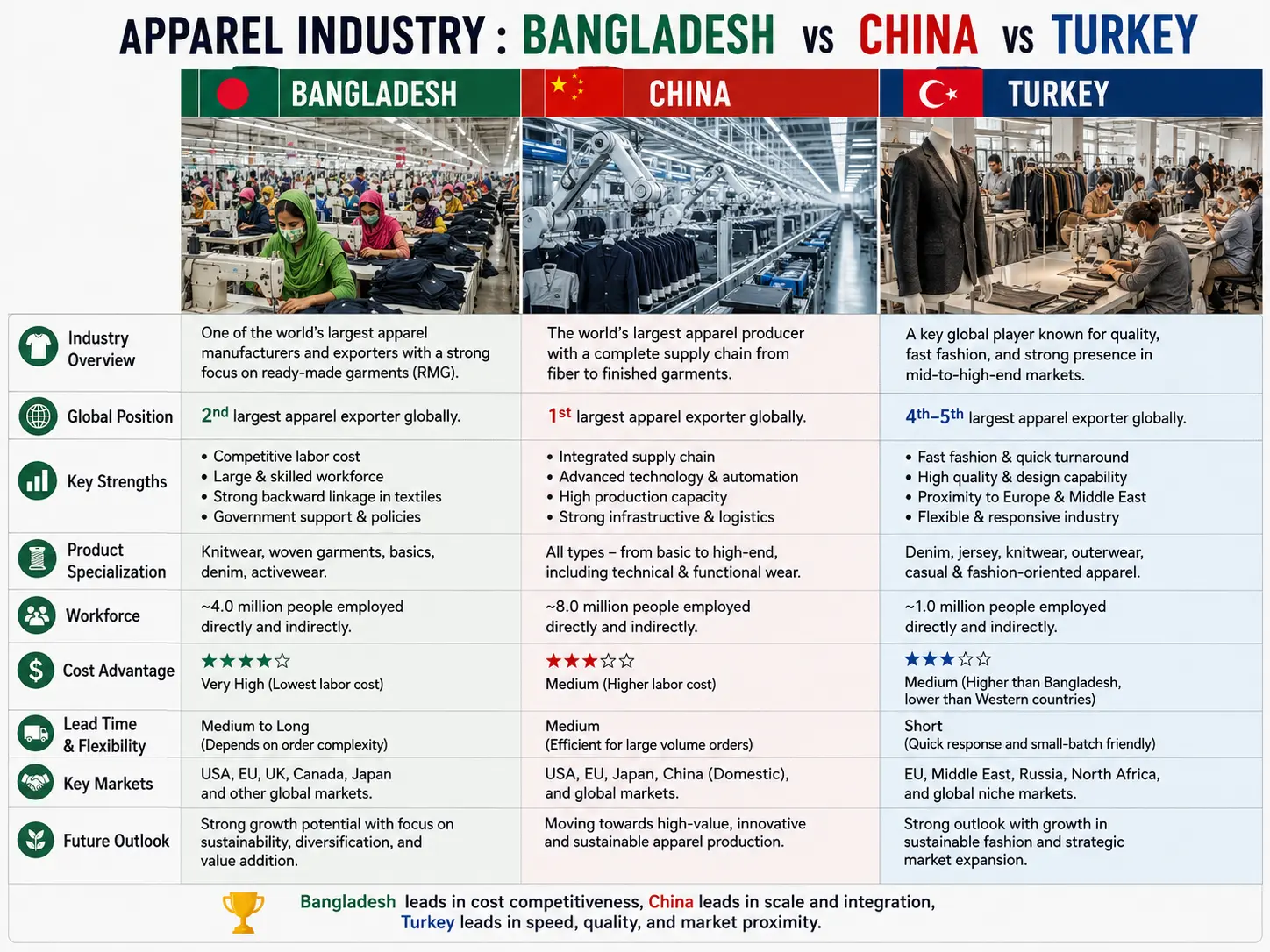
For most fashion brands, Bangladesh offers the lowest cost, China offers the deepest capability and speed, and Turkey offers the fastest delivery to Europe. The right choice depends on your priority: Bangladesh wins on price and EU duty-free access, China wins on product range and complex orders, and Turkey wins on lead time for European brands. This guide compares all three across cost, lead time, minimum order quantity, quality, and compliance — with 2026 data — so you can match the right country to your programme.
Quick Answer: Bangladesh vs China vs Turkey
Each country has a distinct strategic advantage:
- Bangladesh — Lowest production cost, 0% EU and UK import duty, strongest for knitwear and basics. Best for price-sensitive, high-volume programmes.
- China — Widest product range, fastest factory turnaround, deepest material ecosystem. Best for complex, technical, or varied product lines.
- Turkey — Fastest delivery to Europe (7–15 days), premium quality, low MOQs. Best for European brands prioritising speed and small runs.
At a glance:
| Factor | Bangladesh | China | Turkey |
|---|---|---|---|
| Production cost | Lowest | Mid–high | High |
| EU/UK import duty | 0% (EBA/DCTS) | Full tariff | Reduced (Customs Union) |
| Lead time to EU | 60–90 days + 20–28 shipping | 45–90 days + 30–40 shipping | 8–15 days total |
| Typical MOQ | 500–1,000 | 500–1,000 | 300–500 |
| Best products | Knitwear, denim, basics | Everything, complex/technical | Denim, knits, premium |
| Quality ceiling | High (top factories) | Very high | Very high |
Cost Comparison: Bangladesh vs China vs Turkey
Bangladesh has the lowest garment production cost of the three countries. Based on 2026 industry data for cut-make-trim (CMT) rates on a basic garment:
| Country | CMT cost per basic garment | Labour cost/hour |
|---|---|---|
| Bangladesh | $1–3 | ~$0.60–1.30 |
| China | $3–8 | Higher (3× Bangladesh productivity) |
| Turkey | $5–12 | Premium |
Bangladesh offers the lowest global CMT cost at $1–3 per basic garment, while China runs $3–8 and Turkey $5–12 per piece. However, raw cost is only part of the picture. China’s higher per-worker productivity — nearly three times that of Bangladesh — narrows the gap on complex garments, and Turkey’s speed reduces the inventory cost of carrying stock.
The Duty-Free Advantage
For European and UK brands, Bangladesh has a structural cost advantage beyond labour: 0% import duty. Bangladesh qualifies for the EU’s Everything But Arms (EBA) scheme and the UK’s Developing Countries Trading Scheme (DCTS), both granting duty-free access. China pays full tariffs into the EU, and Turkey benefits from the EU Customs Union. On a large knitwear programme, the duty saving alone can exceed the labour-cost difference.
Lead Time Comparison: Bangladesh vs China vs Turkey
Turkey has by far the fastest delivery to Europe. This is its defining advantage:
| Country | Production | Shipping to EU | Total to EU |
|---|---|---|---|
| Turkey | 8–10 weeks | 7–15 days | ~8–10 weeks |
| Bangladesh | 60–90 days | 20–28 days | ~14–18 weeks |
| China | 45–90 days | 30–40 days | ~13–19 weeks |
A 16-to-20-week production cycle from Bangladesh means committing to styles and quantities five months before delivery, while Turkey delivers in 8 to 10 weeks. For fast-fashion and trend-driven brands, this lead-time gap is critical — it can be the difference between selling at full price and marking down. For basics and core programmes with stable demand, Bangladesh’s longer lead time is rarely a problem.
Minimum Order Quantity (MOQ) Comparison
Turkey generally offers the lowest minimum order quantities, making it attractive for small brands and test runs. China and Bangladesh factories typically require higher minimums when approached directly:
- Turkey: 300–500 pieces per style typical
- Bangladesh: 500–1,000+ per style factory-direct
- China: 500–1,000 per style typical
However, this is where a buying house changes the equation. A buying house in Bangladesh negotiates on total programme value across multiple styles, accessing MOQs from 500 pieces — closing much of the gap with Turkey while keeping Bangladesh’s cost and duty advantages.
Quality Comparison: Bangladesh vs China vs Turkey
All three countries can produce excellent quality — the difference is consistency and verification. China and Turkey have very high quality ceilings, with Turkey particularly strong in premium denim and knits. Bangladesh’s top-tier factories match this quality, but the country’s vast number of factories makes verification essential.
Bangladesh’s top-tier factories produce excellent technical garments, but the sheer number of manufacturers makes it harder for buyers to identify and verify reliable partners without significant due diligence or on-the-ground sourcing support.
This is the single most important insight for brands choosing Bangladesh: the quality is there, but you must work with the right factory. This is precisely the role of a buying house — independent factory vetting and in-line quality control that removes the verification risk.
Product Specialisation: Which Country for Which Product?
Each country has product categories where it excels:
| Product | Best Country | Why |
|---|---|---|
| Knitwear (t-shirts, sweaters, hoodies) | Bangladesh | Lowest cost, deep knit capability, EU duty-free |
| Denim | Bangladesh or Turkey | Bangladesh for cost, Turkey for premium fast turnaround |
| Complex/technical garments | China | Deepest material ecosystem and machinery |
| Premium fashion, small runs | Turkey | Speed, quality, low MOQ |
| High-volume basics | Bangladesh | Unbeatable cost at scale |
| Embellished/varied product lines | China | Range and flexibility |
Compliance and Sustainability
All three countries offer certified, compliant factories — but verification practices differ. Bangladesh has invested heavily in compliance since 2013, and now has one of the world’s largest bases of BSCI, WRAP, GOTS, and OEKO-TEX certified factories, plus more LEED-certified green factories than any other country. China and Turkey also offer strong certified options.
For EU brands navigating the CSDDD, LkSG, and Green Claims Directive, what matters most is not the country but whether certifications are verified before production. A buying house that confirms BSCI, GOTS, and OEKO-TEX documentation before you commit protects your brand regardless of sourcing country.
So Which Country Should You Choose?
Match the country to your priority:
- Choose Bangladesh if: cost and EU duty-free access are your priority, your products are knitwear, denim, or basics, and your demand is stable enough to plan 3–4 months ahead.
- Choose China if: you need complex or technical garments, a very wide product range, or extremely high volumes with deep material sourcing.
- Choose Turkey if: speed to the European market is critical, you need small runs, and you can absorb a higher unit cost for the lead-time advantage.
For most European brands sourcing knitwear, denim, and casualwear at competitive prices, Bangladesh offers the strongest overall value — provided you work with a partner who manages factory selection, quality, and compliance. The lead-time and verification challenges that are Bangladesh’s main weaknesses are exactly what a buying house solves.
How Milky Fashions Fits In
Milky Fashions is a BGBA-registered Bangladesh buying house (Member No. M-0357) that addresses Bangladesh’s two main challenges directly: factory verification and production management. Since 2002, we have sourced certified knitwear, denim, and woven garments for European brands — with accessible MOQs from 500 pieces, in-line quality control, full compliance documentation, and transparent pricing.
If you are weighing Bangladesh against China or Turkey, see our guides to knitwear sourcing and factory certifications, or read how a Polish menswear brand switched from China and Turkey to Bangladesh and cut costs 28%.
Frequently Asked Questions
Which is cheaper: Bangladesh, China, or Turkey?
Bangladesh is the cheapest of the three for garment production, with CMT costs of $1–3 per basic garment compared to $3–8 in China and $5–12 in Turkey. Bangladesh’s advantage is widened for EU and UK brands by 0% import duty under the EBA and DCTS schemes. However, China’s higher productivity narrows the gap on complex garments.
Is Bangladesh better than China for clothing manufacturing?
For knitwear, basics, and high-volume programmes at the lowest cost, Bangladesh is generally better — especially for EU and UK brands benefiting from duty-free access. For complex, technical, or highly varied product lines requiring a deep material ecosystem, China is stronger. The best choice depends on product type and volume.
Why is Turkey faster than Bangladesh for European brands?
Turkey is geographically close to Europe, delivering in 8–15 days versus 14–18 weeks total from Bangladesh including shipping. This nearshoring advantage lets European brands respond to demand rather than forecasting months ahead, reducing markdown risk on trend-driven products. It comes at a higher unit cost.
Which country is best for knitwear sourcing?
Bangladesh is the leading country for knitwear sourcing. It is the EU’s largest knitwear supplier, offers the lowest production cost, has deep knit manufacturing capability across t-shirts, sweaters, and hoodies, and provides 0% EU import duty. Turkey is a strong alternative for premium knits requiring fast delivery.
Does Bangladesh have quality problems?
Bangladesh’s top-tier factories produce excellent quality matching China and Turkey. The challenge is consistency across the country’s very large number of factories, which makes verification essential. Working with a buying house that conducts independent factory vetting and in-line quality control removes this risk.
What is the MOQ difference between the three countries?
Turkey typically offers the lowest factory-direct MOQs at 300–500 pieces per style. Bangladesh and China usually require 500–1,000+ per style when approached directly. However, a buying house in Bangladesh can access MOQs from 500 pieces by negotiating on total programme value across styles.
Which country has the best duty advantage for EU brands?
Bangladesh has the strongest duty advantage for EU and UK brands, with 0% import duty under the Everything But Arms (EBA) scheme and the UK’s Developing Countries Trading Scheme (DCTS). Turkey benefits from the EU Customs Union, while China pays full tariffs into the EU.
Is it cheaper to source from Bangladesh even with longer lead times?
Often yes, for stable-demand products. Bangladesh’s lower cost and duty-free access typically outweigh the longer lead time for basics and core programmes. For trend-driven products where speed prevents markdowns, Turkey’s faster delivery can make it cheaper in real terms despite a higher unit price.
Can I use a buying house to source from all three countries?
Some buying houses operate across multiple countries, but most specialise in one to provide genuine expertise and factory relationships. A pure-Bangladesh buying house offers the deepest knowledge of Bangladesh factories, pricing, and compliance — more valuable than a generalist spread across several countries.
Which country is best for sustainable and certified garments?
All three offer certified factories. Bangladesh has one of the world’s largest bases of BSCI, WRAP, GOTS, and OEKO-TEX certified factories and leads in LEED-certified green factories. What matters most for EU compliance is verifying certifications before production, regardless of country — a core buying house function.
Conclusion
There is no single best country for garment sourcing — only the best match for your priorities. Bangladesh leads on cost and EU duty-free access, China on capability and range, and Turkey on speed to Europe. For most European brands sourcing knitwear, denim, and basics at competitive prices, Bangladesh offers the strongest overall value, provided its lead-time and verification challenges are managed by an experienced partner.
If you are evaluating Bangladesh, Milky Fashions has helped European brands source there successfully since 2002. Send us your product brief for a factory recommendation and indicative pricing within 24 hours.
Compare Your Sourcing Options → Contact
Related Reading
What Is a Garment Buying House? | Knitwear Sourcing Bangladesh | Polish Brand Case Study | Factory Certifications | EU Textile Regulations | Garment Sourcing Services

Director and Head of Merchandising at Milky Fashions, a BGBA-registered garment buying house in Bangladesh since 2002. Specialises in knitwear sourcing, factory compliance, and European buyer relations.