EU Apparel Compliance Checklist 2026: What Brands Sourcing Abroad Must Cover
If you sell clothing in the European Union, you now face the most significant wave of regulation the fashion industry has ever seen — and almost all of it lands between 2026 and 2029. This is the complete, plain-English map: every major rule, what it requires, when it bites, and the single thread that connects them all. Each section links to a full deep-dive guide. Think of this as your EU apparel compliance home base.
There is one insight worth holding onto before you start, because it makes the whole picture simpler: nearly every rule below ultimately depends on the same thing — verifiable data from your supply chain. Get your sourcing foundations right, and you are preparing for all of them at once.
Need a compliance-ready supplier? See our EU supply chain compliance sourcing page.
The 2026–2029 compliance timeline at a glance
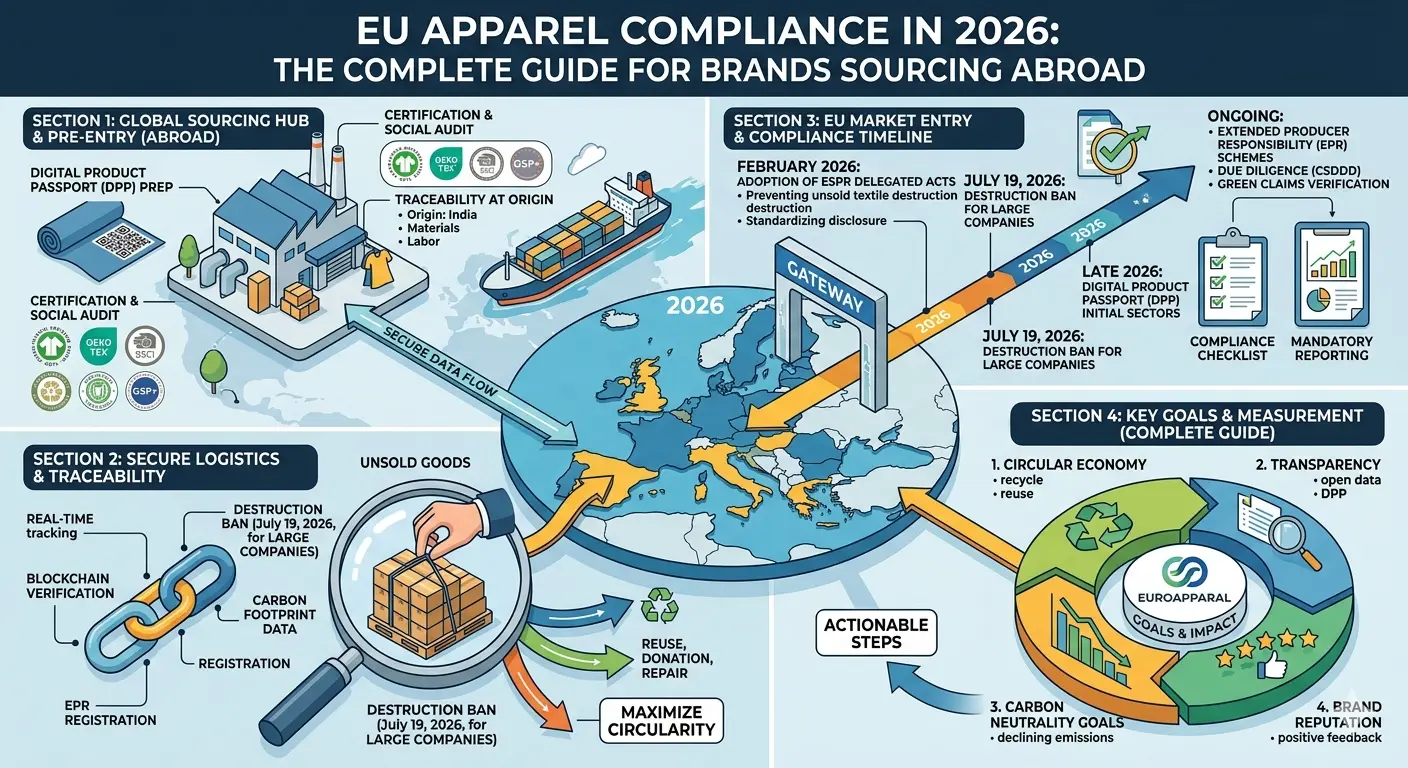
Here is the sequence of what binds, and when:
- In force now (2026): REACH chemical restrictions, OEKO-TEX 2026 limit values (from 1 June 2026), the REACH formaldehyde limit (from 6 August 2026), France’s PFAS ban (from 1 January 2026), and mandatory textile Extended Producer Responsibility rolling out across member states.
- Late 2026: the EU green claims rules (ECGT) become enforceable from 27 September 2026; France’s environmental cost label reaches its next milestone on 1 October 2026.
- 2027–2029: the Digital Product Passport for textiles (delegated act expected around 2027, compliance around 2028–2029) and the Corporate Sustainability Due Diligence Directive (first compliance around 2029 after the Omnibus narrowing).
Some of these are law today. Some are coming. All of them require preparation that starts at the factory — which is why none of them can be left to the last minute.
Green claims: what you can and can’t say
From 27 September 2026, the EU’s green claims rules (the ECGT Directive) ban vague environmental claims like “eco-friendly” and offset-based “climate neutral” labels unless you can substantiate them. This turns sustainability marketing into a supply-chain evidence problem: if your factory cannot prove it, you cannot say it.
Read the full guide: EU green claims rules for apparel brands.
The Digital Product Passport: traceability becomes mandatory
Under the EU’s Ecodesign regulation (ESPR), the Digital Product Passport will give every garment a QR-accessible record of its materials, origin, durability, and environmental data. For textiles, the rules are expected around 2027 with compliance around 2028–2029 — but readiness depends on supplier data you have to build now.
Read the full guide: The Digital Product Passport for apparel.
Chemical compliance: REACH and OEKO-TEX
REACH is the EU’s mandatory chemical law; OEKO-TEX is the voluntary certification most brands use to prove they meet it. Both tightened in 2026, with a new REACH formaldehyde limit from 6 August and updated OEKO-TEX limits from 1 June. This is the compliance layer that binds today, and the most testable.
Read the full guide: REACH and OEKO-TEX compliance for apparel.
France: the strictest national market
France layers its own rules on top of EU law: a PFAS ban in force since January 2026, the Environmental Cost label (the textile eco-score), and the AGEC circular-economy law. Because France legislates ahead of Brussels, getting France-ready future-proofs your wider EU sourcing.
Read the full guide: France textile regulations: PFAS, eco-score and AGEC.
Supply-chain due diligence (CSDDD)
The Corporate Sustainability Due Diligence Directive requires large companies to identify and address risks across their supply chains. The 2026 Omnibus package narrowed its scope to the biggest companies, with compliance around 2029 — but the obligation reaches suppliers indirectly, because in-scope buyers request facility-level data from the factories they use. Keeping that data ready is becoming a competitive advantage.
You can read more about how these frameworks affect sourcing in our overview of EU textile regulations and Bangladesh sourcing.
Textile Extended Producer Responsibility (EPR)
Following the revision of the EU Waste Framework Directive, mandatory textile EPR schemes are rolling out across member states. Brands placing clothing on the market pay fees toward its collection and recycling — and those fees are increasingly linked, through “eco-modulation,” to the same product sustainability data the Digital Product Passport will hold.
The one thread that connects everything
Step back from the detail and a single pattern runs through all of it. The green claims rules need substantiation data. The Digital Product Passport needs traceability data. Chemical compliance needs test data. France’s eco-score needs life-cycle data. Due diligence needs supplier data. EPR fees are modulated by product data.
Every one of these regulations ultimately asks the same question: can you prove it, with verified information from your supply chain?
That is the strategic takeaway. You do not need six separate compliance projects. You need one well-structured, certified, document-ready supply chain — and it satisfies all of them. Brands that source through certified, traceable factories with documentation built in will absorb this entire wave with minimal friction. Brands sourcing on price alone from opaque suppliers will find themselves unable to label, claim, sell, or report.
How to build a compliance-ready supply chain
The practical foundations are the same across every rule on this page:
- Source through certified factories — BSCI, WRAP, SEDEX, GOTS, GRS, and OEKO-TEX certification generates most of the data and assurance these rules require.
- Make documentation standard — certificates, test reports, and origin data should arrive with every order, not on request.
- Test finished products — chemical and PFAS testing on the finished garment, to current limits.
- Build traceability one tier deeper — know where your fabric and fibre come from, not just where garments are assembled.
- Verify before you commit — confirm certification before placing an order, not after a problem appears.
- Work with a partner who documents as standard — a buying house that builds compliance evidence into every order turns a regulatory burden into a routine process.
Why sourcing from Bangladesh fits the new compliance era
Bangladesh is well positioned for this regulatory wave. It has the largest base of LEED-certified green garment factories in the world, with widely available certification across the social and environmental standards these rules rely on, and OEKO-TEX-certified production that maps directly onto the chemical and substantiation requirements. The infrastructure for compliant, documented sourcing exists — the task is to apply it consistently.
Whether you produce knitwear, denim, t-shirts, hoodies, or private-label ranges, and whether you sell into Germany, France, Sweden, or anywhere across the EU, the principle is the same: certified factories, documented as standard, with a partner managing the compliance evidence. Explore our approach to sustainable garment sourcing and verified certifications.
EU apparel compliance acronyms, decoded
This field is drowning in acronyms. Here is the plain-English version of the ones that matter:
- ECGT / EmpCo — Empowering Consumers for the Green Transition Directive (2024/825). The green claims law banning vague environmental claims from September 2026.
- ESPR — Ecodesign for Sustainable Products Regulation (2024/1781). The framework law that introduces the Digital Product Passport.
- DPP — Digital Product Passport. A QR-accessible digital record of a product’s materials, origin, and environmental data.
- CSDDD — Corporate Sustainability Due Diligence Directive. Requires large companies to address supply-chain human-rights and environmental risks.
- REACH — Registration, Evaluation, Authorisation and Restriction of Chemicals. The EU’s mandatory chemical law.
- OEKO-TEX — a voluntary independent certification proving textiles are tested for harmful substances.
- AGEC — France’s Anti-Waste for a Circular Economy law (2020).
- EPR — Extended Producer Responsibility. Brands pay toward the end-of-life collection and recycling of what they sell.
- PFAS — per- and polyfluoroalkyl substances (“forever chemicals”), used in water-repellent finishes and banned in clothing in France.
- SVHC — Substances of Very High Concern. A REACH candidate list of hazardous chemicals, updated twice a year.
- LCA — Life Cycle Assessment. The method behind environmental scores like France’s eco-score.
Compliance as a competitive advantage, not just a cost
It is easy to read a page like this and see only burden. But there is a strategic reframe worth making, and the brands winning right now have already made it.
As these rules take effect, the market splits into two groups. One group can prove what it sells — certified, tested, traceable, documented. The other cannot. Retailers, increasingly liable for the products they stock, will favour the first group. Consumers, given verifiable information, will trust it. Regulators will leave it alone. The brands that built compliance-ready sourcing early are not just avoiding penalties — they are winning shelf space, retail partnerships, and consumer trust that the unprepared are losing.
In other words, the same supply-chain discipline that keeps you legal also makes you more competitive. Compliance and commercial advantage are turning out to be the same project. The cost of getting ready is real, but it is an investment in market access and brand trust — not a tax.
The brands that understand this are not asking “what is the minimum we must do?” They are asking “how do we make verifiable, certified sourcing our default?” — because that single decision answers every regulation on this page at once.
Certified, compliant factories are not necessarily the most expensive option — see our 2026 FOB and landed-cost guide for a realistic breakdown of Bangladesh sourcing costs.
Frequently Asked Questions
What EU regulations apply to apparel brands in 2026?
The main ones are the green claims rules (ECGT, from September 2026), REACH and OEKO-TEX chemical compliance (updated in 2026), the Digital Product Passport under ESPR (around 2027–2028), the Corporate Sustainability Due Diligence Directive (around 2029), textile Extended Producer Responsibility, and national rules such as France’s PFAS ban and environmental cost label.
Do EU apparel regulations apply to brands based outside the EU?
Yes. These rules generally apply to products placed on the EU market, regardless of where the brand is based or where the clothing is manufactured. Selling into the EU brings you into scope.
What is the common thread across all these regulations?
Almost every rule depends on verifiable data from the supply chain — material composition, origin, traceability, certification, and chemical test results. One well-documented, certified supply chain satisfies multiple regulations at once.
When do the main EU apparel rules take effect?
Chemical limits and France’s PFAS ban are in force in 2026; the green claims rules apply from 27 September 2026; the Digital Product Passport for textiles is expected around 2027–2028; and due diligence compliance begins around 2029.
How do I prepare my sourcing for EU compliance?
Source through certified factories, make certificates and test reports a standard part of every order, test finished products, build traceability into your fabric and fibre sources, and work with a sourcing partner that documents compliance as standard.
Source EU-compliant apparel from Bangladesh
At Milky Fashions, compliance is built into how we source — certified factories, verified before every order, with the documentation European brands need across all of these regulations. As an independent, BGBA-registered buying house operating since 2002, we help brands turn the EU compliance wave from a risk into a routine.
Get in touch with Milky Fashions to build compliance-ready sourcing from Bangladesh, explore our full range of garment sourcing services, or read our Bangladesh Supplier Compliance Report 2026 for the full picture.

Director and Head of Merchandising at Milky Fashions, a BGBA-registered garment buying house in Bangladesh since 2002. Specialises in knitwear sourcing, factory compliance, and European buyer relations.