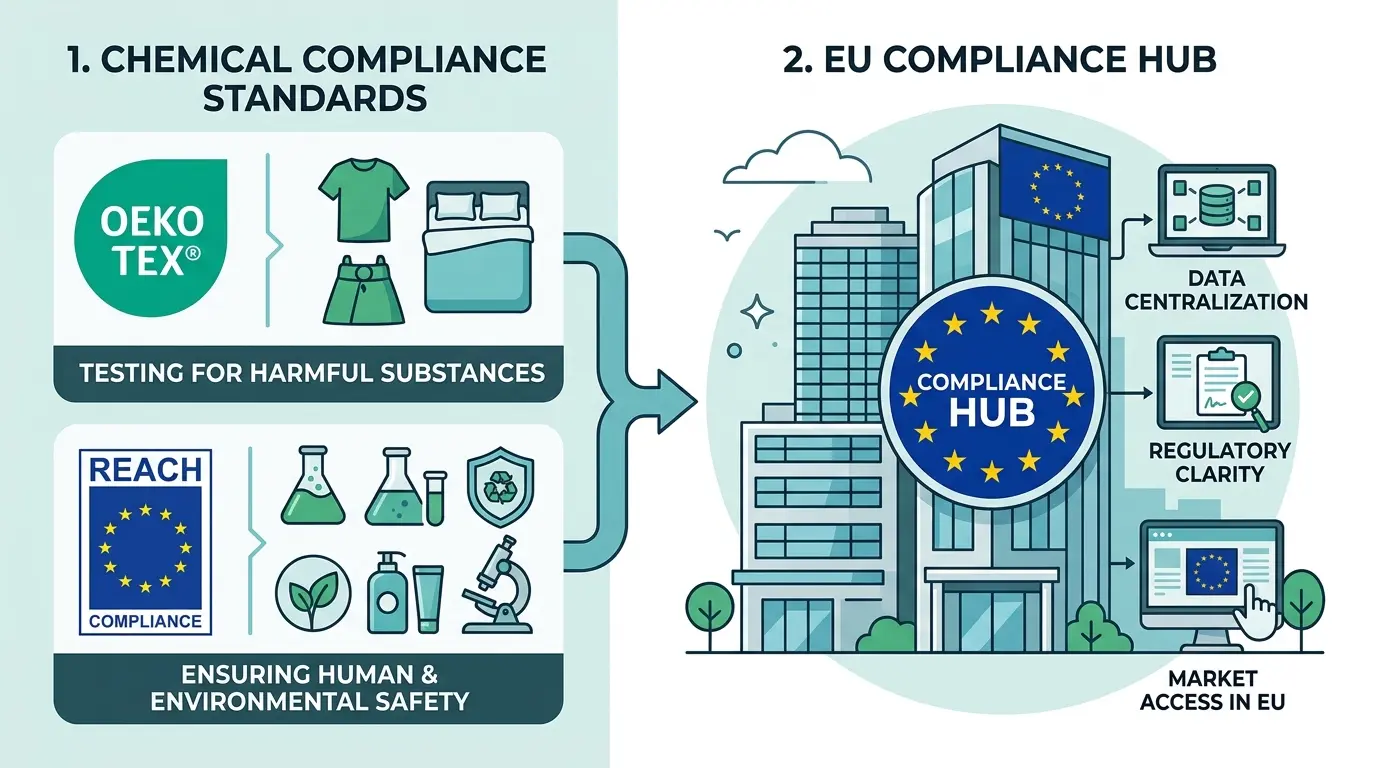
REACH and OEKO-TEX Compliance: A Chemical Safety Guide for Apparel Brands
Of all the EU rules reshaping fashion, chemical compliance is the one that binds you today. REACH is mandatory EU law, enforced by the European Chemicals Agency; OEKO-TEX is the voluntary certification most brands use to prove they meet it, detailed in the OEKO-TEX STANDARD 100 requirements. Both tightened in 2026. This guide explains what each one is, how they differ, what changed this year, and how to make sure the clothing you source is chemically safe and legally sellable in Europe.
Chemical safety is also the most testable area of compliance — it comes down to laboratory results, not paperwork promises. That makes it the clearest example of why compliance is a sourcing decision: the proof lives in your fabric, generated at the factory.
What is REACH, and why does it matter for clothing?
REACH — Registration, Evaluation, Authorisation and Restriction of Chemicals (Regulation (EC) No 1907/2006) — is the EU’s central chemicals law. For apparel, the part that matters most is the restriction list in Annex XVII, which sets legal limits on specific hazardous substances in consumer products, including textiles.
REACH is not optional and not a certification. It is the law. Any garment placed on the EU market must comply, regardless of where it was made. The substances most relevant to clothing include:
- Formaldehyde (Annex XVII Entry 77) — used in wrinkle-resistant and easy-care finishes.
- CMR substances (Entry 72) — carcinogenic, mutagenic, or reprotoxic chemicals restricted in clothing and textiles.
- Azo dyes that can release carcinogenic aromatic amines.
- APEOs / nonylphenol ethoxylates (Entry 46a) — surfactants used in processing.
- SVHCs (Substances of Very High Concern) — a candidate list updated twice a year, so monitoring is continuous rather than one-off.
Because REACH is binding law, non-compliance is not a reputational risk — it is a market-access risk. Non-compliant goods can be refused entry, recalled, and penalised.
What does OEKO-TEX certify?
OEKO-TEX is a voluntary, independent testing and certification system for textiles, established in 1992. Its best-known certification, STANDARD 100, verifies that a textile has been tested for harmful substances across every component — fabric, thread, buttons, prints, and finishes.
STANDARD 100 tests for over 1,000 regulated and unregulated substances, including formaldehyde, heavy metals (lead, cadmium, mercury, arsenic, chromium VI, nickel), carcinogenic aromatic amines from azo dyes, phthalates, flame retardants, allergenic dyes, and pH levels. Limits are set by product class based on skin contact:
- Class I (babies): the strictest limits — for example, formaldehyde effectively undetectable (≤ 20 mg/kg).
- Class II (direct skin contact — underwear, shirts, socks): stricter limits (formaldehyde ≤ 75 mg/kg).
- Class III (no direct skin contact — jackets, outerwear): standard limits (formaldehyde ≤ 300 mg/kg).
- Class IV (furnishings).
A STANDARD 100 certificate is valid for 12 months and renewed annually. Importantly, OEKO-TEX limits are often stricter than the legal minimum — so certification typically demonstrates REACH compliance and then some.
REACH vs OEKO-TEX: what’s the difference?
This is the question that confuses many brands, so here it is plainly.
REACH is the law. OEKO-TEX is the proof.
- REACH is a mandatory legal requirement. You must comply to sell clothing in the EU. It tells you what is prohibited. It does not, by itself, give you a certificate or a logo — it is simply the legal baseline.
- OEKO-TEX is a voluntary certification you choose to obtain. It involves independent laboratory testing and produces a certificate you can show buyers and consumers. It generally sets stricter limits than REACH, so an OEKO-TEX-certified product is comfortably REACH-compliant on the substances they share.
In practice, the two work together. REACH defines the legal floor; OEKO-TEX is the most widely recognised way to demonstrate you are above it, with documentation. A brand that sources OEKO-TEX-certified fabric has both legal compliance and a marketable trust signal in one step.
One nuance worth knowing: OEKO-TEX tests for the substances on its list and confirms they are within limits — but a STANDARD 100 certificate is not the same as a specific “PFAS-free” declaration, even though PFAS are restricted across OEKO-TEX standards. If a market like France requires PFAS-free assurance, you may still need targeted PFAS testing on top of certification.
What changed in 2026?
Both regimes got stricter this year, which is why chemical compliance is back on every sourcing manager’s desk.
REACH — formaldehyde, from 6 August 2026. A new emission limit for formaldehyde of 0.080 mg/m³ under Annex XVII Entry 77 comes into force. This directly affects resin-based finishing and easy-care or wrinkle-resistant treatments, where formaldehyde is a by-product. Brands sourcing treated garments need to confirm their finishing chemistry and processes meet the new limit.
OEKO-TEX — new limit values, from 1 June 2026. After a three-month transition, updated test criteria and limit values took effect for STANDARD 100, ECO PASSPORT, and ORGANIC COTTON. They are mandatory for all new certifications and renewals from that date. The update tightens several substance limits and refines the standard. Practically, if you request STANDARD 100 certification now, the fabric must be managed to these current limits — a certificate issued under older limits does not reflect the 2026 criteria.
The direction is unmistakable: chemical limits in textiles are tightening, not loosening. Sourcing decisions made on outdated assumptions will not hold.
Which chemicals are restricted in clothing?
For brands new to this, the recurring offenders in apparel are worth knowing, because they map directly to specific production stages:
- Formaldehyde — from wrinkle-resistant and easy-care resin finishes.
- Azo dyes releasing aromatic amines — from certain colourants.
- Heavy metals — from dyes, pigments, and metal trims.
- Phthalates — from plastisol prints and PVC coatings.
- APEOs / NPEOs — from washing and processing surfactants.
- PFAS — from water- and stain-repellent finishes (now banned outright in France).
- Chlorinated compounds and chlorophenols — from preservation and processing.
The pattern: most restricted chemicals enter not through the base fibre but through dyeing, printing, and finishing. That is exactly why testing the finished garment — not just the raw fabric — matters, and why your finishing factory’s chemistry is central to compliance.
How chemical compliance connects to the wider rules
Chemical safety is not an island. It links directly into the rest of the EU compliance picture:
- France’s PFAS ban is a chemical restriction enforced at national level — see our guide to France textile regulations.
- The EU green claims rules mean any “non-toxic” or “safe” marketing claim must be substantiated — testing is the substantiation. See EU green claims rules.
- The Digital Product Passport will include a chemical-compliance data field, so your test results become passport data. See our Digital Product Passport guide.
Get chemical testing right, and you are simultaneously feeding three other compliance obligations. It is the same principle running through all of this and the wider EU textile regulations: one set of verified supply-chain data serves many rules at once.
Why chemical compliance is a sourcing and testing decision
You cannot desk-check chemical safety. A garment is either within limits or it is not, and the only way to know is to test it — at the factory, on the finished product. That makes compliance a function of two things: which factory makes your goods, and whether testing is built into the process.
A factory with strong chemical management, certified processes, and a track record of passing tests will produce compliant goods consistently. A factory chosen purely on price, with opaque chemical inputs, is a compliance gamble you take on every order. The difference does not show up until a test fails or a shipment is stopped — by which point it is expensive.
This is why sourcing through certified, tested production is not a premium add-on. It is risk management. And it is exactly what a buying house exists to manage on your behalf.
How to ensure your Bangladesh production is chemically compliant: a checklist
- Source OEKO-TEX-certified fabric and trims. STANDARD 100 certification is the most efficient way to demonstrate compliance across the substances that matter, with documentation you can show buyers.
- Test the finished garment, not just the fabric. Most restricted chemicals enter during dyeing, printing, and finishing — so final-product testing is what protects you.
- Confirm finishing chemistry against the 2026 limits. For treated or easy-care garments, verify formaldehyde and resin chemistry meet the new REACH Entry 77 limit.
- Request PFAS testing for relevant markets. For water-repellent garments going to France or other strict markets, add targeted PFAS testing on top of certification.
- Keep test reports on file as standard. Certificates and lab reports are your evidence for REACH, green claims, and the future DPP — make them a routine deliverable, not a special request.
- Work with a sourcing partner who manages testing. A buying house that arranges certification and testing as part of every order turns chemical compliance from a recurring worry into a default.
Why sourcing from Bangladesh supports chemical compliance
Bangladesh is well equipped for this. OEKO-TEX-certified production is widely available across the country’s factory base, and the major mills and finishing units routinely work to international chemical standards for their global buyers. The country also leads the world in LEED-certified green garment factories, many of which run advanced chemical-management and effluent-treatment systems.
That means the testing and certification infrastructure chemical compliance requires is accessible — the task is to structure your sourcing so it is applied consistently. Whether you produce knitwear, denim (where dyeing and washing chemistry matters most), t-shirts, or private-label ranges, the approach is the same: certified fabric, finished-product testing, and a partner who documents results. Our work on sustainable garment sourcing and verified certifications is built around exactly this.
What getting chemical compliance wrong actually costs
Brands sometimes treat chemical testing as an optional expense until something goes wrong. The downside is worth understanding clearly, because it is rarely just a fine.
A non-compliant shipment can be stopped at the EU border and refused entry — meaning the goods never reach your shelves and the production cost is lost. Products already on the market can be recalled and listed publicly on the EU’s Safety Gate (RAPEX) system, where consumer-product warnings are visible to regulators, retailers, and journalists across Europe. For a fashion brand, a public chemical-safety recall is a reputational event that outlasts any single season. Retail partners may also delist a brand whose goods fail testing, because the retailer carries its own liability for what it sells.
Set against those outcomes, the cost of testing and certified sourcing is small. Chemical compliance is one of the few areas where the insurance is clearly cheaper than the risk.
Common chemical compliance mistakes
A handful of avoidable errors account for most failures:
- Testing the fabric but not the finished garment. Restricted chemicals often enter during printing, dyeing, and finishing — and through trims, prints, and coatings. A compliant base fabric can still produce a non-compliant garment.
- Assuming an old certificate still applies. OEKO-TEX limits changed on 1 June 2026 and REACH formaldehyde limits change on 6 August 2026. A certificate issued under previous limits does not prove current compliance.
- Treating OEKO-TEX as automatic REACH cover for everything. OEKO-TEX is excellent proof, but specific market rules — such as France’s PFAS requirements — can demand additional, targeted testing.
- Relying on supplier assurances without reports. “It’s compliant” is not evidence. A test report is. Enforcement is document-driven, and so should your sourcing be.
- Ignoring the SVHC list updates. The Substances of Very High Concern candidate list changes twice a year. Compliance is a moving target, not a one-time checkbox.
The brands that avoid these mistakes share one habit: they build testing into the order from the start and keep the documentation current, rather than scrambling to prove compliance after a problem appears.
Frequently Asked Questions
What is the difference between REACH and OEKO-TEX?
REACH is mandatory EU chemical law — you must comply to sell clothing in the EU. OEKO-TEX is a voluntary certification that independently tests textiles for harmful substances and proves compliance, usually to stricter limits than REACH requires. In short, REACH is the legal floor and OEKO-TEX is the proof you meet and exceed it.
Is OEKO-TEX certification mandatory?
No. OEKO-TEX is voluntary. However, complying with REACH is mandatory, and OEKO-TEX certification is the most widely recognised way to demonstrate that compliance with documentation, so many buyers require it contractually.
What chemicals does REACH restrict in textiles?
REACH restricts substances including formaldehyde, certain azo dyes that release carcinogenic amines, CMR substances, APEOs, heavy metals, and substances of very high concern (SVHCs), with limits set in Annex XVII. The SVHC list is updated twice a year.
What changed for chemical compliance in 2026?
A new REACH formaldehyde emission limit (0.080 mg/m³, Annex XVII Entry 77) comes into force on 6 August 2026, and updated OEKO-TEX limit values for STANDARD 100, ECO PASSPORT, and ORGANIC COTTON became mandatory from 1 June 2026.
Does OEKO-TEX STANDARD 100 mean a product is PFAS-free?
Not exactly. PFAS are restricted across OEKO-TEX standards, but a STANDARD 100 certificate confirms testing against the listed substances rather than issuing a specific “PFAS-free” declaration. For markets like France that require PFAS-free assurance, targeted PFAS testing may still be needed.
How do I verify my clothing is chemically compliant?
Source OEKO-TEX-certified materials, test the finished garment (not just the fabric) for the restricted substances relevant to your product, confirm finishing chemistry meets current REACH limits, and keep the test reports on file as evidence.
Source chemically compliant apparel with confidence
At Milky Fashions, certification and chemical testing are part of how we source. As an independent, BGBA-registered buying house operating since 2002, we work with OEKO-TEX-certified factories, arrange finished-product testing where markets require it, and keep the documentation European brands need to prove their clothing is chemically safe and legally sellable.
For the full picture, see our complete guide to EU apparel compliance in 2026.
Get in touch with Milky Fashions to source chemically compliant apparel from Bangladesh, explore our full range of garment sourcing services, or read our Bangladesh Supplier Compliance Report 2026 for the full picture.

Director and Head of Merchandising at Milky Fashions, a BGBA-registered garment buying house in Bangladesh since 2002. Specialises in knitwear sourcing, factory compliance, and European buyer relations.