France Textile Regulations in 2026: The PFAS Ban, the Environmental Cost Label and AGEC
France has the most advanced national textile-compliance regime in the European Union — three sets of rules that go beyond general EU law: a PFAS ban (in force since January 2026), the Environmental Cost label (the textile eco-score), and the AGEC circular-economy law. If you sell clothing in France, wherever your brand is based, these apply to you. This guide explains what each rule requires, the deadlines that matter, and what it all means for how you source.
France is where EU sustainability ambition arrives first and hardest. A brand that can meet the French rules is, in practice, ahead of the curve for the rest of Europe. Here is what you need to know — and why it is a sourcing question before it is a labelling one.
Why France is the EU’s strictest textile market
Most EU textile regulation is harmonised across all member states. France goes further, layering its own national rules on top — and it tends to move years ahead of Brussels. France pioneered textile Extended Producer Responsibility, it built the EU’s first operational environmental-labelling scheme for clothing, and it has enacted a PFAS ban tougher and earlier than the EU-wide approach.
For brands, that means France is both a demanding market and a useful proving ground: get France-ready, and you are largely ready for where the rest of the EU is heading. The three pillars below are what you have to clear.
The French PFAS ban: what is prohibited, and from when
PFAS — per- and polyfluoroalkyl substances, the “forever chemicals” — are widely used in textiles for water- and stain-repellent finishes. France has moved to eliminate them from consumer clothing faster than anywhere else in Europe.
The framework is Law No. 2025-188 of 27 February 2025, made enforceable by Decree No. 2025-1376 of December 2025. The key points:
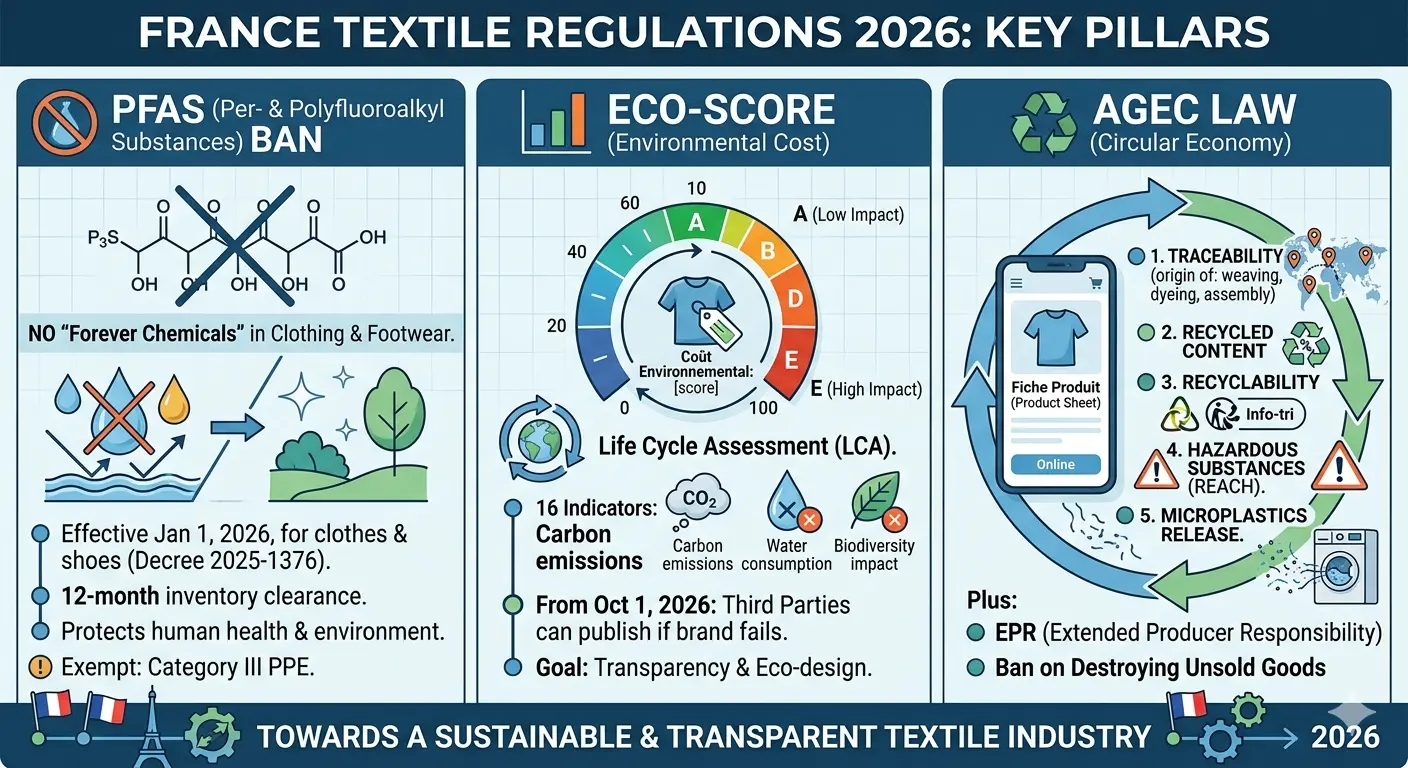
- From 1 January 2026, France prohibits the manufacture, import, export, and sale of apparel textiles, footwear, and waterproofing agents for clothing and footwear that contain PFAS above defined residual thresholds.
- Exemptions apply to personal protective equipment, textiles for national defence, certain technical and industrial textiles where no alternative exists, and products containing at least 20% post-consumer recycled material (where the PFAS is limited to the recycled fraction).
- Sell-through: products manufactured before 1 January 2026 may be sold or exported until 31 December 2026, giving a short window to clear existing stock.
- From 1 January 2030, the ban extends to all textile products, with narrow exemptions for essential uses.
Enforcement runs through existing frameworks — the Environmental Code and customs law — meaning non-compliant goods can be stopped at the border and removed from the market, with penalties.
What this means for sourcing: the main PFAS risk in clothing is water-repellent (DWR) finishes, common on outerwear, technical garments, and some denim treatments. If you sell into France, you need PFAS-free finishes and, crucially, the test reports to prove it. This is where chemical-safety testing — OEKO-TEX and equivalent — becomes a hard requirement, not a nice-to-have. You cannot self-declare a garment PFAS-free; you need verified evidence from production.
The French Environmental Cost label (the textile eco-score)
France is rolling out the EU’s first mandatory-track environmental label for clothing — the Environmental Cost (Coût Environnemental), part of its affichage environnemental scheme. Introduced under the AGEC law and formalised by the 2021 Climate and Resilience Law, it is coordinated with ADEME, the French ecological-transition agency, through the official “Ecobalyse” methodology.
Here is how it works. Each garment is assigned a single score in “environmental points.” The methodology is based on life-cycle assessment and aggregates 16 environmental impact categories (from the EU’s Product Environmental Footprint framework), then adds textile-specific factors such as microfibre release and transport, and applies a durability coefficient. The higher the score, the worse the environmental impact — so a lower number is better. That score is displayed to consumers.
The deadlines that matter:
- The texts governing how the score is calculated and communicated came into force on 1 October 2025, with deployment beginning in autumn 2025.
- The label becomes effectively unavoidable from 1 October 2026. From that date, if a brand has not published the environmental cost of its products, third parties — retailers, NGOs, comparison platforms, even journalists — can calculate and publish the score without the brand’s agreement, using the official methodology and mandatory parameters.
- Separately, the French rules require that if you communicate any other environmental score (for example, a carbon-footprint figure on your e-commerce site), you must also display the official French Environmental Cost.
Critically, the scheme applies to all producers, importers, and distributors who place garments on the French market, whatever their origin — French or not. The scope covers adult and children’s clothing; current exclusions include footwear, accessories, leather goods, second-hand items, B2B protective equipment, and garments with a high proportion of non-textile material.
What this means for sourcing: the eco-score is built on life-cycle data — material composition, fibre origin, production processes, durability. Almost none of that lives in your marketing department; it comes from your supply chain. A brand that cannot get accurate composition and origin data from its suppliers cannot produce a credible score — and risks a third party publishing an unflattering one on its behalf.
The AGEC law: traceability and circular-economy obligations
The Anti-Waste for a Circular Economy law (loi AGEC, 2020) is the foundation the other rules build on. For apparel, its key obligations include:
- Traceability and information duties — brands must disclose certain information about their products, including the country where key manufacturing stages took place and the presence of any hazardous substances or recycled content.
- A ban on destroying unsold goods — unsold textiles must be reused, donated, or recycled rather than destroyed, an obligation that already applies across company sizes.
- Textile Extended Producer Responsibility — France operates a long-established textile EPR scheme, where brands placing clothing on the market contribute to the cost of its end-of-life collection and recycling.
AGEC is, in effect, the data-and-responsibility backbone that makes the eco-score and broader EU rules workable: it requires brands to know and disclose where and how their clothing is made.
What these three rules have in common
Step back and the pattern is unmistakable. The PFAS ban needs chemical test data. The eco-score needs life-cycle and origin data. AGEC needs traceability data. Every one of them ultimately depends on verifiable information that originates at the factory.
This is the same convergence visible across all EU textile law — the Digital Product Passport, the EU green claims rules, and the wider EU textile regulations all pull in the same direction: brands must be able to prove what they claim, with data from their supply chain. France simply gets there first and most strictly.
Why French compliance is a sourcing decision
A brand cannot solve the French rules from its head office. You cannot certify a garment is PFAS-free without testing it. You cannot calculate an honest eco-score without composition and origin data. You cannot meet AGEC traceability duties without knowing where your fabric was made. Every requirement traces back to what your suppliers can verify and document.
That makes France-readiness a question of how you source, not how you market. Brands sourcing through certified, document-ready factories will have the test reports and traceability the French rules demand. Brands sourcing on price alone from opaque suppliers will find themselves unable to certify, label, or defend their products in the French market — and France enforces.
How to get your Bangladesh production France-ready: a checklist
The work is practical and can start now.
- Specify PFAS-free finishes and test them. For any water-repellent or treated garment bound for France, require PFAS-free alternatives and obtain chemical test reports confirming compliance. Build this into the order, not the post-mortem.
- Lock in chemical-safety certification. Prioritise OEKO-TEX-certified production, which directly addresses the chemical-testing burden the PFAS ban creates.
- Capture life-cycle and origin data. Make verified material composition, fibre origin, and production-stage information a standard deliverable from every supplier — the raw material for an accurate eco-score and AGEC disclosure.
- Build traceability one tier deeper. Know not just where garments are assembled but where the fabric and fibre come from.
- Favour certified, traceable factories. GOTS, GRS, OEKO-TEX, BSCI, WRAP, and SEDEX certification generates much of the data and assurance the French rules require.
- Work with a sourcing partner who documents as standard. The fastest route to France-readiness is a buying house that confirms certification, arranges testing, and assembles documentation as part of every order.
Why sourcing from Bangladesh fits France’s requirements
Bangladesh is well placed for the French market. The country has the largest base of LEED-certified green garment factories in the world, and certified, tested production across OEKO-TEX, GOTS, GRS, and the major social standards is widely available — exactly the evidence base the PFAS ban and eco-score demand. OEKO-TEX testing in particular maps directly onto the chemical-safety proof France now requires.
The task is to structure your sourcing so that this data and these test reports reach you consistently, on every order. Whether you produce knitwear, denim, t-shirts, or private-label ranges, the principle holds: source through certified factories with a partner who tests and documents as standard, and French compliance becomes part of your process rather than a barrier to the market. This pairs directly with our work helping brands with apparel sourcing from Bangladesh for the French market, and our approach to sustainable garment sourcing and verified certifications.
France as the bellwether: why France-readiness future-proofs your EU sourcing
There is a strategic reason to treat France as a priority rather than a burden. France consistently legislates ahead of the rest of the EU, and Brussels often follows where Paris leads. France had textile EPR years before EU-wide schemes; it built the first operational clothing eco-score; its PFAS ban is tougher and earlier than the EU’s chemical-restriction timeline.
That means a brand that gets its sourcing France-ready is, in effect, building the data and testing infrastructure the whole EU is moving toward. The PFAS test reports you secure for France help you meet tightening EU chemical rules. The life-cycle and origin data you gather for the eco-score is the same data the Digital Product Passport will require across Europe. The traceability you build for AGEC supports EU due-diligence expectations. Solve France once, properly, and you are ahead of the curve everywhere else.
Treating France as a leading indicator rather than a one-off market turns a compliance cost into a strategic head start.
Common mistakes brands make with French compliance
A few avoidable errors trip brands up:
- Assuming “made outside France” means exempt. All three rules apply based on placing goods on the French market, not on where the brand or factory sits. Manufacturing in Asia does not remove the obligation.
- Treating the PFAS ban as a fabric issue only. PFAS often enters through finishes and treatments — water-repellent coatings especially — not just base fabric. You have to check the whole garment, including trims and treatments.
- Ignoring the eco-score until it’s “mandatory.” Because third parties can publish your score from October 2026 without your consent, staying silent does not protect you — it just means someone else controls your number. Getting your own accurate data ready is the only real defence.
- Self-declaring instead of testing. French enforcement is document-driven. A claim of compliance without test reports and verified data is exposure, not protection.
- Leaving it to the marketing or legal team. Every French requirement depends on supply-chain data. If sourcing is not involved early, the data simply will not exist when it is needed.
The brands that avoid these mistakes share one habit: they treat French compliance as something built into sourcing from the first order, not bolted on before a launch.
Frequently Asked Questions
Is PFAS banned in clothing in France?
Yes. Since 1 January 2026, under Law No. 2025-188, France prohibits the manufacture, import, export, and sale of apparel textiles, footwear, and waterproofing agents containing PFAS above defined thresholds, with limited exemptions. The ban extends to all textile products from 1 January 2030.
What is the French Environmental Cost label?
It is France’s textile eco-score (Coût Environnemental) — a single environmental-impact score, based on life-cycle assessment across 16 indicators plus textile-specific factors, displayed to consumers. A higher score means greater environmental impact.
When does the French eco-score become mandatory?
The calculation and communication rules came into force on 1 October 2025. From 1 October 2026, if a brand has not published its products’ environmental cost, third parties may calculate and publish it without the brand’s agreement. Brands communicating any other environmental score must also display the official French one.
Does French textile regulation apply to brands outside France?
Yes. The PFAS ban, the Environmental Cost label, and AGEC obligations apply to all producers, importers, and distributors placing clothing on the French market, regardless of where the brand is based.
What is the AGEC law?
The AGEC law (2020) is France’s anti-waste, circular-economy law. For apparel it requires product traceability and information disclosure, bans the destruction of unsold goods, and operates a textile Extended Producer Responsibility scheme.
How do I make my clothing PFAS-free for the French market?
Specify PFAS-free finishes with your manufacturer, prioritise OEKO-TEX-certified production, and obtain chemical test reports verifying compliance before goods are placed on the French market. Self-declaration without testing is not sufficient.
Source for France with the evidence built in
At Milky Fashions, chemical testing, certification, and documentation are part of how we source — which is exactly what the French market now demands. As an independent, BGBA-registered buying house operating since 2002, we work only with certified factories, arrange the testing and verification European markets require, and assemble the supply-chain data brands need to sell into France with confidence.
Get in touch with Milky Fashions to build France-ready sourcing from Bangladesh, explore our full range of garment sourcing services, or read our Bangladesh Supplier Compliance Report 2026 for the full picture.

Director and Head of Merchandising at Milky Fashions, a BGBA-registered garment buying house in Bangladesh since 2002. Specialises in knitwear sourcing, factory compliance, and European buyer relations.