The Digital Product Passport for Apparel: A Readiness Guide for Brands Sourcing Abroad
The Digital Product Passport (DPP) is a digital record — accessed through a QR code — that holds a garment’s materials, origin, durability, and environmental data. Under the EU’s Ecodesign for Sustainable Products Regulation (ESPR), it becomes mandatory for textiles around 2027–2028. For apparel brands, readiness comes down to one thing: the data your suppliers can give you. This guide explains what the DPP is, when it applies, what data it requires, and how to get your sourcing ready now — before the deadline arrives.
If you sell clothing into the EU, the DPP is the single biggest structural change coming to how your products carry information. The brands preparing now will move into compliance smoothly; the ones who wait will scramble. Here is what you need to know.
What is the Digital Product Passport?
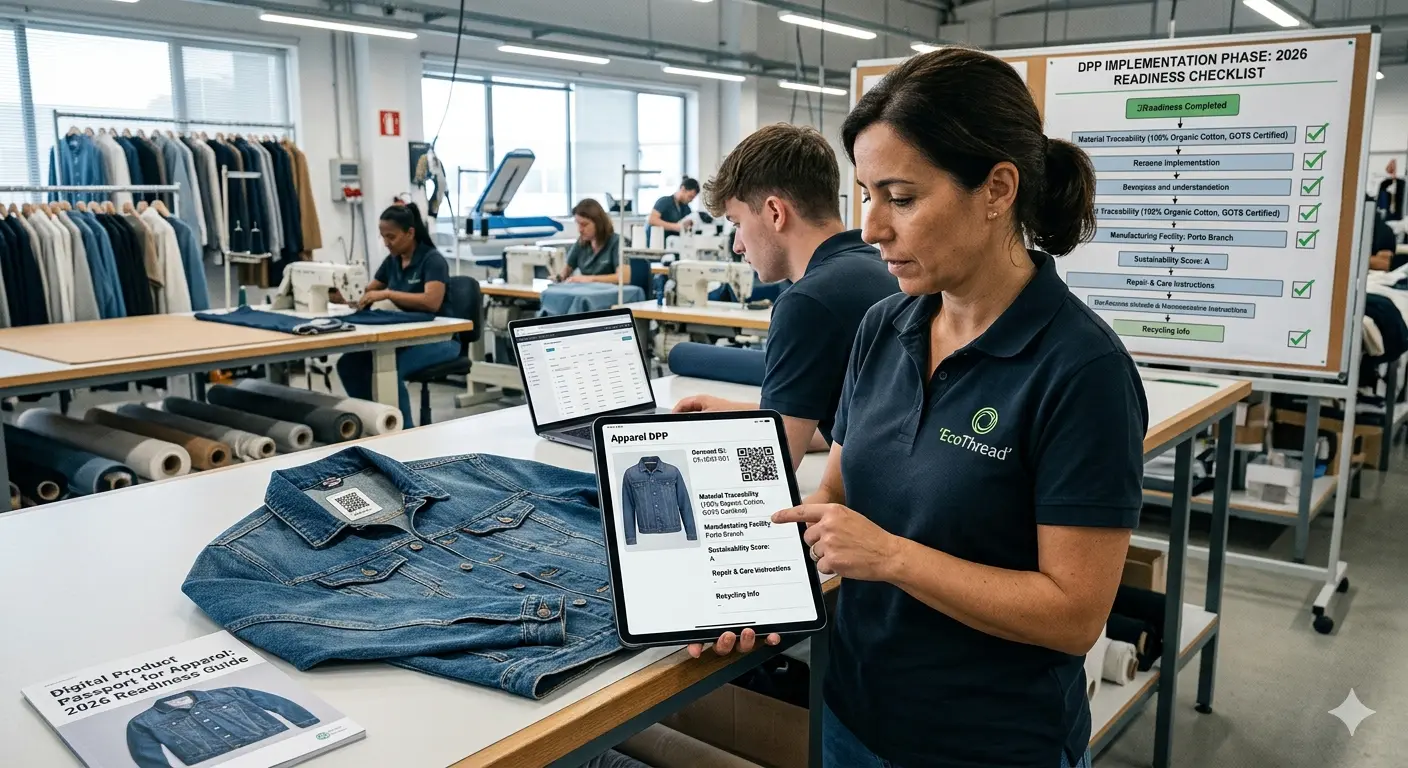
The Digital Product Passport is a structured digital record attached to a physical product, accessed through a data carrier such as a QR code. Scan the code, and you reach a verified set of information about that item: what it is made of, where and how it was produced, how long it should last, whether it can be repaired or recycled, and its environmental footprint.
Think of it as a “digital fingerprint” for every garment. Today, most of that information either does not exist in a structured form or lives in scattered spreadsheets across a supply chain. The DPP forces it into one accessible, verifiable place — for consumers, regulators, and recyclers alike.
The DPP is created under the Ecodesign for Sustainable Products Regulation (ESPR) — Regulation (EU) 2024/1781 — which entered into force in July 2024. ESPR is a framework regulation: it sets the legal structure, but the specific rules for each product type come later through separate “delegated acts.” Textiles and apparel are named as a priority category.
When does the Digital Product Passport apply to textiles?
This is the question most brands ask first, so here is the precise picture as it stands.
ESPR is already law, but the DPP does not switch on for all products at once. It rolls out category by category. The governing document is the ESPR Working Plan 2025–2030, adopted in April 2025, which sets the sequence. The battery passport, arriving in early 2027, is the first mandatory DPP and acts as the proof of concept for the whole system.
For textiles and apparel, the timeline is roughly:
- 2025–2026: preparatory studies, stakeholder consultation, and infrastructure build (technical standards, an EU registry, and data-carrier standards).
- Around 2027: the textiles delegated act — the document that defines exactly what data a clothing DPP must contain — is expected to be adopted.
- 2028–2029: mandatory compliance for textiles, realistically beginning 12–18 months after the delegated act is finalised.
In short: the rules are not fully written yet, and the mandatory date is a couple of years out — but the infrastructure is being built now, and the brands structuring their supplier data today are the ones who will be ready when the clock starts. This is not a “deal with it later” situation, because the readiness work takes time and sits with your suppliers, not your office.
Does the Digital Product Passport apply to brands outside the EU and to small brands?
Yes, on both counts, with one nuance.
The DPP is expected to apply to any apparel sold on the EU market, regardless of where the brand is based. A brand in the UK, the US, or anywhere else selling clothing into the EU is in scope. Manufacturing location does not exempt you; market access is the trigger.
On size: ESPR includes provisions for extended transition periods for smaller companies under Article 19, so micro and small businesses are likely to get more time for some obligations — but not a permanent exemption. The direction of travel is clear: the EU has already applied its ban on destroying unsold textiles to companies of all sizes on the same timeline, which signals how it intends to frame DPP obligations too. Smaller brands should plan for the DPP, not assume they are outside it.
One detail still being confirmed is the exact threshold of textile content that triggers inclusion for a given product — so the fine print will sharpen as the delegated act is finalised.
What data will a textile Digital Product Passport require?
The delegated act will set the final list, but based on the ESPR framework and the work underway, a clothing DPP is expected to carry information across these categories:
- Material composition — the fibres and materials in the product, and in what proportion.
- Origin and traceability — where key production stages took place and, increasingly, who the suppliers were.
- Durability and repairability — how long the product is designed to last and whether it can be repaired.
- Recyclability and end-of-life — what can be recovered or recycled at the end of use.
- Environmental footprint — impact data across the product’s life cycle.
- Chemical compliance — confirmation that the product meets chemical-safety requirements.
- Recycled content — verified proportions of recycled material, where claimed.
Look closely at that list and a pattern jumps out: almost none of it can be generated by your design or marketing team. Composition, origin, chemical safety, recycled content — these are facts about how and where the garment was made. They come from your supply chain.
Why the DPP is a sourcing problem, not an IT problem
Most brands first hear about the DPP and assume it is a technology project — build a QR system, plug in a database, done. That misses the real challenge. The hard part is not the QR code. It is the data behind it — and that data is only as good as what your suppliers can verify.
You cannot declare a fibre’s origin you cannot trace. You cannot confirm recycled content without GRS verification. You cannot assert chemical safety without OEKO-TEX testing. You cannot vouch for organic cotton without GOTS certification flowing through the chain. Every field in a DPP that matters traces back to a certificate or a verified record held at the factory.
This is why the DPP, like the EU green claims rules, is fundamentally a sourcing decision. The brands that will populate a DPP easily are the ones already sourcing through certified, document-ready factories. The brands that source on price alone from undocumented suppliers will find, when the deadline arrives, that they simply do not have the information the law requires — and gathering it retroactively across an opaque supply chain is slow, expensive, and sometimes impossible.
How the DPP connects to the wider EU compliance picture
The DPP does not stand alone. It is the data backbone that several EU rules increasingly depend on, and they all converge on the same supply-chain information:
- The Green Claims rules (ECGT) require you to substantiate environmental claims — and the DPP is the infrastructure that makes substantiation verifiable.
- Textile Extended Producer Responsibility (EPR) is moving toward “eco-modulation,” where the fees you pay are linked to product sustainability data — the same data the DPP holds.
- Corporate due-diligence rules push brands to know and verify conditions across their supply chains.
- National rules such as France’s environmental-cost labelling layer further data demands on top.
Build your supplier data once, properly, and you are preparing for all of them at the same time. You can see how these fit together in our overview of EU textile regulations.
How to get your sourcing DPP-ready: a step-by-step checklist
You do not need to wait for the final delegated act to start. The readiness work is the same regardless of the precise wording, because it is about knowing and documenting your supply chain. Here is where to begin.
1. Map your current supplier data. For your core products, list what you can already verify — composition, origin, certifications, chemical testing — and where the gaps are. The gaps are your roadmap.
2. Make documentation a standard order requirement. Stop treating certificates and test reports as something you request when a customer asks. Build them into every order as a default deliverable from your supplier.
3. Prioritise certified, traceable factories. Production through factories certified to GOTS, GRS, OEKO-TEX, BSCI, WRAP, and SEDEX already generates much of the data a DPP will need. The more certified your sourcing, the smaller your readiness gap.
4. Establish traceability one tier deeper. The DPP will increasingly ask not just “where was it sewn” but “where did the fabric and fibre come from.” Start building visibility into your fabric and trim sources now.
5. Treat readiness as a competitive edge, not a cost. Brands that can produce clean, verified product data will win shelf space and retail partnerships as the deadline approaches. Those that cannot will lose it. Early movers are already in pilot phase with smooth supplier data flows.
6. Work with a sourcing partner who builds the data in. The single biggest accelerator is a buying house that confirms certification and assembles documentation as part of the process — so your DPP data is being created with every order, not reconstructed under deadline pressure.
Why sourcing from Bangladesh is well positioned for the DPP
There is good news for brands sourcing from Bangladesh. The country has invested heavily in exactly the kind of certified, documented production the DPP rewards. Bangladesh hosts more LEED-certified green garment factories than any country in the world, and certified production across GOTS, GRS, OEKO-TEX, and the major social standards is widely available.
That means the raw material for DPP readiness — verifiable certification and testing — is accessible. The task is to make sure your sourcing is structured to capture and pass that data through to you, consistently, on every order. Whether you produce knitwear, denim, t-shirts, or private-label ranges, the same principle applies: source through certified factories with a partner who documents as standard, and the DPP becomes a process you are already running rather than a wall you hit in 2028. Our approach to sustainable garment sourcing and verified certifications is built around exactly this.
Common misconceptions about the Digital Product Passport
A few myths are circulating that lead brands to underprepare. Worth correcting each.
“It’s years away, so I can wait.” The mandatory date is around 2028, but the readiness work — getting verified data flowing from your suppliers — takes months to set up and sits outside your control. The brands that wait will be trying to build supply-chain traceability under deadline pressure, which is the worst time to do it. The infrastructure phase is now; the preparation window is now.
“It only affects big brands.” The DPP applies based on selling into the EU market, not company size. Smaller brands may get longer transition periods, but the obligation is coming for them too. Treating it as a “big brand problem” is how small brands get caught out.
“It’s a software project.” The QR code and database are the easy 10%. The hard 90% is the verified data — composition, origin, chemical safety, recycled content — and that comes from your factories, not your IT team. A brand with perfect software and no supplier data has nothing to put in the passport.
“I can add the data later.” Retroactively tracing a fibre’s origin or proving recycled content for products already made, through suppliers who never documented it, ranges from expensive to impossible. The data has to be captured at the point of production. That is why sourcing structure matters more than any tool.
“Certifications and the DPP are separate things.” They are deeply linked. Your existing GOTS, GRS, and OEKO-TEX certificates already contain much of what a DPP will require. A well-certified supply chain is not just compliant today — it is most of the way to DPP-ready for tomorrow.
The throughline behind every one of these: the Digital Product Passport rewards brands that already know and document their supply chain, and exposes those that do not. That makes it, above all, a reason to get your sourcing foundations right now.
The transparency the DPP enables directly supports the supplier due diligence required under the EU CSDDD — here’s how the two connect for apparel buyers.
Frequently Asked Questions
What is the Digital Product Passport for clothing?
The Digital Product Passport is a digital record, accessed via a QR code or similar data carrier, that holds verified information about a garment — its materials, origin, durability, recyclability, environmental footprint, and chemical compliance. It is introduced under the EU’s Ecodesign for Sustainable Products Regulation (ESPR).
When will the Digital Product Passport be mandatory for textiles?
The textiles delegated act defining the requirements is expected around 2027, with mandatory compliance realistically following 12–18 months later — so roughly 2028–2029. The supporting infrastructure is being built through 2026.
Does the Digital Product Passport apply to non-EU brands?
Yes. The DPP applies to apparel sold on the EU market regardless of where the brand is based. If you sell clothing into the EU, you are in scope, even if you manufacture elsewhere.
Does the DPP apply to small fashion brands?
Smaller companies are likely to receive extended transition periods under ESPR, but not a permanent exemption. Small brands should plan for the DPP rather than assume they are outside it.
What data does a textile Digital Product Passport need?
Expected data includes material composition, origin and traceability, durability and repairability, recyclability and end-of-life information, environmental footprint, chemical compliance, and verified recycled content — most of which must come from the supply chain.
How do I prepare my supply chain for the DPP?
Map your current supplier data, make certificates and test reports a standard part of every order, prioritise certified and traceable factories, build visibility into your fabric and fibre sources, and work with a sourcing partner that documents compliance as standard.
Get DPP-ready from the supply side
At Milky Fashions, certification and documentation are built into how we source — which is exactly what Digital Product Passport readiness requires. As an independent, BGBA-registered buying house operating since 2002, we work only with certified factories, verify their certifications before every order, and assemble the supply-chain data European brands will need to populate a DPP with confidence.
Get in touch with Milky Fashions to build DPP-ready sourcing from Bangladesh, explore our full range of garment sourcing services, or read our Bangladesh Supplier Compliance Report 2026 for the full picture.

Director and Head of Merchandising at Milky Fashions, a BGBA-registered garment buying house in Bangladesh since 2002. Specialises in knitwear sourcing, factory compliance, and European buyer relations.