The EU Green Claims Rules in 2026: What Apparel Brands Selling in Europe Can and Can’t Say
From 27 September 2026, the EU bans vague environmental claims and offset-based “climate neutral” labels on products sold in Europe. For apparel brands, this turns sustainability marketing into a supply-chain evidence problem: if your factory cannot substantiate a claim, you can no longer legally make it. Here is what is changing, what you can and cannot say, and what it means for how you source.
This is one of the most misunderstood areas of EU regulation right now — partly because two different rules share similar names. Let’s clear that up first, because getting it wrong is exactly what creates risk.
What is actually changing on 27 September 2026?
The binding rule is the Empowering Consumers for the Green Transition Directive (ECGT) — formally Directive (EU) 2024/825, sometimes called EmpCo. It is already law. It entered into force in March 2024, EU member states transpose it into national law by 27 March 2026, and it becomes enforceable across all 27 member states from 27 September 2026.
The ECGT amends existing EU consumer-protection law (the Unfair Commercial Practices Directive and the Consumer Rights Directive) to outlaw specific greenwashing practices. In plain terms: from late September 2026, you cannot tell a European consumer a product is “green” unless you can prove it.
Is the “Green Claims Directive” still happening?
This is where most brands get confused, so here is the precise answer.
There were two separate instruments. The one people call the “Green Claims Directive” was a 2023 proposal that would have required businesses to substantiate and have explicit environmental claims independently verified before using them. That proposal was paused and effectively withdrawn in 2025, after political support collapsed over concerns about cost and scope.
But — and this is the part that matters — the withdrawal of that proposal does not reduce your risk. The ECGT Directive is a different, already-adopted law, and it is completely unaffected. If anything, the landscape is now harder to navigate, because brands face binding prohibitions without the harmonised, EU-wide guidance the withdrawn directive would have provided. National courts and regulators are not waiting: Germany’s Federal Court of Justice has already ruled that an unqualified “climate neutral” claim is misleading.
So if you have read that “the Green Claims Directive was withdrawn, so I’m fine” — that is a dangerous misreading. The rules that bite your product labels and marketing are live and dated.
What apparel brands can no longer say
The ECGT targets four categories of claim. For fashion brands, these are the everyday phrases that become liabilities:
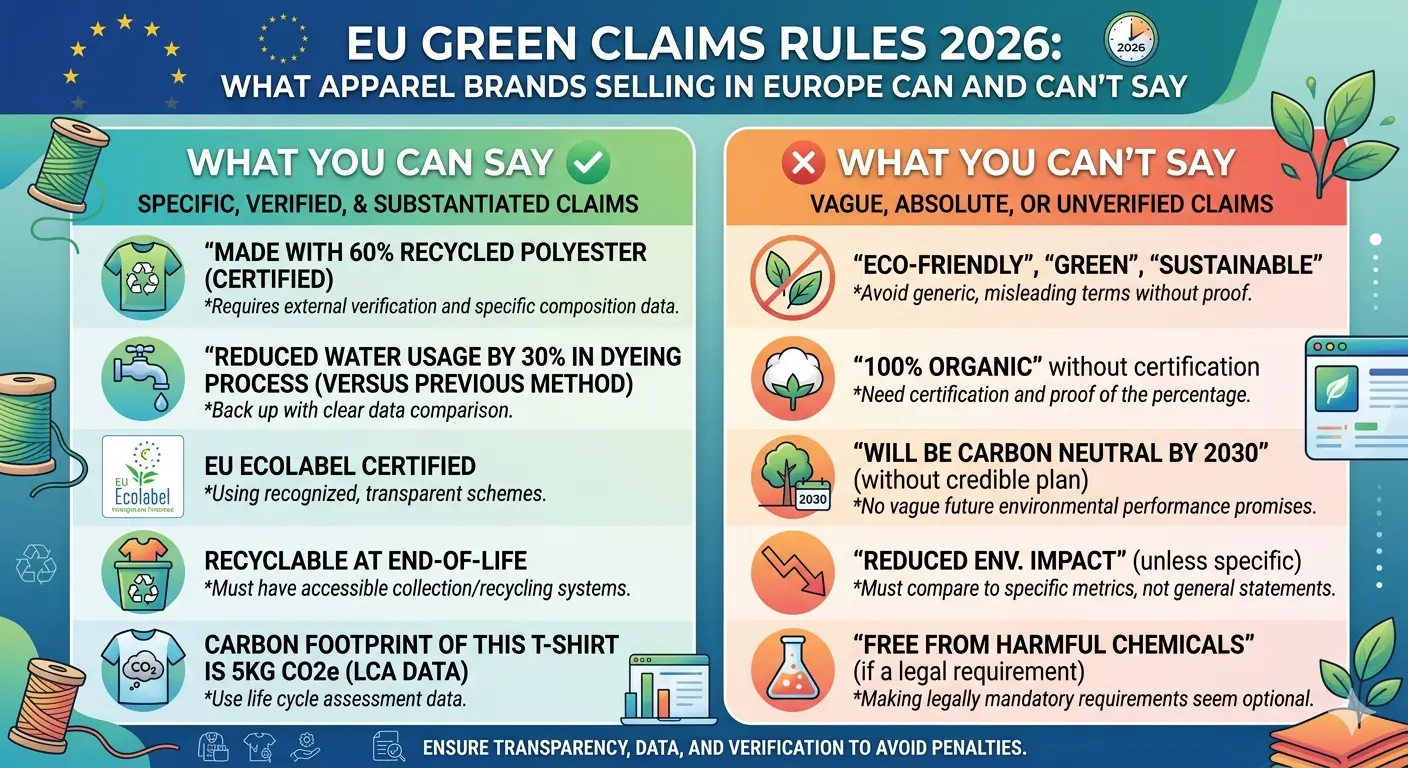
- Generic environmental claims with no proof. Words like “eco-friendly,” “sustainable,” “green,” “conscious,” “responsible,” or “natural” — used on their own, without a recognised certification or verifiable evidence — are banned.
- Offset-based neutrality claims. Labelling a garment “climate neutral,” “carbon neutral,” or “CO2 neutral” because you bought carbon credits, rather than actually reducing emissions in your value chain, is blacklisted outright.
- Sustainability labels not backed by certification. Self-invented “eco” badges and logos that are not grounded in an independent, recognised certification scheme are prohibited.
- Selective or misleading framing. Presenting a single attribute (for example, recycled buttons) as if the whole product is sustainable.
The common thread: vague is out, verifiable is in. A claim survives only if it is specific and backed by evidence.
Compliant vs non-compliant: real examples
The difference between a banned claim and a safe one usually comes down to one thing — specificity backed by proof. A few apparel examples:
- ❌ “Sustainable hoodie” → ✅ “Hoodie made with GOTS-certified organic cotton” (specific + certified)
- ❌ “Eco-friendly t-shirt” → ✅ “T-shirt made from 60% GRS-certified recycled polyester” (specific + verifiable)
- ❌ “Climate-neutral denim” (via offsets) → ✅ “Denim produced in a factory running on 30% renewable energy” (actual reduction, stated plainly)
- ❌ “Green knitwear” → ✅ “Knitwear tested to OEKO-TEX Standard 100 for harmful substances” (specific claim, recognised standard)
- ❌ “Responsibly made” (no evidence) → ✅ “Made in a BSCI-audited factory” (named, auditable)
The pattern is clear: a vague adjective is a liability; a specific, certified, evidence-backed statement is an asset. Notice that every compliant version depends on something only your supply chain can give you — which is exactly why this is a sourcing issue. The same applies across every category, from t-shirts and knitwear to hoodies and denim.
The penalties are serious
This is not a soft guideline. Under the ECGT framework, non-compliance can expose a brand to fines of up to 4% of annual turnover, confiscation of revenues earned from non-compliant claims, and exclusion from public procurement for up to twelve months. For a fashion brand, the reputational damage of a public greenwashing ruling often costs more than the fine itself.
Why this is a sourcing problem, not a marketing problem
Here is the shift most brands underestimate. You cannot fix this with a copywriter. A green claim is only as strong as the evidence behind it — and that evidence lives in your supply chain, at the factory.
If you want to say a t-shirt is made from organic cotton, you need GOTS certification tracing that fibre through the chain. If you want to claim recycled content, you need GRS verification. If you want to reassure customers on chemical safety, you need OEKO-TEX testing on the finished product. None of that comes from your marketing team — it comes from your supplier, in the form of certificates and documentation.
In other words, the ECGT quietly moves the burden of proof from your brand’s website back to the factory floor. The brands that can substantiate their claims will be the ones whose suppliers hand them the paperwork without being chased. The brands that cannot will have to go quiet on sustainability altogether — a real competitive loss in a market where European consumers increasingly expect it.
What brands sourcing from Bangladesh should do now
The good news for brands sourcing from Bangladesh is that the certified factory base is well suited to this. Bangladesh hosts more LEED-certified green garment factories than any country in the world, and certified production is widely available. The task is to make sure your sourcing is set up to deliver the evidence. Practically:
- Audit your current claims. List every environmental word and label you use, and ask of each: can I prove this with a certificate or verifiable data? If not, it has to change before September 2026.
- Demand documentation from your supply chain. Make certification and test reports a standard part of every order — not an afterthought you request when a regulator or customer asks.
- Favour certified factories. Prioritise production through factories certified to GOTS, GRS, OEKO-TEX, BSCI, WRAP, and SEDEX, and verify certification before the order, not after.
- Build the data trail now. The same certified, traceable data the ECGT relies on is also what the incoming Digital Product Passport will require. Building it once serves both.
- Work with a partner who supplies the evidence. A buying house that confirms certification and assembles the documentation as part of the process turns compliance from a scramble into a default.
How this fits the bigger EU compliance picture
The ECGT does not sit alone. It converges with the EU’s wider textile and supply-chain rules — the Digital Product Passport under ESPR, corporate due-diligence requirements, and national rules such as France’s environmental-cost labelling. Every one of them ultimately depends on the same thing: verifiable data flowing up from your factories. A brand that gets its sustainable sourcing and certification foundations right is, in effect, getting ready for all of them at once.
That is the heart of it. Greenwashing rules are not really about what you say — they are about what your supply chain can prove. And that is a sourcing decision long before it is a marketing one.
Credible green claims rest on real supply-chain evidence — the same due-diligence groundwork required by the CSDDD for Bangladesh sourcing.
Frequently Asked Questions
Is “eco-friendly” banned in the EU?
From 27 September 2026, using generic terms like “eco-friendly,” “green,” or “sustainable” on their own — without a recognised certification or verifiable evidence — is prohibited under the ECGT Directive (EU) 2024/825 for products sold in the EU. Specific, substantiated claims are still allowed.
Does this apply to brands based outside the EU?
Yes. The rules apply to products placed on the EU market regardless of where the brand is based. If you sell into the EU, you are in scope.
Was the EU Green Claims Directive withdrawn?
The separate Green Claims Directive proposal, which would have required pre-market verification of claims, was paused and effectively withdrawn in 2025. However, the ECGT Directive — which bans generic and offset-based claims — is already law and takes effect on 27 September 2026, unaffected by that withdrawal.
What evidence do I need to call a garment sustainable?
You need verifiable proof tied to a recognised standard — for example, GOTS for organic fibres, GRS for recycled content, and OEKO-TEX for chemical safety — supplied as certificates and test reports from your supply chain. A claim without that documentation is no longer permitted.
What are the penalties for non-compliance?
Penalties under the ECGT framework can reach up to 4% of annual turnover, alongside confiscation of revenues from non-compliant claims and exclusion from public procurement for up to twelve months.
Source with the evidence built in
At Milky Fashions, certification and compliance documentation are part of how we source — not an afterthought. As an independent, BGBA-registered buying house operating since 2002, we work exclusively with certified factories, verify their certifications before every order, and assemble the documentation European brands need to substantiate their claims with confidence.
Get in touch with Milky Fashions to source apparel from Bangladesh with the compliance evidence built in — explore our full range of garment sourcing services, or read our Bangladesh Supplier Compliance Report 2026 for the full picture.

Director and Head of Merchandising at Milky Fashions, a BGBA-registered garment buying house in Bangladesh since 2002. Specialises in knitwear sourcing, factory compliance, and European buyer relations.