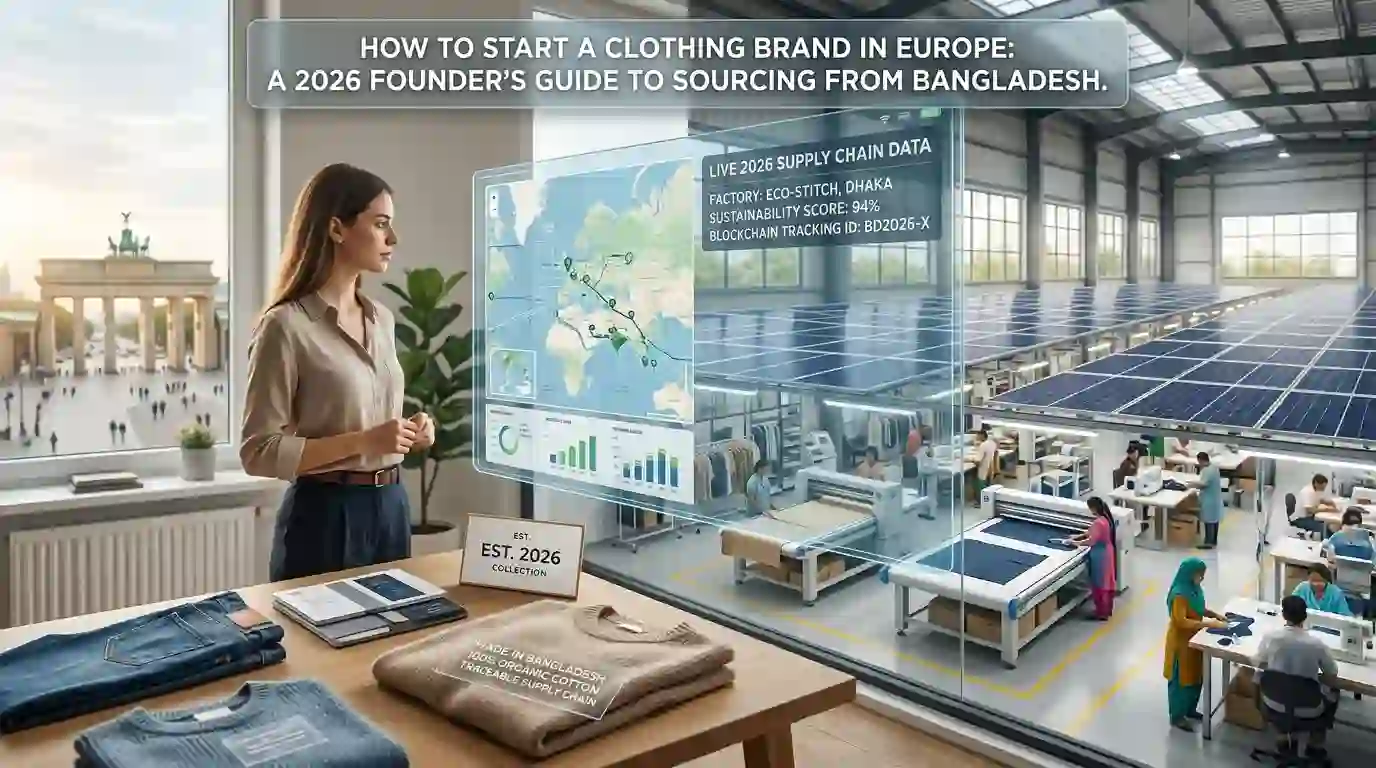
How to Start a Clothing Brand in Europe: A 2026 Founder’s Guide to Sourcing from Bangladesh
Starting a clothing brand in Europe has never been more achievable — or more competitive. Lower barriers to entry, print-on-demand tools, and social commerce mean anyone can launch. But building a brand that actually holds margin, meets EU regulations, and scales past the first drop is a different challenge entirely. The difference between a hobby and a business almost always comes down to one thing: how well you handle manufacturing.
This guide walks European founders — in Germany, France, Spain, the Netherlands, Denmark, the UK, and beyond — through the entire journey of starting a clothing brand in 2026, from concept to your first shipment landing in the EU. It focuses on the decisions that actually determine whether your brand survives: product development, choosing where to manufacture, understanding minimum order quantities, meeting the EU’s tightening compliance rules, and getting your costing right. And it explains why so many European brands, from first-time founders to established retailers, source their production from Bangladesh.
Milky Fashions has helped European brands source apparel from Bangladesh since 2002. We wrote this guide as the resource we wish new founders had before their first order — the one that saves you a wasted season and a five-figure mistake.
For fast costing and sampling support please read our blog for more information.
Is Starting a Clothing Brand Still Worth It in 2026?
Yes — but only with realistic expectations. The European apparel market remains enormous, and consumers increasingly favour smaller, values-driven brands over fast-fashion giants. There is genuine room for new labels that offer a clear point of view, better quality, or a stronger sustainability story.
What has changed is the bar for professionalism. EU regulations now hold brands legally responsible for their supply chains, consumers expect transparency, and marketplaces demand compliance documentation. The founders who succeed treat their brand as a real business from day one — with proper tech packs, verified manufacturing, and compliant sourcing — rather than improvising. This guide is built around doing it properly, because doing it properly is now the only way it works.
Step 1: Define Your Brand and Product Concept
Before you speak to a single factory, you need clarity on three things: what you are making, who it is for, and what makes it different. A clothing brand is not a logo on a blank t-shirt — that is a reseller, and it competes only on price. A brand has a defined product, a target customer, and a reason to exist.
Start narrow. Pick one or two hero products you can execute exceptionally well — a heavyweight organic tee, a specific hoodie, a particular fit of trouser — rather than launching a sprawling range you cannot fund or manage. Define your fabric, your fit, your quality level, and your price point. Decide where you sit: premium, mid-market, or value. Every manufacturing decision that follows flows from this concept, so the sharper it is, the smoother everything downstream becomes.
Step 2: Turn Your Idea Into a Tech Pack
A tech pack is the single most important document you will create, and the one most first-time founders skip — to their cost. It is the technical blueprint that tells a factory exactly how to make your garment: flat sketches, measurements and grading, fabric composition and weight (GSM), trims, stitching details, labels, and packaging. Without one, you cannot get accurate quotes, and your samples will come back wrong.
You do not need to be a technical designer to produce one. A good buying house or sourcing partner can develop a tech pack from your sketches, reference garments, or even a clear description. But the more precise your specification, the more accurate your pricing and the fewer sampling rounds you will pay for. Our guide on what a tech pack is and why factories need it breaks down exactly what to include.
Step 3: Choose Where to Manufacture — Why European Founders Choose Bangladesh
You have three broad options: manufacture within Europe, source from nearby (Turkey, Portugal, Eastern Europe), or source from Asia. Each has trade-offs in cost, minimums, lead time, and capability.
For most European founders building a scalable brand, Bangladesh has become the strategic choice — and the reasons are concrete. It is the world’s second-largest apparel exporter, with deep expertise in knitwear, wovens, and denim. It offers duty-free access to the EU market under the Everything But Arms (EBA) scheme, and to the UK under the Developing Countries Trading Scheme (DCTS), which removes tariffs that would otherwise eat 10–12% of your landed cost. Its production costs are significantly lower than Europe or Turkey. And crucially for 2026, it has one of the world’s largest concentrations of certified, compliance-audited factories — including the highest number of LEED-certified green factories globally.
The historical concern was quality and ethics. Both have transformed. A modern Bangladesh factory working through a reputable buying house produces to European retail standards, holds internationally recognised certifications, and provides the documentation EU law now demands. For a fuller comparison of your options, see our breakdown of Bangladesh vs Vietnam vs China for garment sourcing.
Step 4: Understand Minimum Order Quantities and Budget Realistically
Minimum order quantity (MOQ) is where many new founders hit reality. Factories set MOQs per style and often per colour, because setting up a production line has fixed costs. Understanding this early prevents a painful surprise.
As a rough guide, basics like t-shirts start from around 500–800 pieces per style, mid-complexity items such as polos, hoodies, and knitwear from around 1,500–3,000, and technical or certified products like workwear and denim from around 3,000. These are factory minimums — and this is precisely where a buying house helps a small brand, because by consolidating orders it can secure lower minimums than you could achieve approaching a factory directly. Our MOQ guide for sourcing from Bangladesh explains the tiers in detail, and if you are launching lean, our MOQ strategy for fashion startups covers how to start small.
Budget beyond the garment cost. Your true first-order investment includes sampling, the bulk order, shipping and duties, compliance testing, labels and packaging, and a quality-control buffer. Founders who budget only for the FOB garment price run out of cash before the goods arrive.
Step 5: Find and Vet a Manufacturing Partner
This is the decision that makes or breaks your brand. You have three models: go direct to a factory, use a sourcing agent, or work with a buying house. A factory fills its own lines and expects you to manage quality, compliance, and communication yourself. A sourcing agent represents you and finds the right factory for each product. A buying house does the same with fuller in-house service — development, sampling, quality control, and shipping under one roof.
For a first-time founder, going direct is high-risk: you are vetting factories, running inspections, and managing compliance across a six-hour time difference with no local presence. A buying house gives you an experienced partner on the ground who protects your interests. Whichever route you choose, vet rigorously — confirm registration with a recognised body, ask to see certifications, insist on transparent costing, and require pre-shipment inspection. Our guides on how to vet a Bangladesh apparel supplier and how to vet a Bangladesh buying house give you the full checklist, and buying house vs direct factory helps you choose the model.
Step 6: Sampling and Fit
Never place a bulk order without an approved sample. Sampling is where your tech pack becomes a physical garment, and where problems surface cheaply — before they are multiplied across thousands of units. Expect a proto sample first (to confirm the concept), then a fit sample (to perfect measurements), and finally a pre-production sample that matches exactly what bulk will look like.
Budget time and a little money for two or three sampling rounds; it is normal and it is where quality is won. Approve your sample in writing, and insist that bulk production is held to the approved sample. This single discipline prevents the most common and most expensive founder mistake: a bulk order that does not match what you signed off.
Step 7: Nail EU Compliance Before You Import
This is the step that separates 2026 from five years ago, and the one most likely to catch European founders off guard. Selling apparel in the EU now means meeting a stack of regulations — and legal responsibility sits with you, the brand, not the factory.
Key requirements include REACH, which restricts hazardous chemicals in textiles; OEKO-TEX Standard 100 certification, which provides strong evidence of REACH compliance; and correct fibre-composition and care labelling under EU textile labelling rules. Larger and growing brands must also prepare for the Corporate Sustainability Due Diligence Directive (CSDDD), Germany’s Supply Chain Act (LkSG) if you sell into or source for the German market, the Digital Product Passport (DPP) rolling out across the EU, and EU Green Claims rules that restrict unverified sustainability marketing. France adds its own environmental display and anti-waste requirements.
The practical takeaway: source only from factories that hold the right certifications and can supply documentation. This is why working with a compliance-focused partner matters — it turns a legal minefield into a checklist someone else manages. Our EU apparel compliance guide covers the full landscape, and our certifications page explains what each standard proves.
Step 8: Get Your Costing, Duties, and Landed Price Right
Your FOB (Free On Board) price is only the start. Your true landed cost — what the goods actually cost you delivered to your warehouse — includes freight, insurance, import duties, VAT, customs clearance, and any compliance testing. Founders who price their retail range off the FOB figure alone destroy their own margin.
The good news for European brands: Bangladesh’s duty-free access under EBA (EU) and DCTS (UK) removes import tariffs that apply to many other sourcing countries, which materially improves your landed cost. You will still account for import VAT — 19% in Germany, 21% in the Netherlands and Spain, 20% in France and the UK, 25% in Denmark — but VAT is typically reclaimable if you are VAT-registered. Build a complete landed-cost model per country before you set retail prices. Our guides on Bangladesh garment manufacturing cost and EU duty-free sourcing cost show how to build this properly.
Step 9: Production, Quality Control, and Shipping to Europe
With your sample approved and order confirmed, bulk production begins. This is where quality control earns its keep. Insist on inline inspection during production and a pre-shipment inspection against agreed AQL (Acceptable Quality Limit) standards before goods leave the factory — catching defects in Dhaka is far cheaper than discovering them in Hamburg or Rotterdam.
For shipping, sea freight is the standard choice for apparel, balancing cost and volume, with typical transit times of around 20–30 days from Chattogram to major European ports such as Rotterdam, Hamburg, or Felixstowe. Air freight is faster but far more expensive, reserved for urgent restocks. Factor total lead time — production plus shipping — into your launch calendar, usually 60–90 days from approved sample to goods in hand. Our step-by-step guide to sourcing garments from Bangladesh walks through the full production-to-delivery process.
Step 10: Launch, Learn, and Scale
Your first order is a learning order. Launch it, gather real sales and fit data, and use it to refine your second production run. Successful brands treat early drops as iterative — tightening fit, adjusting the range, and building a relationship with a manufacturing partner who knows their product. The founders who scale are the ones who build a reliable supply chain early, so that when demand comes, they can meet it without scrambling.
As you grow, your sourcing partner becomes more valuable, not less — handling larger programmes, more complex products, and the compliance load that increases with scale. Starting with the right partner is what makes scaling smooth rather than chaotic.
Country Notes for European Founders
While the sourcing process is broadly the same across Europe, a few market-specific points are worth knowing.
Germany is Europe’s largest apparel market and enforces the LkSG supply-chain due-diligence law, so German-market brands should prioritise documented compliance from day one. France adds environmental display requirements and strict anti-greenwashing rules under its climate law, making verified sustainability claims essential. Spain offers strong growth in sustainable and value fashion, with import VAT at 21%. The Netherlands is a logistics gateway — Rotterdam is a primary entry port — and Dutch consumers are notably sustainability-conscious. Denmark and the Nordics command premium positioning and expect high ethical standards, rewarding brands with genuine certification. The UK, post-Brexit, uses the DCTS scheme for duty-free Bangladesh imports and has its own product-safety and labelling regime separate from the EU — worth confirming if you sell across both.
Common Mistakes New Founders Make
Learn from the founders who came before you. The most frequent and costly mistakes are: skipping the tech pack and ordering off a vague description; choosing a factory on price alone without checking capability or certification; placing a bulk order without an approved pre-production sample; assuming compliance is the factory’s responsibility when it is legally yours; pricing retail off the FOB cost instead of the full landed cost; and ordering too much of an unproven product before validating demand. Every one of these is avoidable — and a good sourcing partner helps you avoid all of them.
How Milky Fashions Helps First-Time Founders
Starting a clothing brand is hard enough without also becoming an expert in tech packs, factory audits, EU chemical regulations, and export logistics. That is what a buying house is for. Milky Fashions has guided European brands — new and established — through exactly this process since 2002. We develop your tech pack, match you to the right certified factory, manage sampling and quality control, handle compliance documentation, and ship to your European warehouse. As a BGBA-registered buying house and apparel sourcing agent, we give first-time founders an experienced partner on the ground, so you can focus on building your brand while we handle production.
Frequently Asked Questions
How much money do I need to start a clothing brand in Europe?
It varies widely with your product and ambition, but a realistic first production run — covering sampling, a minimum order, shipping, duties, compliance, and packaging — typically starts in the low thousands of euros for basics and rises with complexity and volume. Budget for the full landed cost, not just the garment price, and keep a buffer for sampling rounds and quality control. Working through a buying house can lower your entry cost by securing lower minimums.
Can I start a clothing brand with low quantities?
Yes. While factory minimums exist, a buying house can consolidate orders to access lower MOQs than you could get directly — often from around 300–800 pieces per style for basics. This makes launching viable for new brands that cannot commit to large volumes upfront. Start with one or two hero products at achievable quantities and scale once you validate demand.
Do I need to worry about EU compliance as a small brand?
Yes. EU regulations such as REACH chemical restrictions and textile labelling rules apply regardless of your size, and legal responsibility sits with the brand, not the factory. Larger obligations like CSDDD and the Digital Product Passport scale with growth. The simplest way to stay compliant is to source only from certified factories that supply full documentation, which a compliance-focused sourcing partner manages for you.
Why source from Bangladesh instead of manufacturing in Europe?
Bangladesh offers significantly lower production costs, deep manufacturing capability across knitwear, wovens, and denim, and duty-free access to the EU and UK markets, which removes import tariffs. It also has one of the world’s largest bases of certified, compliance-ready factories. For most founders building a scalable, price-competitive brand, this combination is difficult to match in Europe, where minimums and costs are typically higher.
How long does it take to get my first order?
From an approved sample, expect roughly 60–90 days: production usually takes 45–75 days depending on product and volume, plus around 20–30 days of sea freight to European ports. Add time upfront for tech pack development and sampling. Building this timeline into your launch calendar prevents the common mistake of promising customers a date you cannot meet.
Do I need a tech pack to get started?
It is strongly recommended. A tech pack lets factories quote accurately and produce correctly, dramatically reducing sampling errors and costly misunderstandings. If you do not have one, a buying house can develop it from your sketches, a reference garment, or a detailed brief — but skipping it entirely almost always leads to wrong samples and wasted money.
Ready to Start Your Clothing Brand?
Every successful European clothing brand started exactly where you are now — with an idea and a decision about how to make it real. The founders who succeed are the ones who treat manufacturing seriously from the start: a clear concept, a proper tech pack, a verified partner, compliant sourcing, and realistic costing.
If you are ready to move from idea to your first production run, Milky Fashions can help. Send us your product concept, target quantity, and market, and we will guide you through the process — from tech pack to your first shipment landing in Europe. Starting a clothing brand is a big step; doing it with the right partner on the ground makes all the difference.
Director and Head of Merchandising at Milky Fashions, a BGBA-registered garment buying house in Bangladesh since 2002. Specialises in knitwear sourcing, factory compliance, and European buyer relations.