Bangladesh Garment Lead Time: The Complete 2026 Guide for European Buyers
A typical Bangladesh garment lead time is 75 to 120 days from confirmed purchase order to goods loaded at port (FOB). Knitwear sits at the faster end (75–100 days), while denim and complex woven garments run longer (90–130 days). Add 21 to 25 days of sea freight to reach a European port, and your realistic order-to-warehouse window is roughly 14 to 20 weeks.
That is the answer most buyers come here for. But if you are a European sourcing manager planning a season around a fixed launch date, the headline number is not what protects your delivery — the breakdown behind it is. This guide gives you the real, stage-by-stage timeline that most factories will not volunteer, the seasonal traps specific to Bangladesh, an honest comparison against rival sourcing origins, and the practical levers that genuinely compress your lead time.
It is written from the perspective of a garment buying house in Bangladesh that has managed European orders since 2002 — so the numbers below reflect what actually happens on the production floor, not a marketing estimate.
What “Lead Time” Actually Means in Bangladesh Sourcing
Most missed deliveries do not come from slow sewing. They come from a buyer and a supplier measuring “lead time” from two different starting points.
When a factory quotes you “90 days,” they almost always mean 90 days from the moment all inputs are locked — approved sample, confirmed fabric, received trims, and a paid advance. When you, the buyer, hear “90 days,” you assume the clock starts the day you send the order. The gap between those two start points is where seasons get missed.
A cleaner way to think about it: there is quoted lead time (the factory’s clean production window) and real lead time (everything from your first enquiry to goods arriving at your warehouse). This guide measures the real one, because that is the one your retail calendar runs on.
The distinction matters most for first-time buyers. If you have never produced in Bangladesh before, read our step-by-step guide on how to source garments from Bangladesh alongside this article — the two together give you the full picture of process plus timing.
The Full Bangladesh Garment Lead Time Breakdown, Stage by Stage
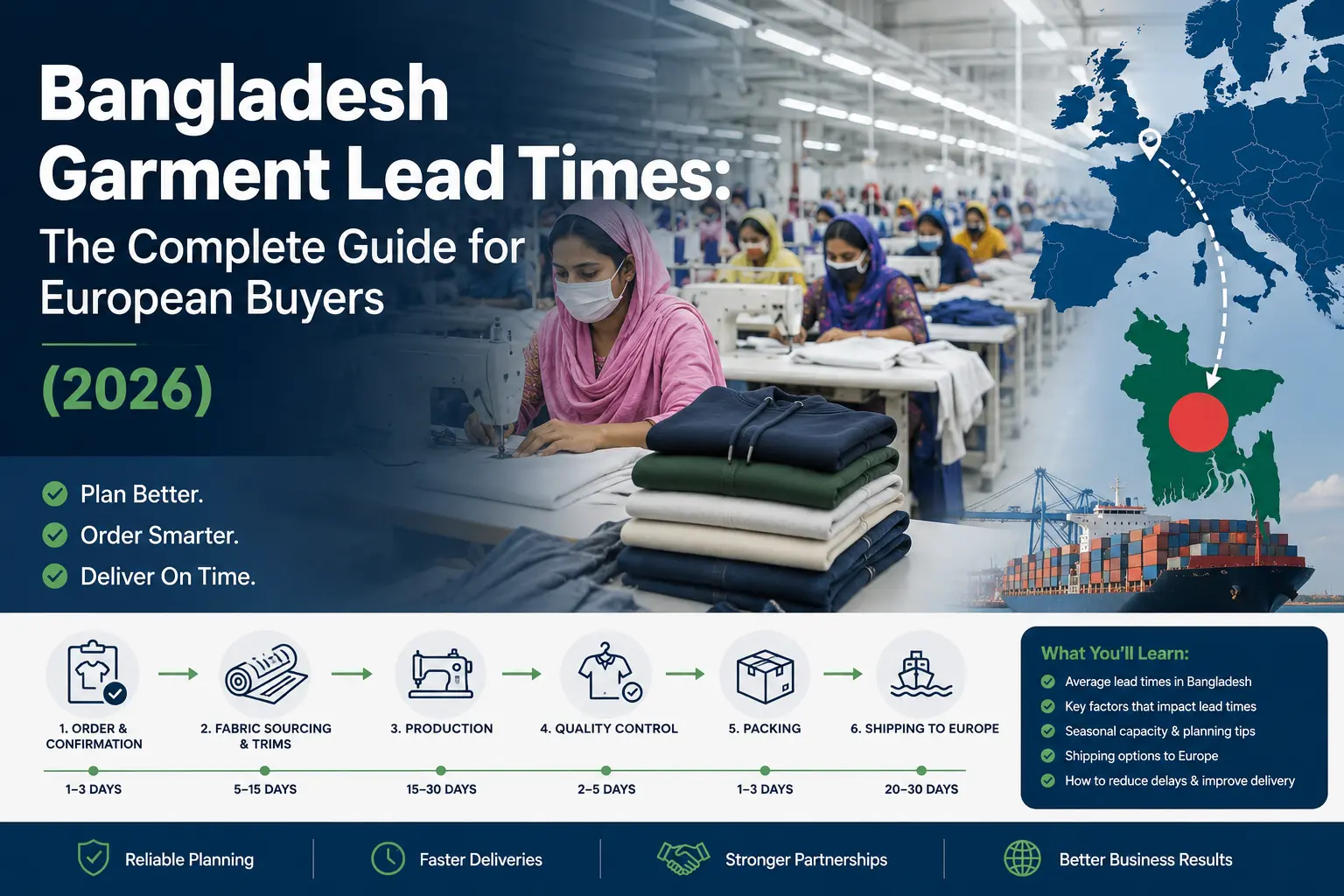
Here is how a standard order actually flows. Timings assume a small-to-mid European order — roughly 1,000 to 5,000 pieces per style — sourced through a buying house or a well-managed factory.
| Stage | What happens | Typical duration |
|---|---|---|
| 1. Costing & order confirmation | Tech pack review, FOB quote, negotiation, proforma invoice signed | 5–10 days |
| 2. Sampling | Fit sample → buyer approval → pre-production (PP) sample sign-off | 12–25 days |
| 3. Fabric knitting/weaving & dyeing | Yarn booking, knitting or weaving, dyeing to approved shade | 20–35 days |
| 4. Trims & accessories | Labels, zippers, buttons, polybags, cartons sourced | 10–20 days (runs in parallel) |
| 5. Bulk production | Cutting, sewing, finishing | 25–45 days |
| 6. Quality control | Inline QC during sewing + final AQL inspection | 3–7 days |
| 7. Shipment & FOB | Booking, documentation, customs, loading at Chittagong | 5–10 days |
| Total (PO to FOB) | 75–120 days | |
| 8. Sea freight to Europe | Chittagong → Hamburg / Rotterdam / Felixstowe | 21–25 days |
Two things European buyers consistently underestimate:
Sampling is the silent killer. Buyers obsess over the 30–45 day sewing window and treat sampling as a formality. In reality, fit corrections, fabric re-development, and slow approval cycles — often on the buyer’s own side — routinely add two to four weeks. The single fastest way to lose a delivery date is to take ten days to approve a sample that the factory turned around in three.
Fabric, not sewing, sets the floor. For most knit programmes, the dyeing and fabric stage is the longest single block in the entire timeline. If your colour is a difficult shade, or you require a specific certified fabric such as GOTS organic cotton or GRS recycled polyester, book it early — fabric lead time, not machine capacity, is what you are actually waiting on. Our overview of sustainable garment sourcing from Bangladesh explains why certified fabric carries a longer runway.
Bangladesh Garment Lead Times by Product Category
Not all garments move at the same speed. Construction complexity and fabric type drive the difference. Here is what to expect by category.
| Product category | Typical PO-to-FOB lead time | Main timeline driver |
|---|---|---|
| T-shirts, basic jersey tops | 60–90 days | Fabric dyeing |
| Polo shirts | 70–95 days | Collar and placket construction |
| Hoodies & sweatshirts | 75–100 days | Fleece fabric, heavier finishing |
| Sweaters & cardigans | 75–110 days | Yarn booking, panel knitting |
| Woven shirts & blouses | 85–115 days | Woven fabric, intricate make |
| Denim jeans | 90–130 days | Fabric, washing & finishing |
| Outerwear / padded jackets | 100–140 days | Multi-component construction, trims |
If you are weighing one category against another, our product-specific guides go deeper on each: knitwear sourcing, T-shirt supply, polo shirts, hoodies, sweatshirts, sweaters and cardigans, and denim. You can also browse the full Milky Fashions product range to see what we produce for European brands.
The lighter the construction and the more standard the fabric, the faster you ship. A white cotton T-shirt in a stock fabric can move in eight to nine weeks. A washed denim jean in a custom shade with multiple trims is a fundamentally different timeline, and no amount of pressure changes that physics. Plan the category, not just the order.
The Bangladesh Sourcing Calendar: Seasonal Traps to Plan Around
This is the part generic guides miss entirely. Lead time in Bangladesh is not constant across the year — it bends around two predictable pressure points and one religious calendar. Understanding this calendar is the difference between a buyer who hits every season and one who is perpetually expediting.
Q3 Peak Season (August to October)
This is the global holiday production rush. Every brand on earth is loading the same factories for the same Christmas deliveries. During this window, expect lead times to stretch by 15 to 25% and minimum order quantities to be enforced more strictly, because factory floor space is at a premium. If you need Q3 capacity, book it by April or May — not July. Leaving it late means either a price premium or a flat refusal.
Monsoon (June to September)
Heavy seasonal rains can disrupt inland logistics and bunch shipments together. It rarely stops production outright, but it adds unpredictability to the freight and port-handling stages. Build a few days of buffer into anything shipping in this window, and do not schedule a tight launch around a monsoon-period sailing.
Eid Shutdowns (Twice a Year)
Bangladesh effectively pauses for Eid-ul-Fitr and Eid-ul-Adha. Factories close for roughly 7 to 10 days for each festival, and productivity dips in the run-up as millions of workers travel home to their villages. The exact dates shift every year on the lunar calendar, so they must be checked against your specific production window each season. An order that straddles an Eid period can quietly lose two weeks without anyone flagging it — unless your sourcing partner is planning around it deliberately.
Practical rule: if your production window overlaps Q3 peak or either Eid, add a two-week buffer to whatever lead time you are quoted. That buffer is far cheaper than air freight, and infinitely cheaper than missing your in-store date.
Bangladesh vs Other Sourcing Origins: Lead Time Reality
European buyers rarely evaluate Bangladesh in isolation. Here is how it compares on speed and total landed timing against the origins you are most likely weighing it against.
| Origin | Typical PO-to-FOB | Freight to EU | EU duty status | Speed verdict |
|---|---|---|---|---|
| Bangladesh | 75–120 days | 21–25 days (sea) | Duty-free under EBA (in transition) | Strong on cost + volume |
| Vietnam | 70–110 days | 25–32 days (sea) | ~12% MFN duty | Comparable make, higher duty |
| Turkey | 45–70 days | 4–7 days (truck/sea) | Customs Union — duty-free | Fastest to EU, higher unit cost |
| China | 60–100 days | 30–38 days (sea) | Standard duty | Broad capability, tariff exposure |
The honest read: Turkey wins on pure speed to Europe, thanks to geographic proximity and same-week trucking. If a four-week-faster delivery is the single most important variable in your decision, near-shore Turkey may suit you better.
But Bangladesh wins on the combination that matters to most mid-market brands: duty-free EU access, the lowest mainstream unit cost in Asia, and a vertically integrated knit base that competitors struggle to match at volume. For vertically integrated knit programmes specifically, where yarn, fabric, and garment sit under one roof, Bangladesh frequently runs faster than equivalent Vietnam programmes because three handoffs are collapsed into one facility.
For the full strategic comparison — including cost, compliance, and risk rather than just speed — see our detailed breakdowns of Bangladesh vs China vs Turkey and Bangladesh vs Vietnam vs China. And because duty status is shifting, factor in our analysis of Bangladesh’s LDC graduation in 2026, which affects the duty-free advantage shown in the table above.
Why Lead Time Reliability Matters More Than Lead Time Itself
Here is the insight that separates experienced buyers from first-timers: a factory that quotes 80 days and delivers in 110 is worse than one that quotes 100 and hits it every single time.
European retail runs on fixed launch dates, marketing calendars, store windows, and e-commerce drop schedules. A garment that arrives two weeks late does not just inconvenience you — it can miss its entire selling season, leaving you with stock you must discount. The cost of a late delivery is almost never the freight; it is the lost full-price sell-through.
This is why chasing the lowest quoted lead time is a trap. The buyers who succeed in Bangladesh are the ones who build a relationship with a partner who protects the committed date — through daily production follow-up, early problem flagging, and on-the-ground quality control before goods ever leave the factory floor. A quoted timeline is a promise; a met timeline is a track record.
How to Compress Your Bangladesh Garment Lead Time
Lead time is not fixed. Here are the levers that genuinely move it, in order of impact.
1. Approve samples fast. The single biggest controllable variable is your own approval speed. Same-day or next-day sign-off on fit and PP samples can save one to two weeks across an order. Slow buyer-side decisions are the most common cause of missed dates — and the one entirely within your control.
2. Book fabric early, or choose stock fabric. Custom dyeing adds weeks to the longest stage in the timeline. Where your design allows, using mill-stock or fast-turn fabric collapses that block dramatically. If a deadline is tight, fabric flexibility buys you more time than any other single decision.
3. Lock trims in parallel, not in sequence. Good factories source trims while production is being scheduled, not after. Confirm this is actually happening on your order rather than assuming it — a trims delay can stall an otherwise on-track production run.
4. Use a buying house to run stages concurrently. A direct factory tends to run your order linearly. An experienced buying house overlaps sampling, fabric booking, and trim sourcing, and chases each stage daily. This is where the difference between working with a buying house versus a direct factory shows most clearly — not just on price, but on protected delivery dates.
5. Plan around the calendar. Place Q3 orders early and route production around Eid and monsoon. Calendar discipline prevents the avoidable delays that no amount of late expediting can fix.
6. Vet your supplier properly before you commit. A factory that fails mid-production is the worst lead-time risk of all. Use our checklists for vetting a Bangladesh garment factory and vetting a Bangladesh buying house before you place a first order. Verified compliance and capacity up front prevents the catastrophic delays that come from choosing the wrong partner.
7. Consolidate styles with one supplier group. Splitting an order across multiple unconnected factories multiplies your QC and coordination overhead. Group-level sourcing improves both lead-time reliability and compliance governance.
Lead Time and the Cost Equation
It is worth being clear that speed and cost are linked. The fastest options — air freight, rush production, expedited fabric — all carry premiums, typically 10 to 20% above base for rush production and several times the freight cost for air over sea. The cheapest path is almost always the well-planned one: early booking, fast approvals, and a realistic timeline agreed up front.
If you are modelling total landed cost alongside timing, our guide to garment sourcing costs in Bangladesh and our MOQ guide for Bangladesh sourcing give you the price and volume context that sits alongside this lead-time picture. Read all three together and you have a complete commercial view before you ever send an enquiry.
How Milky Fashions Manages Your Lead Time
As a BGBA-registered apparel buying house (Member M-0357) operating from Dhaka since 2002, Milky Fashions manages the full timeline on your behalf. We run sampling, fabric booking, and trim sourcing concurrently rather than in sequence; we conduct inline and final quality control on the ground; and we flag risks early — before they become missed deliveries.
For European brands without a Dhaka office, that local oversight is the difference between a quoted date and a met one. We work with fashion brands, wholesalers, and importers across the UK, Germany, France, the Netherlands, Italy, Spain, Poland, and Scandinavia, sourcing from certified factories that hold BSCI, WRAP, SEDEX, GOTS, GRS, and OEKO-TEX accreditation. For brands with regulatory obligations, our work on EU supply chain compliance and private label clothing sits alongside the production management.
If you want a realistic production timeline for your specific product and target launch date, contact us for a free sourcing consultation. We will map your order against the current production calendar — including Eid and peak-season effects — and tell you honestly what is achievable. No inflated promises, just a date we can hit.
Frequently Asked Questions
How long does it take to manufacture garments in Bangladesh?
A standard Bangladesh garment lead time is 75 to 120 days from confirmed purchase order to FOB, meaning goods loaded at port. Knitwear and basic jersey items are faster at 60 to 100 days, while denim and complex woven garments take 90 to 130 days. You then add 21 to 25 days of sea freight to reach a European port, giving a total order-to-warehouse window of roughly 14 to 20 weeks.
How long does shipping from Bangladesh to Europe take?
Sea freight from Chittagong port to major European ports such as Hamburg, Rotterdam, or Felixstowe takes approximately 21 to 25 days. Air freight is far faster at 3 to 7 days but costs several times more, so it is generally reserved for samples or urgent rush quantities rather than full bulk shipments.
Can Bangladesh factories handle rush orders?
Yes, but with trade-offs. Rush production is possible when fabric is already in stock or quickly available, and it typically carries a price premium of 10 to 20%. The most reliable way to shorten a timeline is to approve samples quickly and book fabric early, rather than relying on expediting at the production stage, which has hard physical limits.
What is the difference between quoted lead time and real lead time?
Quoted lead time is the factory’s clean production window, which usually starts only once your sample is approved, fabric is confirmed, and the advance is paid. Real lead time covers everything from your first enquiry to goods arriving at your warehouse. The gap between the two is often three to five weeks, and it is where most missed delivery dates originate.
How do Eid and peak season affect Bangladesh lead times?
Bangladesh observes two Eid holidays each year, during which factories close for roughly 7 to 10 days each, with reduced productivity beforehand as workers travel home. The Q3 peak season from August to October is the global holiday rush, which can stretch lead times by 15 to 25%. If your production window overlaps either, add a two-week buffer to your quoted timeline.
Does using a buying house reduce lead time?
A buying house can meaningfully protect and often shorten your real lead time by running sampling, fabric booking, and trim sourcing concurrently rather than in sequence, and by chasing each production stage daily. It also reduces the risk of delays caused by quality rejections, because inspection is managed on the ground before shipment rather than discovered after goods arrive in Europe.
What is the fastest garment category to produce in Bangladesh?
Basic cotton T-shirts and simple jersey tops are the fastest, at around 60 to 90 days, because they use standard fabric and simple construction. Denim and structured outerwear are the slowest, at 90 to 140 days, due to specialised fabric, washing, and multi-component assembly. Choosing a simpler construction or a stock fabric is one of the most effective ways to hit a tight deadline.
Plan Your Next Bangladesh Order with Confidence
Lead time is not a number you have to accept blindly — it is something you can plan, protect, and partially control. The buyers who consistently hit their seasons are the ones who understand the full timeline, respect the seasonal calendar, and work with a partner who manages the process daily on the ground in Dhaka.
Whether you are placing your first Bangladesh order or scaling an existing programme, Milky Fashions can give you a realistic, honest timeline for your exact product. Get in touch for a free consultation, or learn more about our buying house and 24 years of European sourcing experience.

Director and Head of Merchandising at Milky Fashions, a BGBA-registered garment buying house in Bangladesh since 2002. Specialises in knitwear sourcing, factory compliance, and European buyer relations.