GOTS Certification Explained: A European Buyer’s Guide to Sourcing Organic Cotton Apparel from Bangladesh
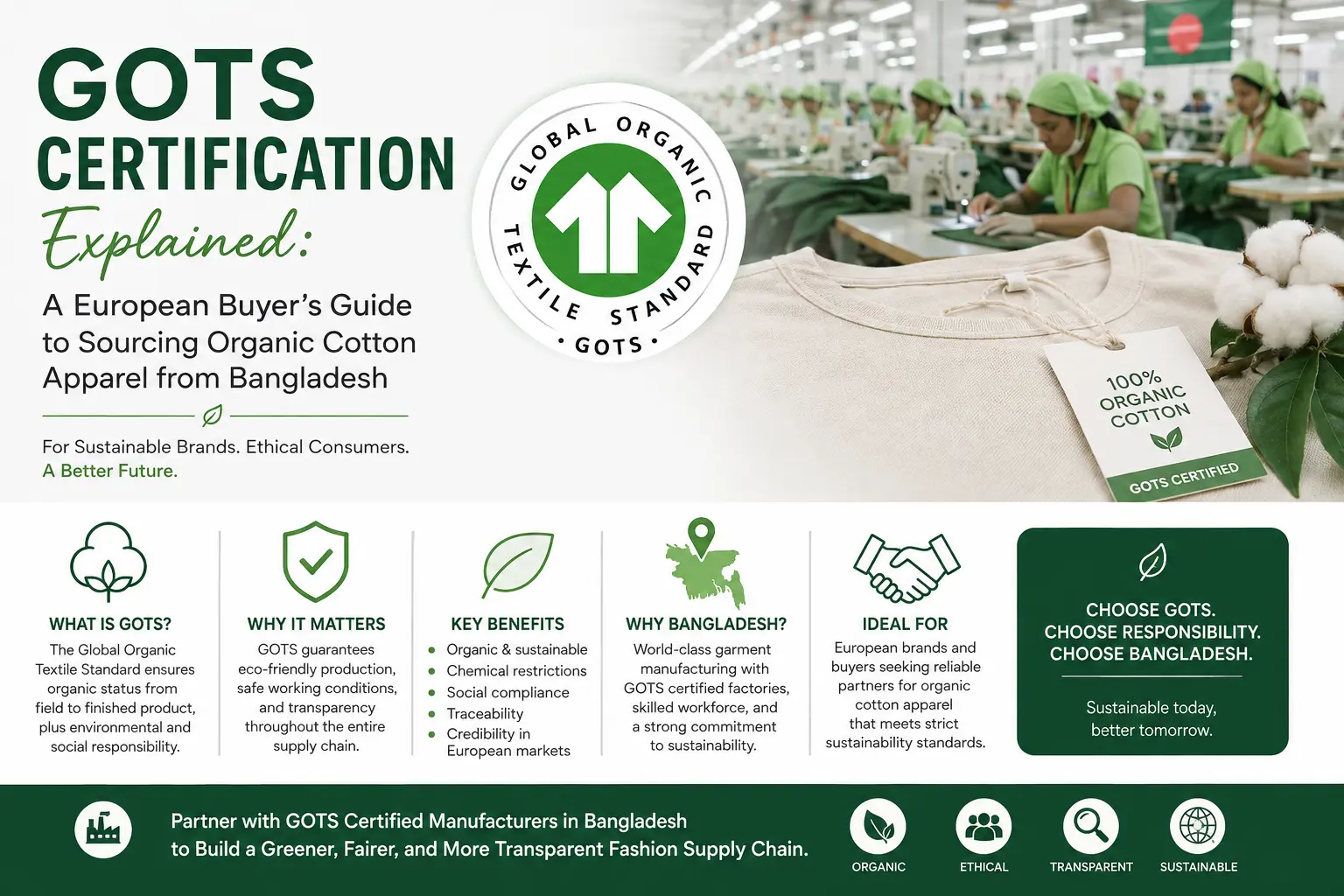
GOTS certified means a textile product has been verified, at every stage from fibre to finished garment, against the Global Organic Textile Standard — the world’s leading certification for organic textiles. It requires a minimum of 70% certified organic fibre content, bans hazardous chemical inputs including chlorine bleach, formaldehyde and heavy-metal dyes, and mandates fair labour conditions across every facility that touches the product. A GOTS licence is only valid when it can be checked against the public database at global-standard.org — anything else is an unverified claim.
For European brands, that definition matters more than most sourcing terms on a spec sheet. “Organic cotton” on its own is unregulated. GOTS is not. If your buyer, your retail customer, or your compliance team asks for proof of sustainable sourcing, GOTS is very often the certificate they mean — and increasingly, the one regulators expect to see behind any organic or eco claim you make.
This guide breaks down what GOTS actually certifies, why it has become close to non-negotiable for brands selling into Germany, France, the Netherlands, Denmark, Spain and the UK, and how to verify a supplier’s certificate before you commit a production order.
What Does GOTS Certified Actually Mean?
GOTS stands for the Global Organic Textile Standard. It is a whole-chain certification, which is the detail most buyers miss. A farm-level organic certificate tells you how the cotton was grown. It says nothing about how it was spun, dyed, printed, sewn or packed — and any of those later stages can undo the “organic” claim with conventional bleach, azo dyes or synthetic finishing agents. GOTS closes that gap by certifying every facility in the chain: ginning, spinning, knitting or weaving, wet processing, and the final cut-and-sew factory.
The Two GOTS Label Grades
GOTS certification is issued under two label grades, and the distinction is one buyers should always confirm before it goes on a hangtag or a product page:
- “Organic” — the product must contain a minimum of 95% certified organic fibres.
- “Made with Organic Materials” — the product must contain a minimum of 70% certified organic fibres, with limits on synthetic fibre content (higher allowances apply to items like sportswear and hosiery).
A supplier who quotes “GOTS” without specifying the grade is giving you an incomplete answer. Ask for the grade and the licence number before you finalise a tech pack.
Why GOTS Certification Matters for European Buyers
GOTS was written as a voluntary industry standard, but across the EU and UK it has effectively become the reference point that due diligence and green-claims regulation is measured against. The pressure looks slightly different market by market.
Germany — LkSG and Retailer Due Diligence
Under Germany’s Supply Chain Due Diligence Act (LkSG), companies are required to identify and document environmental and social risk across their supply chain. A GOTS certificate is one of the cleanest pieces of documentary evidence a German buyer can put in front of an LkSG audit, because it already covers chemical safety, wastewater handling and labour conditions in a single third-party-verified document. For more on how LkSG documentation requirements work in practice, see our German compliance guide.
France — AGEC and the Environmental Cost Label
France’s AGEC law and its forthcoming environmental cost label push fashion brands toward substantiated, traceable material claims rather than generic “eco” marketing. A GOTS licence number gives a French buyer a verifiable data point to feed into that scoring system, rather than a self-declared estimate. Our France textile regulations guide covers how AGEC and PFAS rules interact with sourcing decisions.
Netherlands — CSRD/CSDDD and Sustainability-Led Retail
Dutch retail buyers were early adopters of sustainable sourcing well before it was mandated, and the Netherlands now sits inside the EU’s CSRD and CSDDD reporting framework, which requires documented supply-chain due diligence at scale. GOTS transaction certificates map directly onto the kind of traceability evidence CSRD reporting asks for.
Denmark and the Nordic Markets — Consumer-Led Scrutiny
Danish, Swedish and Norwegian consumers and retailers apply some of the highest scrutiny in Europe to sustainability claims — a claim that would pass unquestioned elsewhere gets checked in Copenhagen. GOTS, alongside GRS for recycled content, is typically the minimum evidentiary bar Nordic buyers expect before they will list an organic-cotton product.
Spain and the Wider EU — Green Claims Directive Pressure
Spain sits inside the same EU Green Claims framework that is reshaping what any brand can say about sustainability across the bloc. From September 2026, unsubstantiated environmental claims carry real regulatory risk, and a GOTS certificate is one of the few claims that is pre-substantiated by design. Our EU Green Claims guide covers what brands can and can’t say without documentation like this behind it.
UK — DCTS and Retailer ESG Requirements
Post-Brexit, UK retailers largely run their own ESG and sustainability scorecards independent of EU law, but GOTS remains the most widely recognised reference point in supplier questionnaires from major UK department stores and marketplaces. UK brands sourcing from Bangladesh under the Developing Countries Trading Scheme (DCTS) commonly request GOTS documentation alongside standard compliance audits.
What GOTS Actually Certifies Across the Supply Chain
Farm to Fibre
Organic fibre cultivation must meet a recognised domestic or international organic farming standard — no synthetic pesticides, fertilisers or GMO seed. GOTS itself does not set the farming standard; it verifies that the fibre entering the supply chain already carries valid organic certification, then tracks it from that point forward.
Processing and Chemical Restrictions
Every wet-processing stage — dyeing, printing, finishing — is restricted to GOTS-approved inputs. Banned substances include chlorine bleach, formaldehyde, carcinogenic azo dyes and heavy-metal-based dyes. Wastewater from certified facilities must meet defined treatment standards before discharge.
Social Criteria
GOTS incorporates core International Labour Organization conventions: no child or forced labour, freedom of association, safe working conditions, and payment of at least the legal minimum wage. This is where GOTS overlaps with — but does not replace — social audits like BSCI, SEDEX/SMETA or WRAP. Our comparison of BSCI, WRAP, SEDEX and amfori explains how these schemes differ and where they overlap with GOTS.
Traceability and Transaction Certificates
Every GOTS-certified transaction along the chain generates a Transaction Certificate (TC), issued by an accredited certification body. A finished garment should be traceable back through TCs at each stage — ginner, spinner, mill, garment factory — not just a single certificate at the end of the line.
GOTS vs Other Certifications: How It Fits with BSCI, OEKO-TEX and GRS
Buyers frequently conflate certifications that answer different questions. It’s worth being precise:
- GOTS certifies organic fibre content and chemical-safe, socially compliant processing across the whole chain.
- OEKO-TEX Standard 100 tests the finished product for harmful substances but does not certify organic fibre content or farming practices. See our REACH and OEKO-TEX guide for the distinction.
- GRS (Global Recycled Standard) certifies recycled fibre content — relevant for recycled polyester, not organic cotton.
- BSCI, WRAP, SEDEX/SMETA are social compliance audits of a factory’s labour and safety practices, independent of fibre or chemical content.
A genuinely sustainable programme often layers two or three of these rather than relying on one. A GOTS-certified organic cotton tee produced in a BSCI-audited factory, for example, gives a buyer documented answers on fibre, chemical safety and worker conditions simultaneously.
How to Verify a GOTS Certificate Before You Place an Order
Checking the Global Standard Database
Every valid GOTS certificate carries a licence number that can be checked at global-standard.org. Search by licence number or company name; a genuine listing will show the certified facilities, the scope of products covered, and the certificate’s validity dates. If a supplier cannot provide a licence number, or the number does not return a match, treat the claim as unverified.
Red Flags of a False or Expired Claim
Watch for a certificate that covers the spinning mill but not the cut-and-sew factory, a validity date that has lapsed, or a scope of certification that doesn’t include the specific product category you’re ordering. GOTS certification is granted per facility and per scope — a factory can be GOTS-certified for knitwear and not for wovens, for instance. Always ask for the certificate to be matched against the specific style you’re placing.
What GOTS Certification Costs: Realistic FOB Impact
Certified organic fibre and the audit overhead of a certified supply chain add real cost. In practical terms, GOTS-certified organic cotton typically raises FOB pricing by roughly 15–20% versus the equivalent conventional-cotton garment, reflecting both the fibre premium and the cost of maintaining certified, segregated production. Our full Bangladesh FOB and landed-cost guide breaks down how that premium sits inside a complete cost sheet. Budgeting for it from the design stage — rather than discovering it at quoting stage — keeps a sustainable line commercially viable.
Sourcing GOTS-Certified Apparel from Bangladesh: What to Expect
Bangladesh operates one of the largest GOTS-certified textile production bases in the world, supported by vertically integrated mills that can hold organic fibre segregated from spinning through to finished garment on a single campus — which materially reduces the traceability risk that comes with handoffs between separate facilities in other sourcing countries.
For European buyers, that means access to certified organic cotton knitwear, denim and woven programmes without the lead-time and documentation friction that fragmented supply chains create elsewhere. A buying house that works with certified factories as standard practice can supply the licence numbers, Transaction Certificates and scope documentation your compliance team needs before goods ever leave Chittagong — rather than chasing it retroactively after an order has shipped.
Frequently Asked Questions
What does GOTS certified mean?
GOTS certified means a textile product has been independently verified against the Global Organic Textile Standard, covering organic fibre content (minimum 70% or 95% depending on label grade), restricted hazardous chemicals at every processing stage, and fair labour standards across all certified facilities in the supply chain.
Is GOTS certification mandatory in the EU?
No. GOTS is a voluntary, independently administered standard, not an EU regulation. However, EU due diligence and green-claims rules — including LkSG in Germany, AGEC in France, CSRD/CSDDD across the EU, and the Green Claims Directive — increasingly require documented evidence behind any organic or sustainability claim, and GOTS is the certification most commonly used to provide that evidence.
How much more does GOTS-certified clothing cost?
GOTS-certified organic cotton garments typically carry a 15–20% FOB premium over the equivalent conventional-cotton product, driven by fibre cost and the overhead of maintaining certified, segregated production and annual audits.
Can Bangladesh factories produce GOTS-certified apparel at low MOQ?
Yes. A growing number of vertically integrated Bangladesh factories hold GOTS certification and can accommodate lower minimum order quantities than large-volume-only mills. See our dedicated guide to GOTS-certified factories with low MOQ in Bangladesh for current MOQ benchmarks by product category.
How do I verify a supplier’s GOTS certificate is genuine?
Search the licence number or company name in the public database at global-standard.org. A genuine listing shows the certified facility, the product scope covered, and current validity dates. Never accept a GOTS claim without a checkable licence number matched to the specific product and factory.
Source GOTS-Certified Apparel from Bangladesh with Milky Fashions
Milky Fashions is a BGBA-registered buying house that has sourced certified apparel for European fashion brands since 2002, working with GOTS, GRS, OEKO-TEX, BSCI and WRAP certified factories across knitwear, wovens and denim. We verify every certificate against the facility and product scope before it goes into your cost sheet — not after.
Send us your tech pack and we’ll confirm certified factory options, realistic MOQs and an indicative FOB for your organic cotton programme within a few working days.

Director and Head of Merchandising at Milky Fashions, a BGBA-registered garment buying house in Bangladesh since 2002. Specialises in knitwear sourcing, factory compliance, and European buyer relations.