Tech Pack for Garment Manufacturing: What Bangladesh Factories Need to Quote and Produce Your Design
A tech pack for garment manufacturing is the technical document that tells a factory exactly how to make your garment — including flat sketches, a bill of materials (BOM), a measurement specification with tolerances, construction notes, colourways, and packaging and labelling details. Without one, a Bangladesh factory cannot give you an accurate quote, and your first sample almost always comes back wrong. With one, you get precise pricing, fewer sampling rounds, and a garment that matches your design.
Most tech pack guides online are written by software companies trying to sell you a platform, or by Western consultants who have never set foot on a production floor. This guide is different. It is written by Milky Fashions, a BGBA-registered garment buying house in Bangladesh that reads, interprets, and produces from tech packs every single day. So this explains not just what a tech pack contains, but what Bangladesh factories actually need to see to quote accurately and produce correctly for the European market — including the labelling and compliance details most templates leave out.
What Is a Tech Pack, and Why It Decides Your Order’s Success
A tech pack (technical package) is the blueprint of your garment. A builder would never construct a house without architectural drawings; a factory should never cut fabric without a tech pack. It is the shared language between your design and the production floor — and in Bangladesh, where the people sewing your garment may not read English, your drawings and specifications become that language.
Here is what a complete tech pack does for your order:
It lets the factory quote accurately. Factories cannot price what they cannot see. Vague enquiries get padded, high quotes to cover unknowns; complete tech packs get sharp, competitive pricing. It cuts sampling rounds. Unclear specifications are the leading cause of first-sample failure, and each extra sampling round typically adds two to four weeks to your timeline. It sets the quality standard. Every garment in your bulk run is checked against the tech pack during quality control. It protects your design. The tech pack is the contractual reference if anything in production is disputed.
In short, the tech pack is where you either prevent expensive mistakes or create them. It is the single highest-leverage document in apparel sourcing — and it directly shapes your garment sourcing cost and your production lead time.
The Essential Components of a Garment Tech Pack
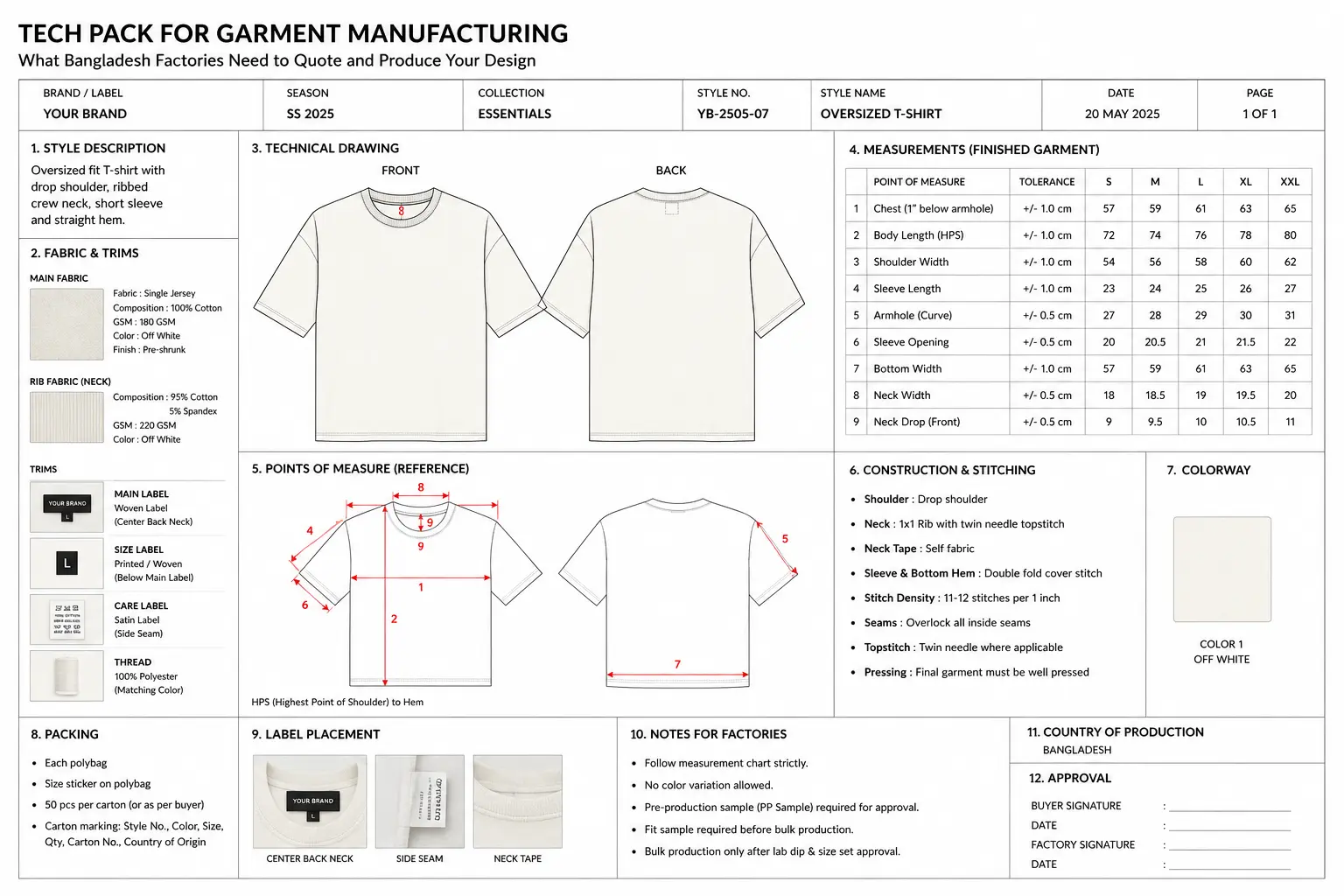
A professional apparel tech pack is not a single page — it is a structured set of pages, each answering a different question the factory will ask. Here is what every complete tech pack should contain.
| Component | What it specifies | Why the factory needs it |
|---|---|---|
| Cover page | Style code, name, season, version, date, brand | Identifies the right document among hundreds |
| Flat technical sketches | Front, back, and detail views (line drawings, not fashion illustration) | Shows construction and proportion |
| Bill of materials (BOM) | Every fabric, trim, label, thread, button, zipper | Enables accurate costing and sourcing |
| Measurement specification | Points of measure (POM) with target sizes and tolerances | Defines fit and acceptable variation |
| Grading | How measurements scale across the size range | Produces a consistent size run |
| Construction / stitching notes | Seam types, stitch density (SPI), finishing | Tells the factory how to assemble it |
| Colourways | Each colour with Pantone / TCX codes | Removes ambiguity in dyeing |
| Labelling & packaging | Care labels, brand labels, hangtags, polybags, cartons | Ensures retail and compliance readiness |
The two sections where first-time buyers lose the most money are the BOM and the measurement specification — so they deserve a closer look.
The Bill of Materials (BOM)
The BOM is the material inventory of your garment. For each item, specify fibre content, fabric weight in GSM (grams per square metre), finish, and exact colour reference. List trims, labels, and packaging with quantity per unit and placement. For example: “Main fabric: 100% combed cotton, 180 GSM single jersey, reactive dyed” or “Button X123, antique brass, four per shirt.” If you write only “cotton fabric,” the factory chooses the weight and quality for you — and their choice may not match your vision or your target price. A precise BOM is what makes a quote accurate and a sample correct.
The Measurement Specification (Points of Measure)
This defines the exact dimensions for every point of measure on the garment, in your base sample size, with a graded chart for the full range. Common POMs include chest width, body length, shoulder width, sleeve length, neck opening, and cuff width. Each entry needs three things: the measurement description, the target value, and an allowable tolerance (the acceptable plus/minus variation). Pair the chart with a POM diagram so the factory measures in exactly the same place you do. Fit is one of the main reasons garments get returned — this section is where you control it.
What Bangladesh Factories Specifically Need to Quote Accurately
This is where generic tech pack guides fall short. Beyond the standard components, a Bangladesh factory needs a few specifics to give you a sharp FOB quote on the first pass:
Fabric construction and GSM, stated precisely. Bangladesh’s strength is its vertically integrated knit base, but that only helps you if the factory knows the exact fabric. “240 GSM brushed fleece, 80% cotton / 20% polyester” lets them price from their own mills; “fleece for a hoodie” does not.
Quantity per style and per colour. Pricing and minimum order quantity both depend on this. If your volumes are modest, read our MOQ guide for Bangladesh sourcing before finalising — it explains how quantity drives both price and feasibility.
Wash, print, or embellishment details. A washed denim, a placement print, or embroidery each changes the costing and the lead time substantially. Spell them out.
Target Incoterm. State whether you want pricing on FOB, CIF, or another basis, so quotes are comparable. Our guide on how to order garments from Bangladesh explains these terms in full.
A complete tech pack with these specifics is what separates a buyer who gets a competitive quote in days from one who waits weeks for the factory to chase missing information.
Tech Pack Requirements by Product Category
Not every garment needs the same depth. A basic tee might run four to six pages; a structured jacket can exceed twelve. Here is a rough guide, with links to our category-specific sourcing pages.
| Product | Tech pack complexity | Key specification focus |
|---|---|---|
| T-shirts | Low (4–6 pages) | Fabric GSM, fit, neckline rib |
| Polo shirts | Medium | Collar/placket construction, fabric |
| Hoodies & sweatshirts | Medium | Fleece GSM, drawcord, pocket detail |
| Knitwear / sweaters | Medium–high | Yarn count, gauge, knit structure |
| Denim | High | Fabric, wash, hardware, stitching |
You can see our full range on the products page. Whatever the category, the principle holds: the more precisely you specify, the more accurately the factory quotes and produces.
The EU Market Detail Most Tech Pack Guides Miss: Labelling and Compliance
Here is the gap no software-company tech pack guide addresses, and it matters enormously for European brands: your tech pack must build in EU labelling and compliance requirements from the start, because they affect materials, labels, and cost.
For the European market, your labelling and material specifications need to account for fibre composition labelling (mandatory in the EU), care labelling, country-of-origin marking, and chemical safety. If your fabric must meet OEKO-TEX or REACH chemical-safety standards, that belongs in your BOM — not discovered after sampling. If you are selling into Germany or other markets with supply chain due diligence laws, your supplier’s certifications matter too.
Building these in early avoids the most expensive mistake European brands make: producing a full bulk order, then discovering the labelling or chemical compliance is wrong for the destination market. Our guides to EU apparel compliance, EU textile regulations for Bangladesh sourcing, and REACH and OEKO-TEX chemical compliance explain exactly what to specify. For German brands, our guide to LkSG supply chain due diligence covers the supplier evidence you will need. Sourcing from certified factories is what makes compliant production straightforward.
How to Create a Tech Pack: Tools and Approach
You do not need to be an illustrator or a technical designer to produce a workable tech pack. Here are the realistic routes.
Spreadsheets (Excel / Google Sheets) work well for the BOM, measurements, and costing — accessible and familiar, and perfectly adequate for brands handling a limited number of styles per season.
Adobe Illustrator is the industry standard for clean flat sketches, though it carries a learning curve.
Dedicated tools such as Techpacker or CLO 3D, and PLM platforms, suit larger brands managing many styles, with version control and collaboration built in.
Or let your sourcing partner build it. This is the route most first-time European brands take with us. You arrive with a design, a sketch, a reference garment, or even a “brain dump” of ideas and inspiration images — and we translate it into a factory-ready tech pack. As a buying house that sits between you and the factory, we know exactly what the production floor needs, which means fewer revisions and a faster path to an accurate quote.
Common Tech Pack Mistakes That Cost European Brands
From two decades of reading tech packs on the Bangladesh side, these are the errors that cause the most expensive problems:
Writing vague fabric specs (“cotton,” not “180 GSM combed cotton single jersey”), which leads to wrong fabric and wrong pricing. Omitting tolerances, so the factory does not know what variation is acceptable. Forgetting grading, leaving the size run inconsistent. Leaving out labelling and packaging, then incurring extra cost and delay late in the process. Changing the design after the tech pack is approved and fabric is cut. Ignoring EU compliance until goods are at port. Sending one tech pack for multiple styles — every style needs its own. Each of these is avoidable, and a good sourcing partner catches them before they reach the floor. Once your tech pack is factory-ready, the next step is understanding how factories build their FOB quote — our Bangladesh garment manufacturing cost guide breaks down every cost component.
Your Tech Pack Readiness Checklist
Before you send a tech pack to any Bangladesh factory or buying house, run it against this checklist. If every box is ticked, you are ready to get an accurate quote and a correct first sample.
Your cover page identifies the style with a code, name, season, and version. Your flat sketches show front, back, and any detail views as clean line drawings. Your BOM lists every fabric with precise GSM and fibre content, plus all trims and labels with placement. Your measurement specification includes every point of measure, with target values and tolerances, plus a POM diagram. Your grading covers the full size range. Your construction notes specify seam and stitch types. Your colourways carry Pantone or TCX codes. Your labelling and packaging section covers care labels, brand labels, hangtags, and cartons. And — the step most European brands miss — your fibre composition labelling, country-of-origin marking, and any OEKO-TEX or REACH requirements are specified for your destination market.
If you cannot tick the last point with confidence, that is exactly where a buying house with European market experience earns its value: building the compliance layer into the specification before production starts, not after.
How Milky Fashions Turns Your Design Into Production-Ready Specs
As a BGBA-registered buying house (Member M-0357) operating from Dhaka since 2002, Milky Fashions does more than place orders — we help European brands build the tech packs that make those orders succeed. We take your design, sketch, or reference garment and turn it into a complete, factory-ready specification, with the fabric, construction, labelling, and compliance detail Bangladesh factories need to quote sharply and produce accurately.
We work with fashion brands, retailers, and importers across the UK, Germany, France, Spain, the Netherlands, Italy, Denmark, Poland, and Scandinavia, sourcing private label collections from certified, sustainable factories. If you have a design but are not sure how to turn it into something a factory can produce, contact us for a free consultation — we will help you get it production-ready. You can also learn more about our buying house and how we support European buyers from first sketch to final delivery.
Frequently Asked Questions
What is a tech pack in garment manufacturing?
A tech pack, short for technical package, is a detailed document that tells a factory exactly how to make a garment. It includes flat sketches, a bill of materials, a measurement specification with tolerances, construction notes, colourways, and labelling and packaging details. It is the blueprint factories use to quote, sample, and produce a garment accurately.
What should a tech pack include for a Bangladesh factory?
It should include flat technical sketches, a bill of materials with precise fabric GSM and trims, a measurement specification with points of measure and tolerances, grading across the size range, construction and stitching notes, colourways with Pantone codes, and labelling and packaging details. For European brands, it should also build in EU labelling and chemical compliance requirements.
Do I need a tech pack to get a quote from a garment factory?
Yes. Most factories will not quote accurately, or begin sampling, without a tech pack, because they cannot price what they cannot see precisely. A complete tech pack lets a Bangladesh factory give you a sharp, competitive FOB quote, while a vague enquiry results in padded pricing to cover the unknowns.
What is the difference between a tech pack and a spec sheet?
A tech pack is a complete, multi-page document covering sketches, materials, measurements, construction, and packaging for a specific garment. A spec sheet usually refers to just the measurement specification within it. For apparel manufacturing you need a full tech pack; a spec sheet alone does not give the factory enough to produce accurately.
How many pages should a tech pack be?
It depends on the garment. A basic T-shirt may need only four to six pages, while a structured jacket or technical outerwear can exceed twelve pages when all construction details are documented. Every individual style requires its own tech pack — you cannot combine multiple styles into one document.
Can a buying house create a tech pack for me?
Yes. An experienced buying house can build a complete, factory-ready tech pack from your design, sketch, or a reference garment. Because the buying house knows exactly what the production floor needs, this typically reduces sampling rounds and produces more accurate quotes than a tech pack made without production knowledge.
What is GSM in a tech pack?
GSM stands for grams per square metre, the standard measure of fabric weight. Specifying GSM precisely (for example, 180 GSM for a T-shirt jersey or 320 GSM for hoodie fleece) is essential, because it directly determines the fabric the factory sources, the feel of the garment, and the price. Vague fabric descriptions without GSM lead to wrong materials and inaccurate quotes.
Turn Your Design Into a Factory-Ready Tech Pack
A tech pack is not bureaucracy — it is the document that decides whether your order arrives looking like your design or like the factory’s guess. The European brands that source successfully from Bangladesh are simply the ones who specify clearly and work with a partner who knows what the production floor needs.
Milky Fashions has turned designs into production-ready specifications for European brands for over two decades. Whether you have a polished tech pack or just an idea and a reference garment, we can get you to an accurate quote and a correct sample. Get in touch for a free consultation, or read our step-by-step guide on how to order garments from Bangladesh to see how the tech pack fits into the wider process. Our FAQ page answers the most common questions European buyers ask before they begin.

Director and Head of Merchandising at Milky Fashions, a BGBA-registered garment buying house in Bangladesh since 2002. Specialises in knitwear sourcing, factory compliance, and European buyer relations.