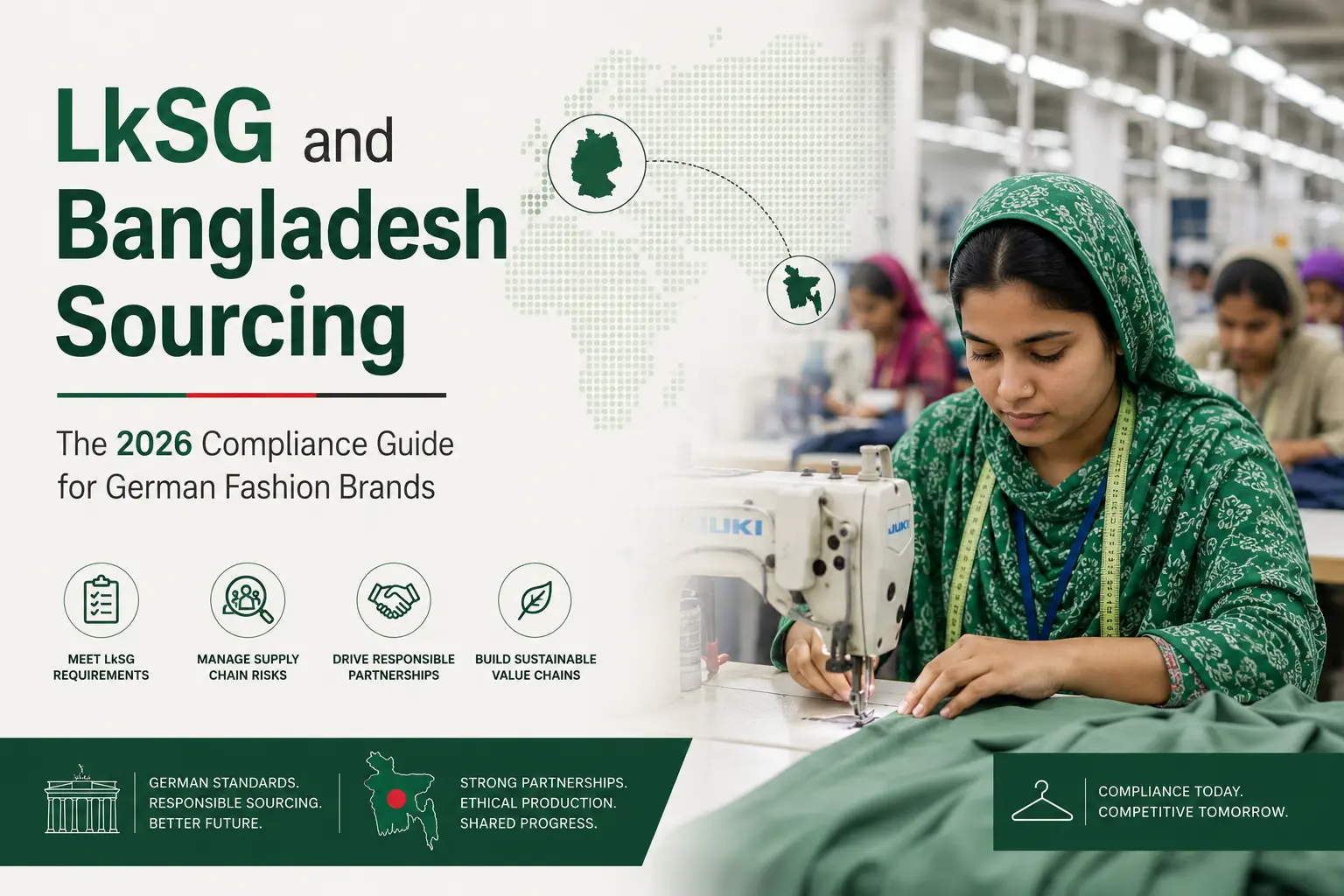
LkSG and Bangladesh Sourcing: The 2026 Compliance Guide for German Fashion Brands
Under Germany’s Supply Chain Due Diligence Act (LkSG), German fashion brands are legally responsible for human rights and environmental standards at their Bangladesh suppliers — not just inside their own offices. If your company has 1,000 or more employees and a presence in Germany, you must run an annual risk analysis, take preventive measures with direct suppliers, operate a complaints mechanism, and document it all. Non-compliance is enforced by BAFA, with fines reaching up to 2% of global annual turnover for serious cases.
That is the part most suppliers will never explain to you — because most of them do not understand it. This guide does. It sets out exactly what LkSG requires of your Bangladesh sourcing, what documents and audit evidence you should be demanding from your supplier today, how the certifications you already know (BSCI, SEDEX, amfori) map onto the law, and why working through a garment buying house in Bangladesh makes compliance dramatically simpler than direct factory sourcing.
It is written by Milky Fashions, a BGBA-registered apparel buying house operating from Dhaka since 2002, working with European brands across Germany, the UK, France, the Netherlands and beyond. We deal with these compliance demands from German buyers every week — so the guidance below is practical, not theoretical.
What Is the LkSG, in Plain Terms?
LkSG stands for Lieferkettensorgfaltspflichtengesetz — the German Supply Chain Due Diligence Act. It came into force on 1 January 2023 and represents one of the most significant shifts in how German companies are held accountable for their global supply chains.
The principle is simple. For decades, a German brand could buy garments from Bangladesh and treat working conditions in the factory as “the supplier’s problem.” LkSG ends that. The law makes the brand responsible for identifying and addressing human rights and environmental risks at its suppliers — including factories thousands of kilometres away in Dhaka, Gazipur or Chittagong.
The law was a direct response to the 2013 Rana Plaza factory collapse in Bangladesh, which killed more than 1,100 garment workers and forced a global reckoning over who bears responsibility for supply chain conditions. More than a decade later, that reckoning is now written into binding German law.
Who Does LkSG Apply To?
The thresholds matter, because they determine whether your brand is in scope.
| Phase | Effective date | Companies covered |
|---|---|---|
| Stage 1 | 1 January 2023 | German-linked companies with 3,000+ employees |
| Stage 2 | 1 January 2024 | German-linked companies with 1,000+ employees |
The law applies to any company with its headquarters, principal place of business, administrative seat, or a branch office in Germany — including German subsidiaries of foreign multinationals. If you are a mid-to-large German fashion brand or retailer sourcing from Bangladesh, you are very likely covered, or you supply someone who is.
Even smaller brands feel the effect indirectly. Larger customers, department stores, and platforms increasingly push LkSG-style requirements down their own supply chains through contracts, so the practical reach of the law extends well below the legal threshold. If you sell to a larger German retailer, expect their LkSG obligations to land on your desk as supplier requirements.
The Nine Core Obligations — and What They Mean for Your Bangladesh Supplier
LkSG sets out nine due diligence obligations. Here is what each one means in practice for a brand sourcing garments from Bangladesh.
- Establish a risk management system across your operations and supply chain.
- Assign internal responsibility — typically a designated Human Rights Officer reporting to management.
- Conduct regular risk analysis — at least annually, and whenever your supply chain changes materially (a new factory, a new product category, a new sourcing country).
- Issue a policy statement on your human rights strategy.
- Take preventive measures in your own business and with direct suppliers — including supplier codes of conduct and contractual commitments.
- Take remedial action when a violation is found or imminent — up to terminating the supplier relationship as a last resort.
- Operate a complaints procedure that workers and third parties can use to report concerns.
- Apply due diligence to indirect suppliers where you have substantiated knowledge of a possible violation.
- Document everything (retained for seven years) and publish an annual report within four months of the financial year end.
The recurring theme is evidence. LkSG does not reward good intentions; it requires verifiable proof that you assessed risk, acted on it, and can show your work. This is precisely where your choice of Bangladesh sourcing partner becomes a compliance decision, not just a commercial one. A supplier who cannot produce audit documents, certificates, and a paper trail on demand is a direct liability under this law.
What German Brands Must Demand From a Bangladesh Supplier in 2026
If you are sourcing from Bangladesh under LkSG, here is the practical evidence checklist your supplier should be able to satisfy without hesitation. We have built this from the actual requests we receive from German buyers.
| LkSG requirement | What to demand from your Bangladesh supplier |
|---|---|
| Risk analysis at direct suppliers | Up-to-date social compliance audit reports (amfori BSCI, SEDEX SMETA) |
| Preventive measures | Signed supplier code of conduct referencing LkSG; valid certifications |
| Worker safety | RSC / Accord structural, fire and electrical safety certificates |
| Complaints mechanism | Evidence of a functioning factory-level grievance channel |
| Environmental due diligence | OEKO-TEX, ZDHC, or wastewater compliance evidence |
| Documentation | Traceability from factory to shipment; dated, verifiable certificates |
| Remediation capability | Demonstrated corrective action processes (CAPA records) |
A supplier who can hand you this evidence package shortens your own LkSG reporting burden enormously. A supplier who cannot leaves you exposed — because under the law, their gap becomes your violation. Our guides on how to vet a Bangladesh garment factory and how to vet a Bangladesh buying house walk through exactly how to assess this before you place an order.
How Your Existing Certifications Map to LkSG
Here is reassuring news: if you already source from properly certified Bangladesh factories, you are most of the way to LkSG readiness. The certifications you already recognise were largely built around the same human rights and environmental risks the law targets. The trick is knowing which certificate answers which obligation.
| Certification | What it covers | LkSG relevance |
|---|---|---|
| amfori BSCI | Social compliance audit across 13 performance areas | Direct evidence for supplier risk analysis & prevention |
| SEDEX SMETA | Labour, health & safety, environment, ethics | Widely accepted for LkSG due diligence files |
| SA8000 | Comprehensive social accountability standard | Strong evidence of working-conditions compliance |
| WRAP | Lawful, humane, ethical production | Supports labour-rights due diligence |
| OEKO-TEX | Chemical and product safety | Covers environmental obligations |
| GOTS / GRS | Organic / recycled content with social criteria | Environmental + partial social evidence |
| RSC (ex-Accord) | Structural, fire, electrical factory safety | Critical post-Rana Plaza worker safety proof |
We unpack the differences between the social audit schemes in detail in our BSCI vs WRAP vs SEDEX vs amfori compliance decoder, and you can see the full range of accreditations our partner factories hold on our certifications page. The key point for LkSG: a stack of valid, current certifications from a transparent supplier is the single most efficient way to build your due diligence file.
LkSG vs CSDDD: What German Brands Need to Know About What Comes Next
LkSG is a German national law. Sitting above it is the EU-wide Corporate Sustainability Due Diligence Directive (CSDDD), which entered into force on 25 July 2024 and is being transposed into national law across the bloc. Understanding the relationship matters, because the regime is evolving.
| Feature | LkSG (Germany) | CSDDD (EU) |
|---|---|---|
| Scope | German-linked companies, 1,000+ employees | Large EU and non-EU companies meeting EU thresholds |
| Geography | Germany | All 27 EU member states |
| Supply chain reach | Primarily direct suppliers | Broader value-chain focus |
| Civil liability | Limited | Stronger civil liability provisions |
| Status in 2026 | In force, being aligned with EU framework | Transposition under way, simplified by EU Omnibus reforms |
In 2025 the EU’s “Omnibus” simplification package adjusted the scope and timing of several sustainability rules, including CSDDD, and Germany signalled it would align LkSG with the EU framework over time. The precise legislative shape continues to move. But here is what does not change for you as a buyer: the underlying expectation that you can demonstrate due diligence over your suppliers is here to stay. Whether the obligation is labelled LkSG or CSDDD, a brand sourcing from Bangladesh will be expected to show it assessed and managed supply chain risk. Building that capability now is the safe move regardless of how the law is renamed.
For the wider regulatory picture beyond Germany, see our complete guide to EU apparel compliance and our overview of EU textile regulations and Bangladesh sourcing, which place LkSG alongside the green claims rules, the digital product passport, and chemical regulation.
The Penalty Reality: Why This Is Not Optional
LkSG has teeth. Enforcement sits with BAFA, the German Federal Office for Economic Affairs and Export Control, which can investigate complaints and audit company compliance.
The penalties are structured to hurt. Serious violations can attract fines of up to 2% of a company’s annual global turnover for larger companies, with other fines reaching several hundred thousand euros. Beyond the financial penalty, a company fined above a certain threshold can be excluded from public contracts for up to three years — a commercial consequence that often outweighs the fine itself.
There is also reputational exposure. The first LkSG complaint against the garment sector was filed with BAFA in 2023, concerning conditions in Bangladesh clothing factories. NGOs and worker organisations actively use the law’s complaints mechanism. For a consumer-facing fashion brand, a public LkSG complaint is a brand-damage event, not just a legal one.
The takeaway is straightforward: LkSG compliance is cheaper than LkSG failure, and a well-chosen, transparent Bangladesh sourcing partner is the most cost-effective insurance you can buy.
Why a Buying House Makes LkSG Compliance Easier Than Direct Factory Sourcing
This is where the structure of your Bangladesh sourcing genuinely changes your compliance burden. Consider the difference.
Sourcing direct from factories, you carry the full due diligence load yourself. You must vet each factory’s certifications, verify they are current, collect audit reports, confirm the grievance mechanism works, and assemble the documentation — across every factory you use, in a country where you have no office and limited visibility. Each new factory multiplies the work.
Sourcing through a buying house, that entire evidence layer is managed on the ground for you. A competent buying house works only with pre-vetted, certified factories; holds current audit documentation; conducts in-person quality and compliance oversight; and can produce the paper trail your LkSG report requires — on demand, in a form German auditors accept.
This is the same logic we set out in our analysis of a buying house versus direct factory sourcing: the buying house absorbs the local complexity so you do not have to staff for it. Under LkSG, that complexity is now a legal obligation, which makes the buying house model more valuable than ever for German brands. It is also why our dedicated work on EU supply chain compliance for Bangladesh sourcing has become central to how we serve European buyers.
How Milky Fashions Supports LkSG-Compliant Sourcing
As a buying house that has served European brands since 2002 (BGBA Member M-0357), Milky Fashions is built for exactly this kind of compliance-led sourcing. We work only with factories holding current BSCI, WRAP, SEDEX, GOTS, GRS, and OEKO-TEX accreditation, we maintain the documentation German brands need for their due diligence files, and we conduct on-the-ground oversight so the evidence behind a certificate is real, not just a piece of paper.
For German fashion brands, that means you can source knitwear, denim, and private label collections from Bangladesh with the compliance backbone LkSG requires already in place. Our focus on sustainable garment sourcing and our dedicated Bangladesh sourcing service for German brands are designed around the regulatory reality you operate in.
If you are a German brand reviewing your supply chain due diligence, contact us for a confidential consultation. We will walk you through the exact compliance documentation we hold and how it supports your LkSG reporting — honestly, with no greenwashing and no unsupported claims.
LkSG is being harmonised EU-wide under the broader Corporate Sustainability Due Diligence Directive (CSDDD) — see our full guide to what CSDDD means for Bangladesh apparel sourcing.
Frequently Asked Questions
What is the LkSG and does it apply to fashion brands?
LkSG is Germany’s Supply Chain Due Diligence Act, in force since 1 January 2023. It applies to companies with a headquarters or branch in Germany and 1,000 or more employees (since 2024), including fashion brands and retailers. Covered brands must conduct due diligence on human rights and environmental risks at their suppliers, including garment factories in Bangladesh.
Does LkSG make a German brand responsible for its Bangladesh factory?
Yes. Under LkSG, a covered German brand is legally responsible for identifying and addressing human rights and environmental risks at its direct suppliers, which includes Bangladesh garment factories. The brand must run a risk analysis, take preventive measures, operate a complaints mechanism, and document everything. A supplier’s failure can become the brand’s legal violation.
What documents do I need from a Bangladesh supplier for LkSG compliance?
You should obtain current social compliance audits (amfori BSCI or SEDEX SMETA), factory safety certificates (RSC or Accord), environmental and chemical compliance evidence (OEKO-TEX), a signed supplier code of conduct, and proof of a working grievance mechanism. Traceability from factory to shipment with dated, verifiable certificates is essential for your due diligence file.
What are the penalties for LkSG non-compliance?
LkSG is enforced by BAFA, Germany’s Federal Office for Economic Affairs and Export Control. Serious violations can attract fines of up to 2% of annual global turnover for larger companies, alongside other fines reaching several hundred thousand euros. A company fined above a certain level can also be excluded from public contracts for up to three years.
What is the difference between LkSG and CSDDD?
LkSG is Germany’s national supply chain law. CSDDD, the EU Corporate Sustainability Due Diligence Directive, is the EU-wide framework that entered into force in July 2024 and is being transposed across member states. CSDDD has broader value-chain scope and stronger civil liability. Germany is aligning LkSG with the EU framework over time, but the core expectation of supplier due diligence remains under both.
Does using a Bangladesh buying house help with LkSG compliance?
Yes, significantly. A buying house works only with pre-vetted, certified factories, holds current audit documentation, and conducts on-the-ground compliance oversight. It can produce the evidence package your LkSG report requires, on demand, in a form German auditors accept — removing the burden of vetting and documenting each factory yourself from outside the country.
Is Bangladesh a high-risk sourcing country under LkSG?
Bangladesh is treated as a higher-risk sourcing geography under supply chain due diligence frameworks, largely because of the legacy of incidents such as Rana Plaza. However, the country also has one of the highest concentrations of BSCI, SEDEX, WRAP, GOTS, and OEKO-TEX certified factories in Asia, which means well-vetted suppliers can provide strong due diligence evidence. The risk lies in choosing an uncertified or opaque supplier, not in Bangladesh itself.
Source from Bangladesh with LkSG Confidence
LkSG has changed what it means to source responsibly from Bangladesh. The brands that handle it well are not the ones that avoid Bangladesh — they are the ones that source through transparent, certified, well-documented partners who turn a legal obligation into a routine part of doing business.
Milky Fashions has spent over two decades building exactly that kind of compliance-ready sourcing operation for European brands. Whether you are auditing your current supply chain or planning your first Bangladesh order, we can give you the documentation and oversight LkSG demands. Get in touch for a confidential consultation, learn more about our buying house, or read our step-by-step guide on how to source garments from Bangladesh to see how the process works from first enquiry to delivery. You may also find our guide to Bangladesh garment lead times useful when planning a compliant production timeline, and our FAQ page answers the most common questions European buyers ask before they begin.

Director and Head of Merchandising at Milky Fashions, a BGBA-registered garment buying house in Bangladesh since 2002. Specialises in knitwear sourcing, factory compliance, and European buyer relations.