
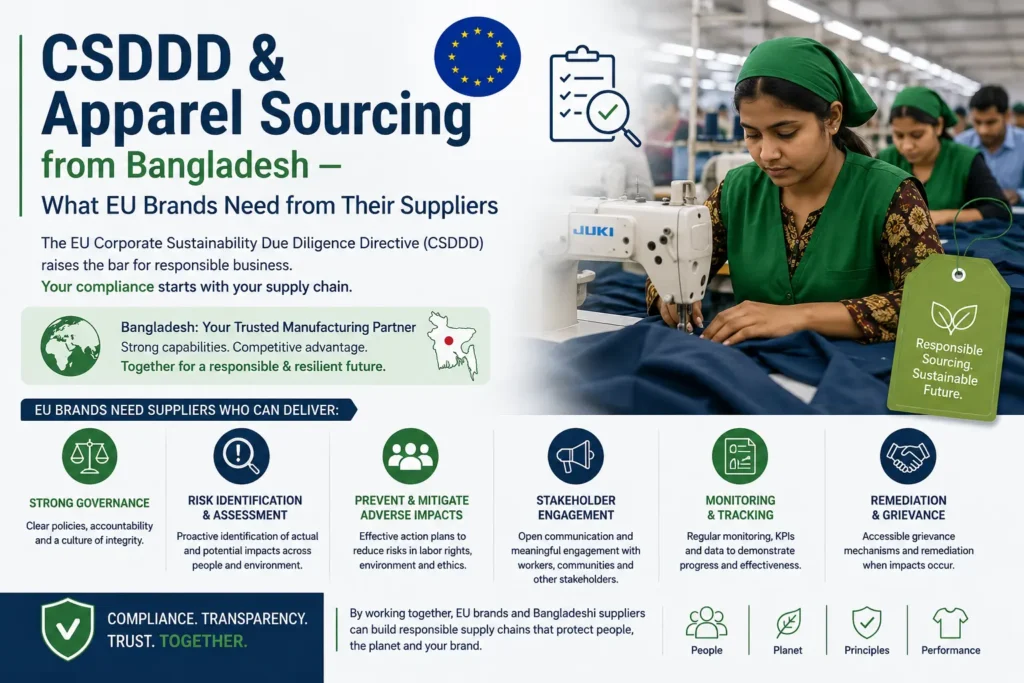
CSDDD & Apparel Sourcing from Bangladesh — What EU Brands Need from Their Suppliers
The EU’s Corporate Sustainability Due Diligence Directive (CSDDD) is reshaping how European fashion brands, importers, and retailers are expected to manage their supply chains — and that expectation flows directly to the factories and sourcing partners you work with in Bangladesh. If you sell apparel into the EU market, CSDDD isn’t only your obligation; it’s a set of requirements you will increasingly need your suppliers to help you meet.
Milky Fashions is a Bangladesh-based garment buying house built around exactly this shift: audited, traceable, well-documented sourcing through BSCI, WRAP, SEDEX, GOTS, and OEKO-TEX certified factories. This guide explains what CSDDD is, how it reaches your Bangladesh supply chain, and how to make your sourcing due-diligence-ready.
Regulatory status note (reviewed early 2026): CSDDD was adopted in 2024, but the EU’s 2025 “Omnibus” simplification package is actively revising its thresholds, timelines, and scope. The principles below are stable; the specific dates and company-size thresholds are moving. Always confirm the current position with an authoritative source such as the European Commission before making compliance decisions.
What Is the CSDDD?
The Corporate Sustainability Due Diligence Directive is an EU law that requires in-scope companies to identify, prevent, mitigate, and account for adverse human rights and environmental impacts connected to their operations and their value chain. In plain terms: large companies selling into the EU can no longer treat what happens upstream — in the mills, dye houses, and garment factories that make their products — as somebody else’s problem. They are expected to actively look for risks, act on them, and be able to prove they did.
For the apparel sector, where value chains stretch from cotton fields to cut-and-sew factories, this is significant. Bangladesh is one of the largest garment sourcing bases serving the EU, so CSDDD’s due-diligence expectations land squarely on the relationship between European buyers and their Bangladeshi suppliers.
Who Does CSDDD Apply To?
CSDDD directly binds large companies — both EU companies above certain employee and turnover thresholds, and non-EU companies generating significant turnover within the EU. The exact thresholds and the phased application dates are among the elements the 2025 Omnibus package is revising, so treat any specific figure you read as provisional until confirmed.
The practical point for a Bangladesh supplier is simpler and more durable: even if your buyer is too small to be directly in scope, they are almost certainly a supplier to someone who is. Large retailers and brands cascade their due-diligence requirements down through their sourcing partners via contracts, codes of conduct, and audits. So the requirements reach small and mid-sized brands indirectly — and reach their suppliers with them. Preparing now is a commercial advantage, not just a legal one.
How CSDDD Reaches Your Bangladesh Suppliers
CSDDD’s due-diligence duty covers a company’s own operations and its chain of activities — the upstream business partners that supply goods and services. For an apparel brand, that chain runs directly into Bangladesh: the buying house, the garment factory, and often the fabric mill and dye house behind them.
In practice, this means EU buyers will increasingly ask their Bangladesh sourcing partners to demonstrate:
- Verified social compliance — valid third-party audits (amfori BSCI, WRAP, SEDEX/SMETA) proving safe, fair labour conditions. See how these frameworks compare in our guide to BSCI vs WRAP vs SEDEX.
- Supply-chain traceability — knowing not just the cut-and-sew factory but the mill and, increasingly, the raw-material source.
- Environmental controls — chemical management and effluent standards, backed by certifications like OEKO-TEX and REACH compliance.
- Documentation and responsiveness — the ability to produce evidence quickly and to engage on any risks identified.
A sourcing partner who can supply this readily makes your due diligence straightforward. A partner who can’t becomes a liability on your CSDDD file.
The Six Steps of CSDDD Due Diligence
CSDDD is built on the internationally recognised OECD and UN due-diligence framework. Whatever the final legislative detail, these six steps are the durable backbone of what “due diligence” means — and where your supplier relationship matters at each stage:
1. Embed due diligence into policy and management
Set out your responsible-business expectations in a supplier code of conduct and management systems. Your Bangladesh partner should be able to sign and operate to it.
2. Identify and assess adverse impacts
Map your supply chain and assess human-rights and environmental risks. This requires supplier transparency — factory lists, audit reports, and traceability data.
3. Prevent and mitigate
Act on the risks found — corrective action plans, improved practices, and choosing partners who already meet high standards rather than remediating poor ones.
4. Track effectiveness
Monitor that measures are working, through repeat audits and ongoing reporting from your suppliers.
5. Communicate
Report publicly on your due-diligence approach and outcomes — which is where CSDDD connects to the separate reporting rules under CSRD.
6. Provide for remediation
Have a grievance mechanism and a route to remedy where harm has occurred. Supplier cooperation is essential to make this real.
CSDDD and the Wider EU Compliance Landscape
CSDDD doesn’t sit alone — it’s the connective tissue across a growing set of EU rules that all touch your Bangladesh sourcing. Understanding how they fit together is what turns compliance from a scramble into a system:
- Germany’s LkSG (Supply Chain Act) — the national predecessor CSDDD builds on and harmonises across the EU. If you sell into Germany, start with our guide to LkSG and Bangladesh sourcing.
- Digital Product Passport (DPP) — traceability data that will make CSDDD-style transparency easier. See DPP for apparel.
- Green Claims Directive — governs the sustainability claims you make; due-diligence evidence underpins credible claims. See EU Green Claims rules for apparel.
- REACH & chemical compliance — the environmental side of due diligence at product level.
For the full picture, our EU supply-chain compliance hub and EU apparel compliance overview tie these regulations together for buyers sourcing from Bangladesh.
How Milky Fashions Makes Your Bangladesh Sourcing CSDDD-Ready
This is where a compliance-first buying house earns its place. Rather than leaving you to audit and chase a fragmented supplier base, we give you a due-diligence-ready supply chain from the start:
- Certified factories only. We work exclusively with BSCI, WRAP, SEDEX, GOTS, and OEKO-TEX certified factories — the audit evidence your due diligence rests on.
- Traceability by design. We know the mills and dye houses behind your garments, not just the final factory, so your supply-chain map is real, not guessed.
- Documentation on demand. Audit reports, test certificates, and compliance declarations supplied as part of the programme — the paperwork that makes your CSDDD file defensible.
- Environmental and chemical control through certified, sustainable sourcing practices.
- One accountable partner. As your buying house — not a single factory — we manage compliance across the whole programme through one point of contact, and we support German-market buyers specifically on LkSG-aligned sourcing.
The result: when your buyer, auditor, or regulator asks for proof, it already exists.
CSDDD Readiness Checklist for Apparel Buyers
A practical starting point for making your Bangladesh sourcing due-diligence-ready:
- Map your supply chain beyond tier one — factory, mill, and material source.
- Require valid, current third-party social audits from every supplier.
- Put a supplier code of conduct in place and get it signed.
- Collect and store audit reports, test certificates, and traceability data centrally.
- Establish a grievance mechanism accessible to workers in your supply chain.
- Consolidate suppliers toward partners who already meet high standards.
- Keep watch on the evolving CSDDD/Omnibus position and adjust as thresholds and dates settle.
Frequently Asked Questions — CSDDD & Bangladesh Apparel Sourcing
What is the CSDDD in simple terms?
The Corporate Sustainability Due Diligence Directive is an EU law requiring large companies to find, prevent, and address human-rights and environmental harms in their operations and supply chains — including the factories that make their products. For apparel brands, that reaches directly into their Bangladesh sourcing.
Does CSDDD apply to my Bangladesh supplier directly?
Usually not directly — CSDDD binds large companies. But those companies pass their due-diligence requirements down to suppliers through contracts and audits, so Bangladesh factories and buying houses are expected to provide the compliance evidence that makes their buyers’ due diligence possible.
My brand is small — does CSDDD still affect me?
Very likely, yes, but indirectly. Even if you fall below the direct thresholds, you probably supply or partner with companies that are in scope, and they will require you — and your suppliers — to meet due-diligence expectations. Preparing early is a commercial advantage.
What should I ask a Bangladesh supplier to prove CSDDD readiness?
Current third-party social audits (BSCI, WRAP, or SEDEX), factory and mill traceability, chemical and environmental certifications such as OEKO-TEX, a signed code of conduct, and the ability to supply documentation on request.
How is CSDDD different from Germany’s LkSG?
LkSG is Germany’s national supply-chain due-diligence law and an early predecessor. CSDDD harmonises similar obligations across the EU. If you already comply with LkSG, you have a strong head start on CSDDD.
Have the CSDDD dates and thresholds changed?
They may have. The EU’s 2025 Omnibus package is revising CSDDD’s timelines, thresholds, and scope. Treat specific dates as provisional and confirm the current position with the European Commission before relying on them.
Build CSDDD-Ready Sourcing from Bangladesh
If you’re preparing your supply chain for the EU’s due-diligence era, the simplest route is to source through a partner who has already built compliance in. Milky Fashions gives you audited, traceable, well-documented sourcing from Bangladesh — so your due diligence is supported by evidence, not assumptions.
Contact Milky Fashions to discuss making your Bangladesh sourcing due-diligence-ready, or learn more about our buying house.