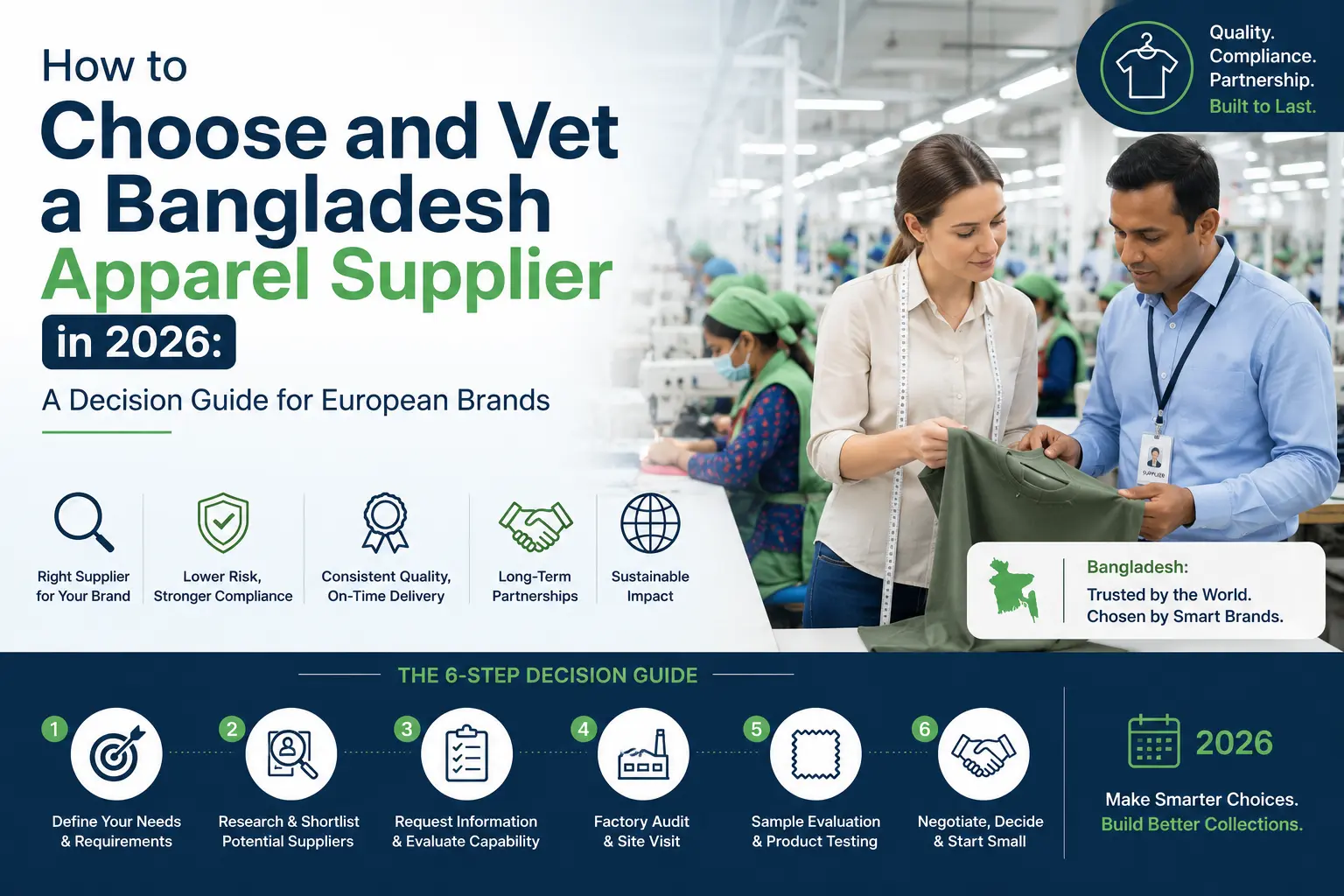
How to Choose and Vet a Bangladesh Apparel Supplier in 2026: A Decision Guide for European Brands
Choosing a Bangladesh apparel supplier is the single decision that determines whether your production runs smoothly or becomes a source of constant risk. For European fashion brands, 2026 raises the stakes: a new wave of EU regulation means your supplier choice now affects not just quality and cost, but your legal compliance. This guide is a practical, buyer-side decision framework — how to shortlist, vet, verify, and question a Bangladesh sourcing partner before you commit a single euro.
It is written by Milky Fashions, an independent, BGBA-registered garment buying house (Member No. M-0357) that has sourced for European brands since 2002. Unlike the “top 10” lists that crown their own author number one, this guide gives you the checklist, the red flags, and the exact questions to ask — so you can judge any supplier, including us, on the evidence. For the underlying market data referenced throughout, see our Bangladesh Supplier Compliance Report 2026.
First decision: buying house, sourcing agent, or factory?
Before you vet anyone, decide what kind of partner your business actually needs. The three options carry very different risk and accountability profiles, and the right answer depends on your order size, your in-house capability, and your appetite for risk.
Direct factory
A factory sells its own production capacity. You may get the lowest unit price, but you carry every risk yourself: vetting, quality control, compliance verification, and accountability when something goes wrong. Factories are also motivated to fill their own lines, not to find your best fit. Going direct works only if you place high volumes of simple, repeating styles and have your own sourcing and QC team on the ground.
Sourcing agent
An agent typically works on a single order with limited ongoing involvement, earning a finder’s fee. Agents can open doors, but they rarely take responsibility across the full production cycle, and transparency about which factory is actually making your goods can be thin.
Independent buying house
A buying house maintains a permanent office, a dedicated merchandising and quality team, and long-term relationships with multiple certified factories. Crucially, an independent buying house owns no factory, so it selects the best-fit factory for your product rather than filling its own lines. For most European brands — especially those without a Dhaka office — this is the model that balances cost, accountability, and compliance. We explain the trade-offs in full in our guide to a buying house versus a direct factory.
Quick decision matrix:
| Your situation | Best fit |
|---|---|
| Large, repeating volumes + in-house QC team in Asia | Direct factory |
| One-off order, you accept the risk | Sourcing agent |
| Growing brand, no local team, need accountability + compliance docs | Independent buying house |
| Small/first order, need low MOQ | Independent buying house |
The 12-point Bangladesh supplier vetting checklist
This is the core of the guide. Run every prospective supplier through these twelve checks before you place an order. A credible partner will pass all twelve without hesitation; evasiveness on any single point is itself a finding.
- Registration. Is the company registered with BGBA (buying houses) or BGMEA (manufacturers), and can it give you its membership number? Bangladesh made Department of Textiles registration mandatory under the Textile Act 2018, yet most operators remain unregistered — so a verifiable registration number is a genuine differentiator, not a given.
- Independence. Does the partner own the factories it places orders with? An independent buying house selects on merit; a factory-owned “sourcing arm” pushes its own capacity. Ask the question directly.
- Certification scope and validity. Which factories hold BSCI, SEDEX/SMETA, WRAP, OEKO-TEX Standard 100, GOTS, and GRS — and are those certificates current? Certificates expire; a logo on a website is not proof.
- Reference clients. Can the supplier name comparable European brands it has served, and will those brands take a call? Relevant, checkable references matter more than a long client logo wall.
- Financial terms. Are payment terms (FOB, deposit/balance split, or Letter of Credit) and the fee structure stated clearly in writing before sampling?
- Communication. Will you have a named contact, responses in your time zone, and merchandising in fluent English? Poor communication is the most common cause of production disputes.
- Capacity and category fit. Does the factory genuinely specialise in your product — knitwear, sweaters, denim, outerwear, or children’s wear — or is it stretching outside its core?
- Sample-to-bulk consistency. Does the supplier follow a structured sampling and approval process, with pre-production samples that bulk must match?
- Quality-control protocol. Are there in-line and final inspections to AQL standards, and can third-party inspection (SGS, Intertek, Bureau Veritas, QIMA) be arranged?
- Subcontracting disclosure. Will the supplier disclose, in writing, every unit involved in your order? Undisclosed subcontracting to unaudited factories is a serious compliance and reputational risk.
- Compliance documentation. Can the supplier provide the chemical, social, and traceability documentation EU rules now require — per order, not on request after a problem?
- Trading history. How long has the company operated? Heritage signals stability; be cautious with very new agencies for high-value programmes.
A buying house worth working with treats this checklist as routine. At Milky Fashions, these answers come as standard — see our textile certifications and quality control process.
Red flags that should stop a deal
Some warning signs are serious enough to end a conversation. If you see any of these, slow down and verify before committing.
- A “factory” you can’t locate. A P.O. box, a shared address, or refusal to share the exact production site.
- Certificate logos with no proof. BSCI or OEKO-TEX badges on a website but no PDF, audit ID, or QR code when you ask.
- “We can get certified later.” Compliance is not a promise to be fulfilled after your order ships.
- Refusal to share audit reports or Corrective Action Plans. Transparency about what an audit found — and how it was fixed — is the mark of a serious operator.
- Pressure to skip samples. Any supplier rushing you past pre-production approval is shifting risk onto you.
- Hidden or vague fees. A partner who won’t state their commission or margin structure in writing is hiding something.
- Undisclosed subcontracting. If the producing unit changes without your knowledge, you have lost control of quality and compliance.
- Self-declared “number one” with no evidence. A ranking means nothing without checkable criteria behind it.
The cost of ignoring these is real. There are documented cases of European orders being destroyed at the border over chemical-safety failures, and of brands discovering their goods were made in unaudited units. Due diligence up front is far cheaper than a rejected shipment.
How to verify a certificate is genuine
Fake, expired, and “borrowed” certificates are common enough that every buyer should know how to check independently. You do not need to take a supplier’s word for it.
- OEKO-TEX: Use the official OEKO-TEX Label Check tool to validate a STANDARD 100 certificate number against the issuing institute’s database.
- GOTS and GRS: Search the public GOTS and Textile Exchange databases by certificate number or facility name; organic and recycled claims must trace to a valid scope certificate.
- BSCI / SEDEX: Request the full audit report and audit ID, not just a summary. SMETA reports list the audit body and date.
- Third-party verification: For high-value programmes, commission an independent audit through SGS, Intertek, Bureau Veritas, or QIMA before bulk production.
A reputable buying house will hand you these verification routes proactively. If you have to fight for them, that is your answer.
MOQ reality for European brands
Minimum order quantity is where many European brands — especially smaller and first-time buyers — hit a wall. Large Bangladesh factories prefer runs of several thousand pieces per style and prioritise their biggest clients, which can leave independent brands locked out.
This is one of the clearest reasons to work through a buying house: by aggregating orders across a factory network, a buying house can secure far lower minimums than a brand approaching a factory cold.
| Product category | Typical direct-factory MOQ | Achievable via buying house |
|---|---|---|
| Basic knitwear / jersey | 3,000–5,000 / style | from ~500 / style |
| Woven garments | 2,000–5,000 / style | from ~500–1,000 / style |
| Sweaters / cardigans | 1,000–3,000 / style | from ~300–500 / style |
| Denim | 3,000+ / style | from ~1,000 / style |
A good buying house also helps you structure orders — combining colourways or coordinating shared fabric — to meet minimums without creating dead stock. See our private label clothing manufacturing page for how this works in practice.
Commission and fee structures: what you’ll really pay
Fee transparency separates trustworthy partners from the rest. Most buying houses in Bangladesh work on commission, typically in the range of 3% to 8% of the FOB value of an order — usually 3–5% for established factory relationships and 5–8% for new introductions. By common Bangladeshi commercial practice, around 5% is the standard, frequently collected from the manufacturer rather than added to the buyer’s price.
The number matters less than the transparency. Ask any prospective partner:
- Is your fee a clearly stated service commission, or is it buried inside an inflated unit price?
- Is pricing quoted FOB or on a cost-of-making (CM) basis, and which Incoterms apply?
- Are there any rebates or kickbacks from the factory that I am not seeing?
When you compare quotes, look at total landed cost and the value of services included — factory vetting, sampling, QC, and compliance — not just the headline factory price. The commission of a transparent buying house is almost always smaller than the cost of one failed, non-compliant shipment.
Making your Bangladesh supply chain EU-compliant for 2026–2028
This is what has changed most for European buyers, and it should now weigh heavily in supplier selection. A wave of EU regulation is converting “sustainability” from a marketing preference into a documented legal obligation — and your supplier is the source of the data you will need.
- France’s PFAS ban has applied since 1 January 2026, prohibiting PFAS-treated clothing above strict thresholds. France-bound goods need PFAS-free declarations backed by lab reports. Our France 2026 compliance playbook covers this in detail.
- The EU greenwashing ban (ECGT) applies from 27 September 2026, outlawing generic claims like “eco-friendly” unless backed by recognised proof. Every green claim now needs a verifiable certificate behind it.
- CSRD and CSDDD, as revised by the Omnibus I package, apply directly only to the largest brands — but those brands cascade due-diligence requests down to suppliers of every size.
- The Digital Product Passport under ESPR is expected to require fibre composition, origin, and certification data for textiles from around 2027–2028.
The common thread: every one of these rules depends on verifiable supply-chain data — material composition, origin, certifications, and audits. A supplier that captures this as standard makes compliance a single export; one that does not makes it a scramble. Our EU supply chain compliance guide sets out exactly what to request.
When vetting a supplier in 2026, add one decisive question to your checklist: Can you provide, per order, the documentation I need for PFAS, the eco-score, CSDDD, and the Digital Product Passport? The answer tells you whether a supplier is built for the current decade or the last one.
Tariffs after Bangladesh’s LDC graduation
Supplier selection is also a budgeting decision, and 2026 brings a tariff variable European buyers must plan around. Bangladesh graduates from Least Developed Country status on 24 November 2026. Its duty-free EU access under Everything But Arms continues through a transition window to around November 2029. After that, without GSP+ or a trade agreement, apparel could face roughly 9.6–12% EU duty.
For European buyers, the practical step is to model your 2027–2030 sourcing budget under three scenarios — duty-free, standard GSP, and GSP+ — rather than assuming today’s zero duty continues indefinitely. UK buyers face no equivalent cliff: under the Developing Countries Trading Scheme, Bangladesh keeps duty-free UK access regardless of graduation. We track this in our analysis of Bangladesh’s apparel sourcing landscape for the UK.
Questions to ask before you commit
Before signing, put these questions to any Bangladesh supplier. The quality and directness of the answers will tell you most of what you need to know.
- What is your BGBA or BGMEA registration number?
- Do you own the factories that will make my order, or do you source independently?
- Which certifications do the producing factories hold, and can I verify them by number?
- Will you name every unit involved in my production, including subcontractors?
- What is your fee, and is it a stated commission or built into the price?
- What is the realistic MOQ for my product and order size?
- Can you share recent inspection reports and references from European brands?
- What compliance documentation will you provide per order for the EU market?
- What is your standard lead time, and how do you handle delays?
- Who will be my named point of contact, and in which time zone?
A note on the numbers competitors quote
When you research Bangladesh sourcing, you will see inflated figures — “$45 billion in exports,” “84% of export earnings.” Use the official data instead. According to the Export Promotion Bureau, Bangladesh’s ready-made garment exports were US$39.35 billion in FY2024-25 (up 8.84%), equal to about 81.5% of national merchandise exports, with the EU taking just over half. A supplier that quotes accurate, sourced figures is signalling something about how it handles facts generally — and so is one that doesn’t. The full, attributed dataset is in our Bangladesh Supplier Compliance Report 2026.
Frequently asked questions
How do I find a reliable clothing manufacturer in Bangladesh?
Start by deciding whether you need a factory, an agent, or an independent buying house, then run each candidate through a vetting checklist: registration, independence, current certifications, references, transparent fees, and compliance documentation. Verify certificates independently and request inspection reports before committing. Working through a registered buying house is the most reliable route for European brands without a local team.
What is the difference between a buying house, a sourcing agent, and a factory?
A factory makes and sells its own production. A sourcing agent typically arranges a single order for a finder’s fee with limited ongoing involvement. An independent buying house maintains a permanent office and team, sources from multiple certified factories on the buyer’s behalf, and stays accountable across the whole order without owning any factory.
How much commission do buying houses in Bangladesh charge?
Buying houses generally charge 3% to 8% of the FOB order value — around 3–5% for established factory relationships and 5–8% for new introductions, with roughly 5% a common standard often collected from the manufacturer. What matters most is transparency: the fee should be stated in writing, not hidden inside an inflated unit price.
What is the minimum order quantity for garments in Bangladesh?
Direct from a large factory, MOQs often run to several thousand pieces per style. Through a buying house that aggregates orders, minimums can start from around 300–500 pieces per style for knitwear and sweaters and from 500–1,000 for woven garments, making Bangladesh accessible to smaller European brands.
How do I verify a Bangladesh factory’s certifications?
Validate OEKO-TEX certificates with the official Label Check tool, search the GOTS and Textile Exchange databases for organic and recycled claims, and request full BSCI or SMETA audit reports with audit IDs. For high-value orders, commission an independent audit through SGS, Intertek, Bureau Veritas, or QIMA.
What are the red flags when choosing a Bangladesh garment supplier?
Watch for unverifiable factory addresses, certificate logos without documentation, refusal to share audit reports, pressure to skip samples, hidden fees, undisclosed subcontracting, and self-declared rankings with no evidence. Any of these warrants stopping to verify before you commit.
Should I work with a factory directly or through a buying house?
Go direct only if you place high volumes of simple styles and have your own quality and compliance team in the region. For most European brands — especially those needing low MOQs, accountability, and EU compliance documentation — an independent buying house is the lower-risk choice.
What documents should a Bangladesh supplier provide for EU compliance?
For 2026, request OEKO-TEX certificates and PFAS-free lab declarations for France, current BSCI/SEDEX/WRAP audits for due diligence, GOTS or GRS certificates for sustainability claims, and full material-composition and origin data for the eco-score and the coming Digital Product Passport — ideally consolidated per order.
Is it safe and ethical to source from Bangladesh?
Yes, when you source through certified, audited factories. Bangladesh has built one of the deepest compliance infrastructures in global apparel since 2013, including the world’s largest base of LEED-certified green factories. The key is verifying each factory’s certifications and audits rather than assuming them.
How long does production take when sourcing from Bangladesh?
Standard production lead times run approximately 60 to 90 days from order confirmation to shipment, depending on product category, fabric, and volume, with sampling typically adding two to three weeks beforehand. Sea freight to European ports adds roughly three to four weeks, while air freight is available for urgent orders or initial drops. A reliable supplier commits to a time-and-action calendar and flags any slippage early, rather than revealing delays only at the shipping deadline. When vetting a partner, ask how they manage capacity peaks and disruption, because consistency of on-time delivery matters more than the headline lead time.
Make your next sourcing decision the right one
The European brands that thrive in 2026 will be those that choose suppliers on evidence, not marketing — and that build documented, compliant Bangladesh supply chains before the regulatory deadlines bite. Use the checklist, the red flags, and the questions in this guide on every supplier you consider.
If you would like to work with an independent, BGBA-registered buying house that meets every test in this guide, contact Milky Fashions — sourcing certified, compliant apparel from Bangladesh for European brands since 2002. You can also learn more about Milky Fashions and how we work.
Director and Head of Merchandising at Milky Fashions, a BGBA-registered garment buying house in Bangladesh since 2002. Specialises in knitwear sourcing, factory compliance, and European buyer relations.