Sourcing Apparel from Bangladesh as a French Brand: The 2026 Compliance Playbook
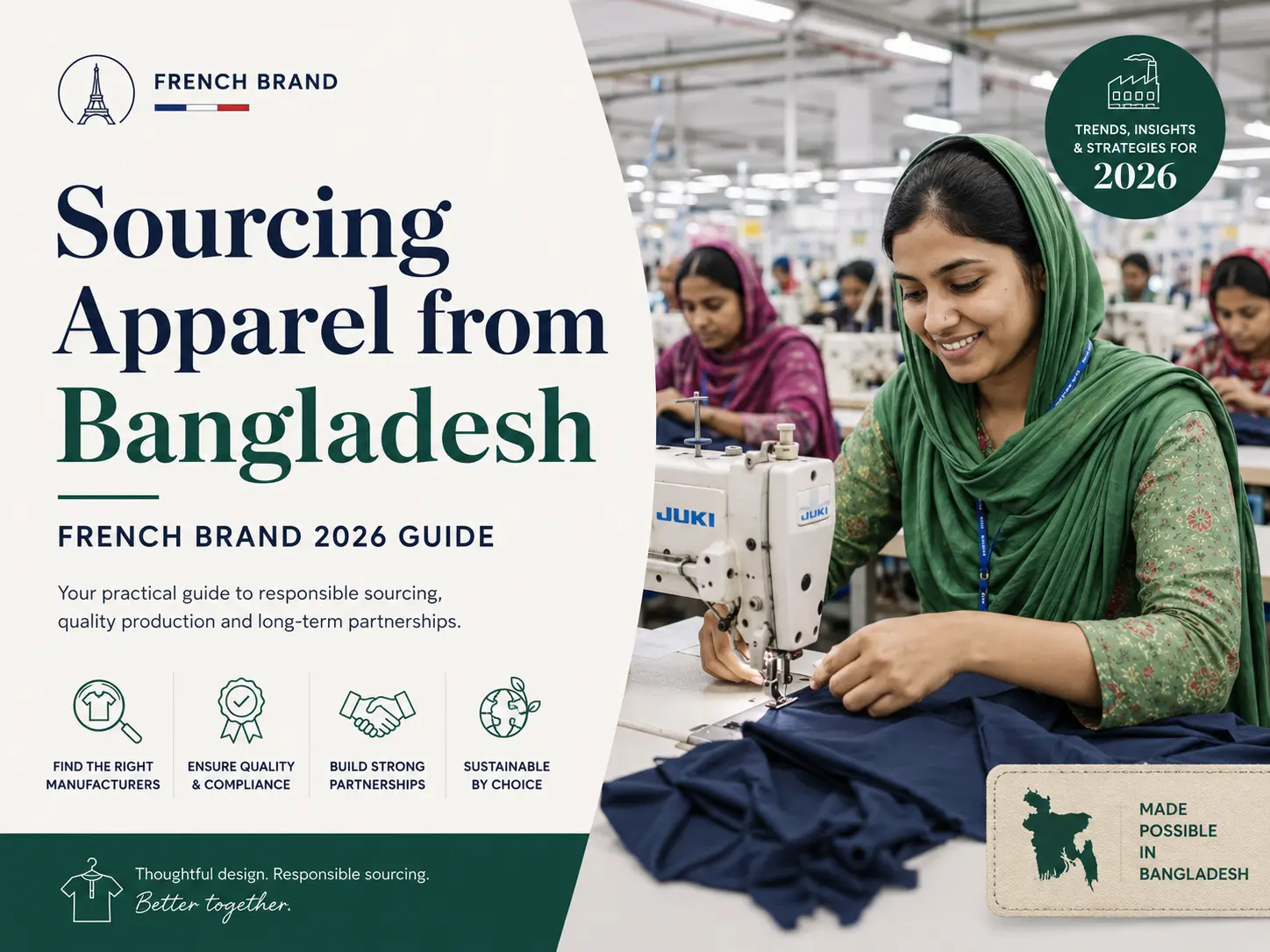
Apparel sourcing Bangladesh France compliance is a growing priority for fashion brands selling on the French market in 2026 — this playbook covers every regulation you need to meet, from the PFAS ban and the Environmental Cost eco-score to CSDDD after Omnibus I and the Digital Product Passport. French fashion brands sourcing from Bangladesh in 2026 face four regulatory pillars: France’s PFAS ban (in force since 1 January 2026), the Environmental Cost eco-score (coût environnemental), EU due diligence under CSRD and CSDDD as revised by Omnibus I, and the coming Digital Product Passport. None of these prevents you from sourcing in Bangladesh — but each one demands supplier data and documentation you must secure before production, not after. This playbook explains exactly what applies, when, and how an independent buying house turns compliance from a risk into a competitive advantage.
Bangladesh is the EU’s largest garment supplier and France’s compliance regime is now the strictest in Europe — so getting this right is not optional for any brand selling apparel on the French market, whether you produce 500 pieces or 500,000. Milky Fashions is a BGBA-registered garment buying house in Bangladesh that has sourced for European brands since 2002, and the guidance below reflects how we prepare French clients for each requirement.
The four regulations every French fashion brand must plan for in 2026
In 2026, four frameworks define compliant sourcing for the French market. Two apply to every brand regardless of size — the PFAS ban and the Environmental Cost — and two are size-dependent or still phasing in. Here is the short version before the detail.
France’s PFAS ban (Law 2025-188)
Since 1 January 2026, manufacturing, importing, exporting or selling PFAS-treated clothing and footwear in France is prohibited above strict residual thresholds. This applies to all brands and all order sizes.
The Environmental Cost eco-score (coût environnemental)
France’s life-cycle-based environmental label for textiles has been live since 1 October 2025. From 1 October 2026, third parties can publish a score on your behalf if you have not — using worst-case data assumptions that penalise brands lacking supplier data.
EU due diligence: CSRD and CSDDD after Omnibus I
The Omnibus I directive, published 26 February 2026, narrowed scope and pushed CSDDD application to 26 July 2029. Only the largest brands are directly in scope, but their due-diligence demands cascade down the supply chain to brands of every size.
The Digital Product Passport (ESPR)
The textile Digital Product Passport delegated act is expected in Q2 2027, with compliance roughly 18 months later. The technical infrastructure goes live in 2026, so data preparation should begin now.
France’s PFAS ban: what it means for your Bangladesh production
Since 1 January 2026, France prohibits the manufacture, import, export and sale of clothing textiles and footwear containing PFAS — the so-called “forever chemicals” used in water- and stain-repellent finishes — above defined residual limits. The ban comes from Law No. 2025-188 and its implementing Decree No. 2025-1376, and it is enforced by French customs and the DGCCRF through testing, audits and market bans. For a French brand importing from Bangladesh, this means every treated garment must be demonstrably PFAS-compliant before it reaches the French market.
The thresholds you must meet
Three residual limits define compliance: 25 parts per billion for any single PFAS measured by targeted analysis, 250 parts per billion for the sum of targeted PFAS, and 50 milligrams per kilogram of total fluorine including polymers. If total fluorine exceeds 50 mg/kg, you must be able to prove on request that the fluorine does not originate from PFAS. Stock manufactured before 1 January 2026 may be sold for a transition period ending 31 December 2026, and from 1 January 2030 the ban widens to cover all textile products, not just clothing and footwear.
How to source PFAS-free from Bangladesh
The practical route to compliance is to source through factories that already operate to chemical-management standards. Production certified to OEKO-TEX STANDARD 100 tests for restricted substances including PFAS, and ZDHC-aligned mills control input chemistry at source. Milky Fashions works only with certified factories and can supply the chemical-test documentation French brands need to demonstrate PFAS compliance. A limited exemption exists for garments containing at least 20% post-consumer recycled material, where residual PFAS is confined to the recycled fraction — relevant for brands building recycled-content ranges.
The French Environmental Cost (eco-score): why supply-chain data is now your asset
The Environmental Cost — coût environnemental, formerly the French eco-score — is a single life-cycle score displayed to consumers on a garment’s environmental impact. It has been in force since 1 October 2025 under Decree No. 2025-957, calculated using the government’s Ecobalyse methodology. For French brands, the score is built almost entirely from supply-chain data, which makes your Bangladesh supplier’s information a direct input into a number French consumers will see.
How the score is calculated
The Environmental Cost aggregates 16 life-cycle impact indicators — greenhouse gas emissions, water use, land use, chemical toxicity and more — using the EU’s Product Environmental Footprint method, then adds textile-specific factors including durability and microfibre release. The result is expressed in environmental points, where a lower score signals lower impact. Material composition, country of manufacture, fabric weight and processing all feed the calculation, so accurate supplier data directly improves your score.
The October 2026 third-party rule is the real deadline
While publishing your own score remains voluntary, from 1 October 2026 any third party — a retailer, NGO, comparison platform or even a competitor — may calculate and publish an Environmental Cost on your behalf if you have not done so. Crucially, third parties use Ecobalyse default values, which apply conservative, worst-case assumptions and produce a higher (worse) score than your real data would. There is also a consistency rule: if you display any other environmental claim, you must co-display the official Environmental Cost. In practice, self-declaration with accurate supplier data is the only way to protect how your brand appears.
What data your Bangladesh supplier must provide
To calculate an accurate score you need verified material composition, fibre origin, manufacturing location, processing steps and weight per garment. This is precisely the data a buying house assembles as part of normal production management. Milky Fashions provides this supply-chain dataset for every order, giving French brands the inputs to generate a defensible Environmental Cost rather than accepting a penalising default.
EU due diligence after Omnibus I: CSRD, CSDDD and your factory documentation
The Omnibus I simplification directive, published in the EU Official Journal on 26 February 2026 and in force from 18 March 2026, significantly reshaped Europe’s two due-diligence laws. Understanding who is now in scope — and who is not — saves French brands from both over-compliance and dangerous gaps. Our dedicated EU supply chain compliance guide covers the technical detail; the France-specific essentials are below.
Who is actually in scope now
After Omnibus I, the Corporate Sustainability Due Diligence Directive (CSDDD) applies only to very large companies — EU firms with more than 5,000 employees and over €1.5 billion in turnover, and non-EU firms with over €1.5 billion of EU turnover — with obligations starting 26 July 2029. The Corporate Sustainability Reporting Directive (CSRD) now applies to companies above 1,000 employees and €450 million turnover. Most independent French fashion brands fall below these thresholds and are not directly obligated.
Why documentation still matters even if you’re below threshold
Being below the threshold does not mean you can ignore due diligence. Large French and EU retailers that ARE in scope must document their supply chains, and they push those requirements down to every supplier and brand they buy from. If you sell to, manufacture for, or aspire to supply a major retailer, you will be asked for Tier 1 factory audits, social-compliance evidence and risk documentation. A buying house that holds BSCI, SEDEX/SMETA, WRAP, GOTS, GRS and OEKO-TEX documentation for every factory lets you answer those requests immediately. This is a core reason French brands choose to work through a buying house rather than direct factory relationships.
The Digital Product Passport: prepare your data now
The Digital Product Passport (DPP) will require a QR-accessible record of a garment’s materials, origin, durability and environmental impact. For textiles, the delegated act under the EU’s Ecodesign for Sustainable Products Regulation (ESPR) is expected in Q2 2027, with compliance roughly 18 months later — meaning late 2028 or early 2029. The DPP applies to any brand selling in the EU regardless of where it or its factories are based, so French brands sourcing from Bangladesh are firmly in scope.
Why 2026 is the year to start
Although no textile DPP is mandatory yet, the supporting infrastructure — the EU DPP registry and CEN/CENELEC technical standards — goes live in 2026. The data a DPP requires is the same data already needed for the Environmental Cost and for due diligence: material composition, traceable origin and supply-chain mapping. Brands that build this dataset now, through a supplier that captures it as standard, will face a simple data export in 2028 rather than a scramble. A DPP-ready supply chain is, in effect, a by-product of doing the eco-score and due-diligence work properly today.
Two more rules French brands should track: Green Claims and textile EPR
Beyond the four core pillars, two further EU rules will shape French-market sourcing, and both reward the same supplier discipline. The first is the Empowering Consumers / Green Claims framework: from 27 September 2026, generic environmental claims such as “eco-friendly” and offset-based “climate neutral” labels are banned across the EU unless substantiated with evidence. For a French brand, this means every sustainability claim on a Bangladesh-made garment must be backed by certification — GOTS for organic cotton, GRS for recycled content, OEKO-TEX for chemical safety — rather than vague marketing language.
The second is Extended Producer Responsibility (EPR) for textiles, which is becoming mandatory across the EU by 2027 to 2028 and already operates in France through the Refashion eco-organisation. Under EPR, brands pay fees and report the quantities they place on the market, with eco-modulation that rewards durable, recyclable and certified products. Accurate product and material data from your supplier feeds directly into both lower EPR fees and stronger green-claim substantiation. In short, the certified, well-documented sourcing that satisfies the PFAS ban and the eco-score also positions you for Green Claims and EPR — which is why consolidating production through one garment buying house is the most efficient path to French compliance overall.
How Milky Fashions makes French compliance manageable
For a French brand, the common thread across all four regulations is the same: each one depends on accurate, verifiable supply-chain data from your factory. An independent buying house is built to capture exactly that. Milky Fashions sources only through audited, certified factories, manages production end to end, and assembles the chemical, social and environmental documentation French compliance now requires — supplied with the order, not chased after a problem.
Because Milky Fashions owns no factory, it selects the best-fit certified factory for your product rather than filling its own lines, and it communicates from buyer-side offices in London and Calgary alongside its Dhaka head office. French brands can explore our dedicated apparel sourcing for France page, our private label manufacturing service, or learn more about Milky Fashions.
Your 2026 France compliance checklist
Use this checklist when briefing any Bangladesh supplier for the French market:
- PFAS: Confirm OEKO-TEX STANDARD 100 or equivalent chemical testing, and obtain documentation showing residual PFAS below French thresholds.
- Environmental Cost: Collect verified material composition, fibre origin, manufacturing location, weight and processing data for every style, and self-declare your score before October 2026.
- Due diligence: Obtain BSCI, SEDEX/SMETA or WRAP audits plus subcontractor disclosure for every factory, even if you are below CSDDD threshold.
- Sustainable materials: Where you make green claims, secure GOTS or GRS certification to substantiate them and meet the Green Claims rules taking effect in September 2026.
- DPP readiness: Ensure your supplier captures traceable supply-chain data now, so a Digital Product Passport export is straightforward by 2028.
- One accountable partner: Consolidate all of the above through a single buying house so documentation arrives per order, in one file.
Frequently asked questions
Is Bangladesh apparel sourcing compliant with France’s AGEC and 2026 rules?
Yes, provided you source through certified factories and obtain the right documentation. Bangladesh holds one of the deepest compliance infrastructures of any sourcing country, with widespread BSCI, SEDEX, WRAP and OEKO-TEX certification. A buying house supplies the chemical, social and environmental data French rules require, so Bangladesh-made garments can meet PFAS, eco-score and due-diligence obligations.
What does the France PFAS ban mean for clothing imported from Bangladesh?
Since 1 January 2026, clothing containing PFAS above residual thresholds (25 ppb per PFAS, 250 ppb total, 50 mg/kg total fluorine) cannot be sold in France. Garments imported from Bangladesh must be produced with PFAS-free finishes and supported by chemical-test documentation. Sourcing through OEKO-TEX certified factories is the most reliable route to compliance.
Do small French fashion brands need to comply with CSDDD?
Most small French brands are not directly in scope of CSDDD, which after Omnibus I applies only to companies above 5,000 employees and €1.5 billion turnover from 2029. However, the PFAS ban and the Environmental Cost apply to all brands regardless of size, and large retail customers will still request due-diligence documentation from smaller suppliers.
What is the French eco-score, and does it apply to imported clothing?
The French eco-score, officially the Environmental Cost (coût environnemental), is a life-cycle environmental label for clothing sold in France, in force since October 2025. It applies to all apparel placed on the French market, including imports from Bangladesh. From October 2026, third parties can publish a score on your behalf using penalising default data if you have not self-declared.
When does the Digital Product Passport apply to textiles?
The textile Digital Product Passport delegated act is expected in Q2 2027, with compliance roughly 18 months later — around late 2028 or early 2029. It will apply to all brands selling textiles in the EU, including French brands sourcing from Bangladesh. The supporting infrastructure goes live in 2026, so data preparation should begin now.
How does a Bangladesh buying house help French brands with compliance?
A buying house captures the verified supply-chain data — material composition, origin, certifications, audits and chemical tests — that every French regulation now depends on, and supplies it with each order. Because all four 2026 frameworks rely on the same underlying factory data, consolidating production through one buying house turns compliance into a single, manageable documentation process.
Can Milky Fashions provide PFAS-free certified garments for the French market?
Yes. Milky Fashions sources exclusively through certified factories, including OEKO-TEX STANDARD 100 production that tests for restricted substances, and provides the chemical-compliance documentation French brands need to meet the 2026 PFAS ban. We also supply GOTS and GRS certified options for sustainable French collections.
Source compliant from Bangladesh for the French market
Milky Fashions has helped European brands navigate changing regulation since 2002. If you are a French brand that needs PFAS-free, certified, fully documented sourcing from Bangladesh, contact Milky Fashions for a compliance-ready quotation tailored to the French market.

Director and Head of Merchandising at Milky Fashions, a BGBA-registered garment buying house in Bangladesh since 2002. Specialises in knitwear sourcing, factory compliance, and European buyer relations.