
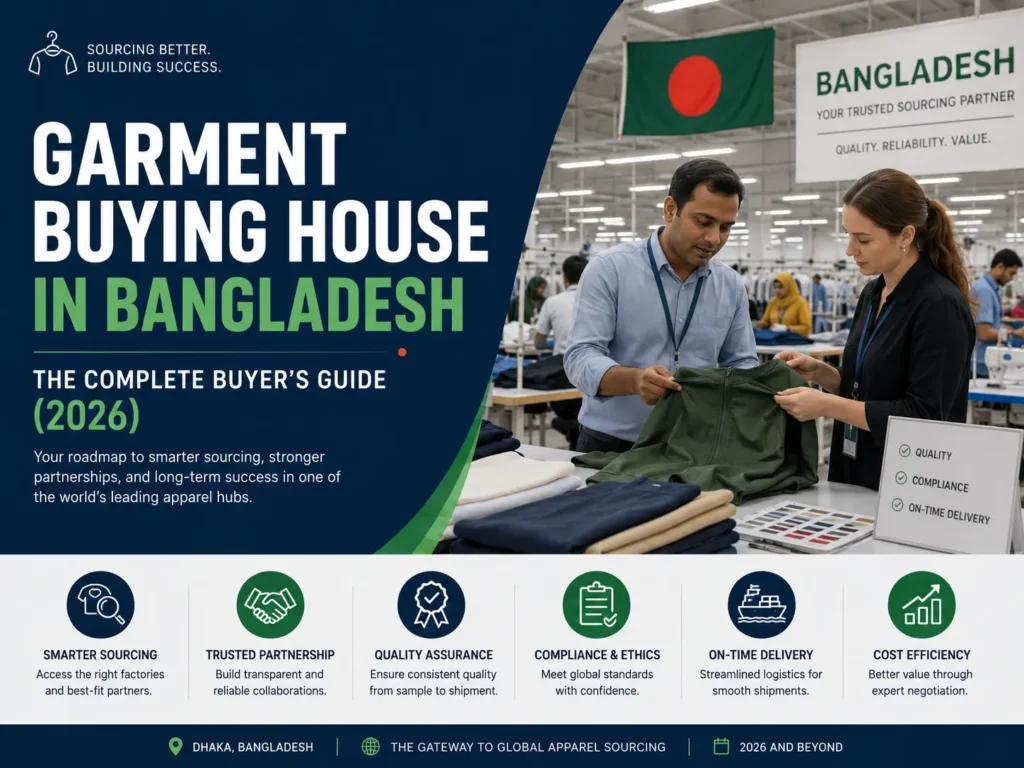
Garment Buying House in Bangladesh: The Complete Buyer’s Guide (2026)
A garment buying house in Bangladesh is an independent sourcing partner that selects the right certified factory for your product, manages sampling and production, controls quality, and handles export — working only in the buyer’s interest, never selling its own factory capacity. For fashion brands, retailers, and importers without a local team, it is the safest and most cost-effective way to source from the world’s second-largest garment exporter.
Bangladesh exported around $38.48 billion in apparel in 2024, holding its place behind China as the world’s second-largest garment exporter (WTO). Yet the country is also home to more than 6,000 buying houses, of which only about 1,000 are formally registered with BGMEA. That gap is exactly why choosing the right partner matters so much. This guide explains what a garment buying house does, how it differs from a factory or a trading agent, what it costs, how to vet one, and why EU compliance now decides which suppliers European brands can use at all.
Milky Fashions has operated as an independent, BGBA-registered garment buying house (Member M-0357) since 2002, with correspondent offices in London and Calgary serving European and global fashion brands.
For a full side-by-side breakdown — cost, control, risk, and when each option
makes sense — see our complete guide: Buying House vs Direct Factory in Bangladesh.
What is a garment buying house in Bangladesh?
A garment buying house is an intermediary that represents the buyer rather than the factory. It sits between an international brand or importer and Bangladesh’s ready-made garment (RMG) manufacturing base, taking responsibility for finding suitable factories, developing samples, negotiating price, supervising production, inspecting quality, and managing shipment and export documentation.
The defining characteristic is independence. A factory sells you its own production capacity and is motivated to keep its lines full. A genuine buying house has no factory to fill, so it selects whichever certified factory is the best fit for your product, target price, and timeline — and stays accountable across the entire order. For brands working without an in-house sourcing office, that single difference protects quality, cost, and compliance.
Buying house vs. sourcing agent vs. liaison office
These terms are often used interchangeably, but they describe different operating models, and the distinction affects how much accountability you actually get.
A sourcing agent typically works on a per-order basis with limited ongoing involvement, often coordinating a single transaction. A buying house usually maintains a permanent office, a dedicated merchandising and quality team, and long-term relationships with factories across multiple product categories — meaning continuity, deeper factory leverage, and consistent oversight. A liaison office is the local arm of a single international brand, following that brand’s own processes and working exclusively on its own production; it is effective but expensive and only relevant to large retailers.
For most growing fashion brands, an independent buying house offers the best balance of accountability, factory access, and cost. To see how this compares with going factory-direct, read our detailed breakdown of a buying house versus a direct factory in Bangladesh.
New to the industry? See our dedicated guidance for a clothing manufacturer for startups and new fashion brands.
Why source garments from Bangladesh?
Bangladesh offers a combination that few sourcing destinations can match: globally competitive labour costs, the world’s deepest knitwear ecosystem, and a rapidly maturing base of certified, compliant factories. The country produces more knitwear than any nation except China, with fabric mills, dyeing houses, printing units, and finishing facilities all clustered within a single integrated supply chain. That integration shortens lead times and tightens quality control.
Most importantly for European buyers, leading Bangladeshi factories now hold the certifications that international retail demands — BSCI, WRAP, SEDEX, OEKO-TEX Standard 100, GOTS, and GRS — making credible, certified, sustainable production achievable at scale.
What does a garment buying house do?
A full-service garment buying house manages your order from first enquiry to delivered goods, acting as your local sourcing office on the ground in Dhaka. Its core responsibilities cover the entire production lifecycle.
The end-to-end sourcing workflow
- Factory selection and vetting — identifying and assessing certified factories matched to your product category, minimum order quantity, and quality level.
- Sampling and product development — managing tech packs, fit samples, and pre-production approvals so that bulk production matches the approved sample.
- Price negotiation and costing — securing competitive factory pricing on the buyer’s behalf and providing transparent costing.
- Quality control — conducting in-line and final inspections, commonly to AQL standards, to catch defects before goods ship.
- Compliance auditing — confirming factories meet social and environmental standards and helping document compliance for your market.
- Production follow-up — tracking the order against a time-and-action calendar and flagging delays early.
- Export and logistics — coordinating shipment, customs paperwork, Incoterms (FOB, CIF, C&F), and rules-of-origin documents for duty-free clearance where applicable.
In short, the buying house becomes the experienced local team you do not have to hire, letting you focus on design, marketing, and selling. Explore the full scope of our garment sourcing services in Bangladesh and the product categories we cover.
Buying house vs. direct factory: which is right for your brand?
Brands sourcing from Bangladesh usually weigh three routes: deal with a factory directly, use a trading agent, or appoint an independent buying house. Each carries a different balance of cost and risk.
A direct factory can offer the lowest unit price, but you absorb all the risk — vetting, quality control, compliance verification, and accountability — and the factory is incentivised to fill its own lines rather than find your best fit. A trading agent often marks goods up and may obscure which factory is actually producing your order, reducing transparency. An independent buying house works openly on the buyer’s side, selects the most suitable certified factory regardless of capacity pressure, and remains accountable throughout.
For new and mid-size brands especially, the apparent saving of going factory-direct is frequently erased by a single failed shipment, a missed compliance requirement, or a sample-to-bulk quality gap. The risk avoided usually outweighs the buying house commission many times over. We cover this trade-off in depth on our buying house vs. direct factory and apparel supplier in Bangladesh pages.
Comparing sourcing countries as well as sourcing models? See our full Bangladesh vs Vietnam vs China comparison.
How much does a garment buying house in Bangladesh cost?
Most garment buying houses in Bangladesh charge a commission of roughly 3% to 8% of the FOB (Free On Board) value of each order. The exact rate depends on order size, product complexity, and the breadth of services provided, with larger and more regular orders typically attracting lower commission rates.
This commission covers the full service: factory selection, sampling and development, price negotiation, quality control, compliance oversight, and export coordination. A transparent buying house explains its commission structure up front rather than burying margin inside an inflated unit price. When comparing quotes, evaluate the total landed cost and the value of the services included — not just the headline factory price. For most brands, the cost of professional vetting and inspection is small relative to the cost of a rejected or non-compliant shipment.
How to choose a reliable garment buying house in Bangladesh
To choose a reliable garment buying house in Bangladesh, verify five things: independence from factory ownership, formal registration and heritage, access to certified factories, transparent communication, and proven experience with your target market’s compliance requirements. With more than 6,000 buying houses operating but only around 1,000 registered with BGMEA, due diligence is essential.
Use this checklist when shortlisting a partner:
- Independence — Does the buying house own or control a factory? A true buying house works only for the buyer and selects factories on merit.
- Registration and track record — Is the company registered (for example with BGBA or BGMEA), and how long has it operated? Heritage signals stability and accountability.
- Certified factory network — Can it prove access to BSCI, WRAP, SEDEX, OEKO-TEX, GOTS, and GRS certified factories relevant to your product?
- Market and compliance experience — Has it shipped to your region, and does it understand its rules — UK DCTS, EU CSDDD, French AGEC, REACH, and the Digital Product Passport?
- Transparency — Will it name the producing factory, share inspection reports, and communicate in your time zone?
- References — Can it point to comparable brands it has served?
If you’re weighing up your options, it helps to see how the leading players compare on commission structure, minimum order quantities, certifications, and buyer fit. Our detailed guide to the top garment buying houses in Bangladesh offers an honest, criteria-based comparison to help you shortlist the right partner for your brand.
Red flags to avoid
Treat the following as warning signs: a supplier that cannot clearly state whether it owns its factories; vague or evasive answers on certifications; pricing that looks too good to be unverified; reluctance to share factory names or inspection documentation; and a lack of any verifiable registration or trading history. In a market this large, the absence of transparency is itself the answer.
Minimum order quantities (MOQ) explained
Minimum order quantities depend on fabric, product complexity, and the factory tier you are matched with. Working through a buying house, typical MOQs for private-label apparel commonly fall in the range of a few thousand pieces per style, though this varies significantly by category, fabric, and season.
A capable buying house helps you structure orders to meet factory minimums efficiently — for example by combining colourways, coordinating shared fabric, or grouping styles — rather than forcing you into dead stock. This is one of the practical advantages of an experienced sourcing partner over a cold factory negotiation. Learn more on our private label clothing manufacturing in Bangladesh page.
EU compliance: the new dividing line for European brands
For European fashion brands, compliance is no longer a back-office formality — it increasingly determines which suppliers are viable at all. A buying house that genuinely understands these regulations is a strategic asset, not just an operational one.
Milky Fashions sources exclusively through factories certified under BSCI, WRAP, SEDEX, OEKO-TEX Standard 100, GOTS, and GRS, and helps buyers document compliance for their specific market. Our full framework is set out on the EU supply chain compliance for Bangladesh sourcing page.
France: AGEC law and PFAS restrictions
French brands face some of the strictest textile rules in Europe. The AGEC anti-waste law introduces eco-design, environmental labelling, and unsold-goods obligations, while PFAS restrictions demand chemical traceability that many sourcing intermediaries simply cannot provide. A buying house that sources through OEKO-TEX and GOTS certified factories gives French brands the documented chemical and environmental compliance their market requires. See our dedicated guidance for apparel sourcing from Bangladesh for French brands.
CSDDD and the Digital Product Passport
The EU Corporate Sustainability Due Diligence Directive (CSDDD) extends due-diligence obligations deep into the supply chain, and the forthcoming Digital Product Passport (DPP) will require traceable, product-level data. Brands that build these requirements into their sourcing now — through a partner that works only with certified, auditable factories — will avoid costly supplier changes later. This forward compliance positioning is a genuine competitive advantage for early movers.
Why European brands choose Milky Fashions
Milky Fashions is an independent garment buying house in Bangladesh, registered with the Bangladesh Garment Buyers’ Association (BGBA Member M-0357) and operating since 2002. Three strengths distinguish the company in a crowded market.
Heritage. More than two decades of merchandising experience across knitwear, woven garments, polo shirts, hoodies, denim, nightwear, and private-label collections — depth that newer, multi-country sourcing start-ups cannot match.
EU compliance depth. Practical, current command of CSDDD, CSRD, AGEC, REACH, OEKO-TEX, and GOTS, with sourcing through certified factories only and no greenwashing — just verifiable certification.
Buyer-side presence in Europe and North America. Correspondent offices in London and Calgary mean communication in your time zone and someone accountable close to your market, bridging the cultural and language gap that often undermines direct factory relationships.
The company works as your dedicated sourcing office in Bangladesh — independent, transparent, and accountable from first sample to delivered shipment. Review our certifications or learn more about Milky Fashions.
Garment buying house services by market
Milky Fashions supplies fashion brands, retailers, wholesalers, and importers across Europe and beyond. Explore tailored sourcing guidance for your market:
What products can you source through a Bangladesh buying house?
Bangladesh’s integrated supply chain supports a wide range of apparel categories, and an experienced buying house matches each product to a factory specialised in it. Common categories sourced through Milky Fashions include knitwear and jersey (t-shirts, polo shirts, hoodies, sweatshirts, and cardigans), woven garments (shirts, blouses, trousers, and dresses), denim (jeans, jackets, and washed-finish styles), outerwear, nightwear and loungewear, and activewear.
The country’s strength in knitwear is particularly relevant for brands building private-label ranges, because the fabric, dyeing, printing, and finishing stages all sit within a single cluster. That means shorter lead times, tighter colour and shrinkage control, and the ability to scale a successful style quickly. For sustainability-led collections, certified organic cotton (GOTS) and recycled polyester (GRS) are widely available through certified factories, allowing brands to support credible material claims. Browse the full range of product categories we source.
Frequently asked questions
What is a garment buying house in Bangladesh?
It is an independent sourcing partner that represents the buyer — selecting certified factories, managing sampling and production, controlling quality, and handling export — without selling its own factory capacity.
What is the difference between a buying house and a sourcing agent?
A sourcing agent usually works per order with limited ongoing involvement, while a buying house maintains a permanent office, a dedicated team, and long-term relationships with factories across multiple product categories.
How much commission does a buying house in Bangladesh charge?
Most charge roughly 3% to 8% of the FOB order value, depending on order size, product complexity, and services included. Larger and more regular orders typically attract lower rates.
How do I choose a reliable buying house in Bangladesh?
Verify independence from factory ownership, formal registration and heritage, access to certified factories, transparent communication, and proven experience with your market’s compliance rules such as CSDDD and AGEC.
Can a Bangladesh buying house help with EU compliance?
Yes. A capable buying house sources through BSCI, WRAP, SEDEX, OEKO-TEX, GOTS, and GRS certified factories and helps document compliance for regulations including CSDDD, the Digital Product Passport, France’s AGEC law, and PFAS restrictions.
What MOQ should I expect through a buying house?
MOQs vary by fabric and product, commonly a few thousand pieces per style for private label. A good buying house helps structure orders to meet factory minimums without creating dead stock.
Where are most buying houses located in Bangladesh?
The majority are concentrated in Dhaka — particularly Gulshan, Banani, Uttara, and Mirpur DOHS — with some operating from Chittagong near the main seaport.
Work with an independent garment buying house
If you are sourcing apparel from Bangladesh and want an independent partner accountable for quality, cost, and compliance, contact Milky Fashions — a BGBA-registered garment buying house serving European and global fashion brands since 2002.