
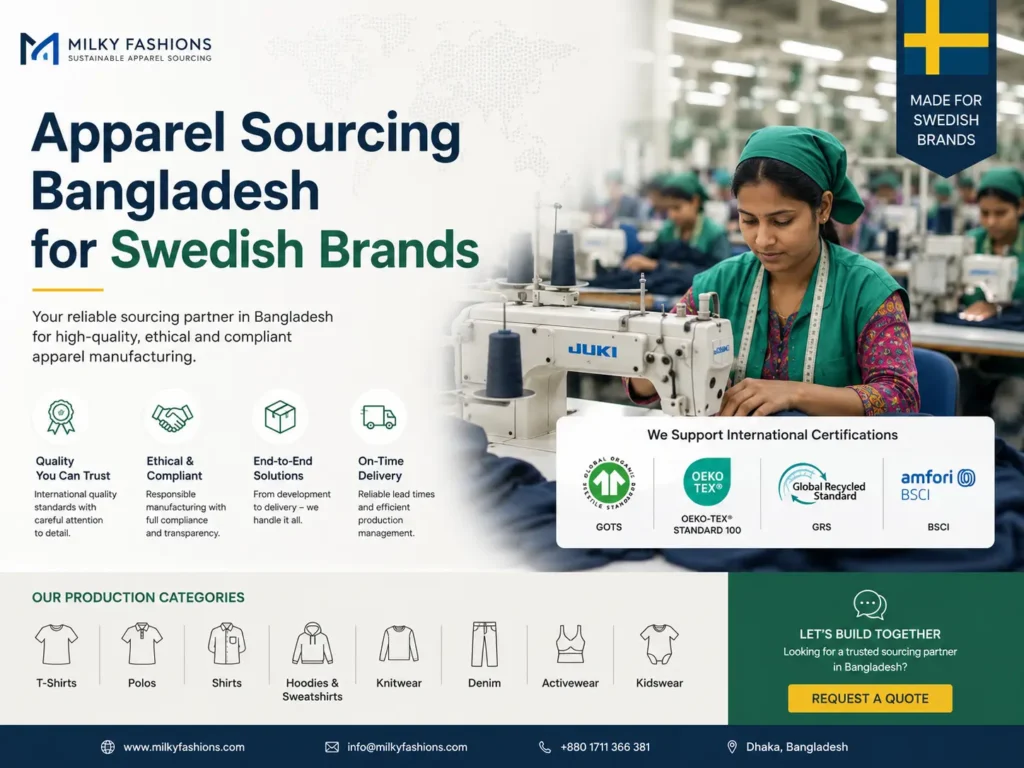
Apparel Sourcing from Bangladesh for Swedish Fashion Brands
Milky Fashions is an apparel sourcing partner in Bangladesh for Swedish fashion brands. As an independent buying house established in 2002, we manage the production of knitwear, denim, and private-label clothing across audited, certified factories — handling sampling, quality control, compliance, and export so Swedish brands get reliable, sustainable manufacturing without managing factories directly.
If you are a Swedish brand, retailer, or importer evaluating Bangladesh, you are looking at the most proven sourcing relationship in the country. This page explains why apparel sourcing in Bangladesh works so well for Swedish brands, how our buying house manages it for you, what we produce, and how we keep your production compliant with EU and Swedish market expectations.
Why Swedish Fashion Brands Source from Bangladesh
No country has a deeper sourcing relationship with Bangladesh than Sweden. H&M — founded in Sweden in 1947 and the most recognisable Swedish fashion brand in the world — has sourced from Bangladesh since the early 1980s and is the country’s single largest foreign garment buyer, working with hundreds of factories. The Swedish-Bangladesh apparel link is not new or experimental; it is decades deep and proven at the largest scale in the industry.
For Swedish brands of any size, the underlying advantages are the same ones that built that relationship.
World-leading knitwear and jersey capability
Bangladesh is the world’s second-largest apparel exporter, and knitwear is its single strongest category, accounting for the larger share of the country’s garment exports. For Swedish brands built on quality essentials, jersey basics, and clean Scandinavian everyday wear, that depth of knit capability is a precise match. Whether you need knitwear, t-shirts, or sweaters and cardigans, the specialised capacity exists at scale.
Competitive pricing without cutting corners
Bangladesh offers genuinely competitive unit costs driven by manufacturing efficiency and scale, not by compromising standards. For Swedish brands managing tight retail margins while holding firm on quality and ethics, that balance is hard to find elsewhere.
A mature compliance ecosystem
After more than a decade of sustained investment, Bangladesh has one of the most audited, certified factory bases in global sourcing. For a market as standards-conscious as Sweden, that maturity matters — it means certified, inspectable, document-ready production rather than promises.
Duty access (with an honest 2026 note)
Swedish brands have historically benefited from strong EU duty access on Bangladeshi apparel. Bangladesh graduates from Least Developed Country status in November 2026, which begins a transition in EU trade treatment under transitional arrangements rather than an overnight change. We track this closely and help Swedish brands plan their costing around the timeline, so your sourcing strategy stays competitive through the shift.
Sustainability: Where Bangladesh Meets Swedish Values
Few markets take sustainability as seriously as Sweden. Swedish consumers expect transparency, Swedish brands lead on circularity through national initiatives like Textile & Fashion 2030, and Swedish regulators apply some of the strictest chemical scrutiny in Europe. A sourcing country has to meet that bar — and Bangladesh increasingly does.
Bangladesh hosts more LEED-certified green garment factories than any country in the world, with over 230 certified units, many at Platinum level. These factories run advanced effluent treatment, zero-liquid-discharge water systems, rooftop solar, and growing textile-to-textile recycling capacity. That is real, verifiable green manufacturing — not a marketing claim.
We work exclusively with factories certified to recognised social and environmental standards: BSCI, WRAP, SEDEX, GOTS, GRS, and OEKO-TEX. For Swedish brands with serious sustainability commitments — organic cotton lines, recycled-content programmes, or OEKO-TEX-tested products for chemical safety — the certified Bangladesh factory base is well matched to your standards. You can read more about how we approach this on our sustainable garment sourcing page.
What Milky Fashions Does as Your Buying House
Sourcing from another continent is risky to do alone. A factory sells you the capacity it owns; it has no incentive to tell you when a different factory would make your product better, cheaper, or more reliably. As an independent buying house, we have no production line to fill and no capacity bias. We represent you — the Swedish brand — and our job is to get your product made right.
Here is what that means in practice across the whole process:
Factory selection and vetting. We match each order to the factory best suited to that specific product and quantity, drawing on a vetted network rather than a single facility. Your t-shirt programme and your structured outerwear go to factories that each do that product well.
Sampling and product development. We translate your design or tech pack into a proto and fit sample, manage revisions, and hold bulk production to the sample you approve.
Production oversight and quality control. We run inline quality checks during production and a final inspection to an agreed AQL standard before anything ships — with reports, not just assurances.
Compliance and documentation. We confirm certification before placing orders and build the documentation trail your market increasingly requires.
Export, logistics, and shipment. We coordinate documentation and export so your finished, labelled goods reach Sweden ready for sale.
You deal with one accountable, English-speaking contact in Dhaka — where your goods are actually made — through our apparel sourcing and sourcing agent service.
Products We Source for Swedish Brands
We coordinate production across the full range of apparel categories Swedish brands rely on, matching each to a specialised factory.
- Knitwear and jersey — the backbone of Swedish everyday fashion, from fine-gauge knits to heavier pieces.
- T-shirts — quality essentials and elevated basics in a range of weights and finishes.
- Polo shirts — piqué and jersey polos for casual and smart-casual ranges.
- Sweaters and cardigans — knitted layering pieces built for Scandinavian seasons.
- Hoodies — heavyweight fleece and brushed-back constructions for streetwear and leisure lines.
- Sweatshirts — crew and quarter-zip styles in a range of loopback and fleece fabrics.
- Denim — jeans, jackets, and washed and treated finishes.
- Private label and OEM — your brand and your designs, produced to your exact specification. If you bring your own designs and tech packs, our OEM apparel and garment supplier service builds them to spec.
Whatever the category, the principle holds: your spec, your standard, inspected before it ships. Explore the full range on our products and capabilities overview, or see our complete apparel supplier offering.
EU Compliance and Swedish Market Requirements
Sweden is an EU member, so the regulatory wave reshaping European fashion applies directly to Swedish brands — and increasingly, the responsibility runs back up the supply chain to the factory. Producing through audited, certified factories is how you stay ahead of it.
The frameworks that matter most: the Corporate Sustainability Due Diligence Directive (CSDDD), which pushes brands to verify conditions across their supply chains; and the Ecodesign for Sustainable Products Regulation (ESPR), whose incoming Digital Product Passport will require traceable product data. On top of EU rules, Sweden’s own chemical scrutiny is among the strictest in Europe, which makes OEKO-TEX chemical-safety certification particularly relevant for goods sold to Swedish consumers.
We build for this from the start: certified factories, verified before production, with the documentation trail assembled as we go. You can review our full certifications and read more about the regulatory landscape on our EU textile regulations guide.
Minimum Order Quantities and Lead Times
Our typical minimum order quantity is 3,000 to 8,000 pieces per style, depending on fabric, construction, and finishing. The reason is practical: fabric is usually knitted or woven to order, and mills set minimum fabric runs. Lower quantities are sometimes possible on simpler constructions or where suitable stock fabric is available — we tell you honestly during costing rather than promising a number we cannot hold.
On timing, plan for sampling and bulk as separate stages. Sampling and approval typically take a few weeks, and bulk production runs on top of that, with shipping time on the back end. Knowing your launch date lets us plan backwards so your collection lands on time. If you are a growing Swedish label that needs a partner able to scale order volumes as you grow, that is exactly the relationship we are built for.
Logistics from Bangladesh to Sweden
Sweden is well connected to Bangladesh by sea. Goods ship from Chittagong, Bangladesh’s main port, to the Port of Gothenburg — the largest port in Scandinavia and Sweden‘s primary gateway for containerised imports — with onward distribution across the country from there. We coordinate export documentation and work with established freight routes so your shipment moves predictably. For Swedish brands, this means a mature, well-trodden logistics path rather than an improvised one.
Why Choose Milky Fashions for Swedish Sourcing
Three things set us apart for Swedish brands.
We are independent. We match your order to the right factory rather than the one we happen to own. That protects both your quality and your price, and it is the core reason to use a buying house instead of walking into a single factory.
We have 24 years of EU buyer experience. Operating since 2002, we work daily with brands across the EU — including Denmark and Germany — so we understand the compliance, labelling, and quality expectations of European markets, and Scandinavian ones in particular.
We communicate directly and honestly. One accountable contact in Dhaka who answers quickly and tells you the truth about cost and timing — no layers, no surprises.
You can learn more about Milky Fashions and how we work, or browse common questions on our FAQ page.
The Swedish Fashion Landscape and Why Bangladesh Fits It
Swedish fashion is broad, and Bangladesh serves every part of it. At the volume end, Swedish high-street and fast-fashion retailers built their supply chains on Bangladeshi knit and woven production years ago. In the mid-market, contemporary Swedish labels known for clean design and dependable quality rely on exactly the kind of well-made essentials — t-shirts, polos, sweatshirts, and knitwear — that Bangladesh produces at scale. And at the premium and outdoor end, Swedish brands demanding technical fabrics, considered construction, and verifiable ethics find a factory base that has matured well beyond basic cut-and-sew.
What unites Swedish fashion across these tiers is a recognisable design philosophy: minimal, functional, quality-led, and increasingly circular. That philosophy puts unusual weight on two things — consistent make quality and credible sustainability — and both are areas where a careful buying house earns its place. Getting a clean, well-constructed garment with honest certification behind it is precisely what we manage on your behalf. For Swedish brands, the appeal of Bangladesh is not only price; it is the combination of price, scale, deep knitwear and denim capability, and a certified, inspectable factory base that can stand up to Scandinavian scrutiny.
This is why the Swedish-Bangladesh sourcing relationship has proven so durable. The country that gave the world its biggest fashion retailer has manufactured in Bangladesh for forty years — and the same advantages that supported that are available to independent Swedish brands, growing labels, and importers today, with a buying house managing the complexity so a small team does not have to.
What to Prepare Before You Start Sourcing
The smoother your first order runs, the more you bring to the opening conversation. You do not need all of this to begin — even a clear idea and a target market is enough for us to start — but the more you have ready, the faster and more accurate your costing and sampling will be.
- A design or reference. A tech pack is ideal, but a sketch, a photo, or a physical sample we can measure all work as a starting point.
- Target fabric and weight. For example, a 180 gsm single jersey for t-shirts or a 320 gsm brushed fleece for hoodies. If you are unsure, we will recommend suitable options.
- Key measurements or a size set. Your fit is part of your brand identity, so locking it early means your samples land closer to right the first time.
- Quantity and size ratio. Your total units and the split across sizes shape both pricing and fabric planning.
- Sustainability and compliance needs. Tell us if you require organic cotton, recycled content, OEKO-TEX chemical certification, or specific documentation for the Swedish and EU market.
- Your timeline. Knowing your launch or delivery date lets us plan sampling and bulk backwards so the collection arrives when you need it.
If you only have a concept and a market, that is still a real starting point. Turning an early idea into a producible, costed specification is part of what a buying house is for — and it is where working with Milky Fashions saves a Swedish brand the most time and risk.
Frequently Asked Questions
Can a small Swedish brand source from Bangladesh?
Yes. While minimums apply, independent Swedish labels and emerging brands source from Bangladesh successfully. As your buying house, we help you find factories suited to your order size and can sometimes consolidate orders to work within lower minimums. Get in touch to discuss your specific collection.
Are Bangladesh factories sustainable enough for Swedish brands?
Bangladesh hosts more LEED-certified green garment factories than any country in the world, and we work exclusively with factories certified under GOTS, GRS, OEKO-TEX, BSCI, WRAP, and SEDEX. For Swedish brands with serious sustainability and chemical-safety commitments, the certified Bangladesh factory base is well matched to your standards.
Which Swedish brands already source from Bangladesh?
H&M — founded in Sweden and one of the world’s largest fashion retailers — has sourced from Bangladesh since the early 1980s and is the country’s single largest foreign garment buyer. That decades-deep relationship shows the sourcing path is proven at the highest level, and it is open to Swedish brands of every size.
What about EU compliance and chemical safety for the Swedish market?
Sweden applies EU frameworks such as CSDDD and the ESPR Digital Product Passport, alongside some of Europe’s strictest national chemical scrutiny. We work only with certified factories, verify compliance before production, and build the documentation trail your market requires — with OEKO-TEX certification particularly relevant for chemical safety.
What is the difference between a buying house and sourcing directly from a factory?
A buying house represents you, the buyer — selecting factories, managing quality and compliance, and staying accountable across the whole process. Sourcing factory-direct means managing capacity, compliance, and quality yourself, from another continent. For brands without an in-house sourcing team in Asia, a buying house removes the risk and complexity.
Start Sourcing from Bangladesh
If you are a Swedish fashion brand, retailer, or importer evaluating Bangladesh as your sourcing destination, Milky Fashions offers the certified factory network, the EU compliance expertise, and the 24 years of experience to make it work. Whether you are launching your first collection or scaling an established range, we manage the entire process so you can focus on your brand.
Get in touch with Milky Fashions and tell us about your product, target quantity, and timeline. You can also explore our full range of garment sourcing services or read more on our blog.