
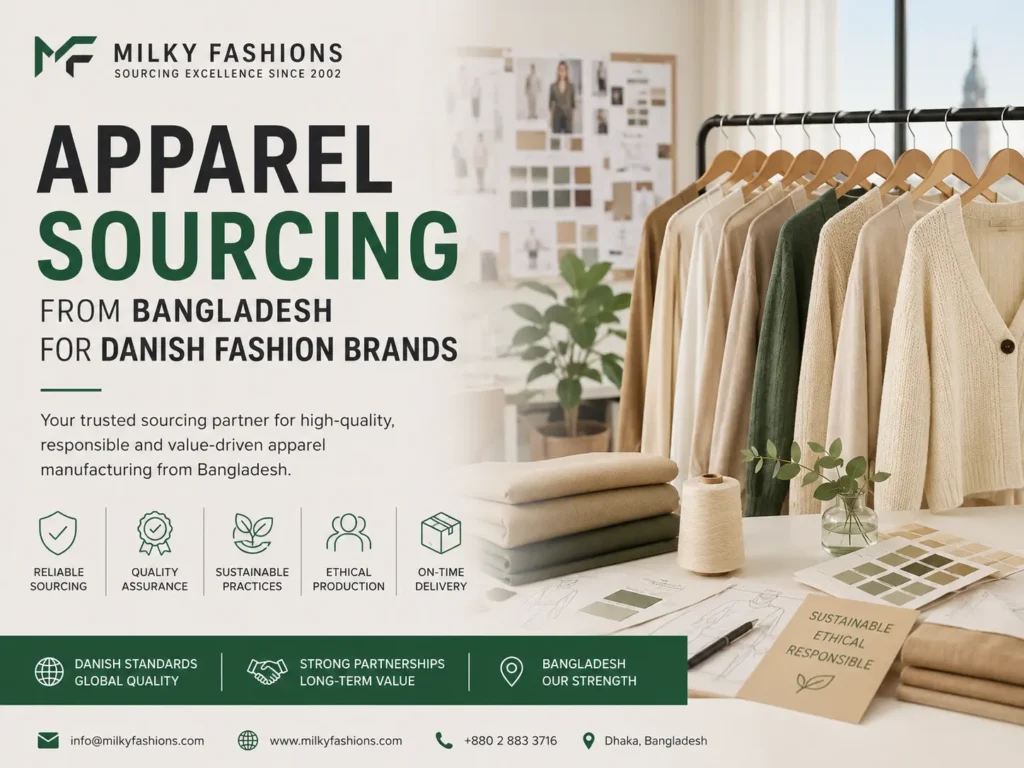
Apparel Sourcing from Bangladesh for Danish Fashion Brands
Milky Fashions helps Danish fashion brands, retailers and importers source apparel from Bangladesh — knitwear, jersey, denim, woven garments and private-label collections. As an independent garment buying house established in 2002 and a BGBA member (M-0357), we represent the buyer’s interests, selecting compliant factories and managing sampling, production and quality control while ensuring every supplier meets the BSCI, WRAP, SEDEX and GOTS standards Danish brands expect.
Denmark holds a unique position in the global fashion landscape. From Copenhagen’s celebrated design houses to a fast-growing ecosystem of independent labels, Danish fashion is defined by clean design, quality construction, and — more than almost any other European market — a serious commitment to sustainability and supply-chain responsibility. For Danish brands sourcing from Bangladesh, the opportunity is clear: access to the world’s most capable knitwear and garment manufacturing base, paired with the certified, compliant factories that Danish consumers and regulators now demand.
This page covers everything a Danish buyer needs to know — why Bangladesh makes commercial and ethical sense for Danish brands, what certifications your supply chain requires, realistic minimum order quantities and lead times, logistics from Chittagong to Aarhus and Copenhagen, and how our full-service buying house model works from first sample to final shipment.
Why Danish Fashion Brands Source from Bangladesh
The relationship between Denmark and Bangladesh’s garment industry is already one of the deepest in global fashion. Bestseller, the Danish multinational behind brands like Vero Moda, Jack & Jones, Only and Selected, is one of the largest buyers of Bangladeshi-made garments in the world — sourcing hundreds of millions of dollars in apparel annually from Bangladeshi factories. That scale of commitment from Denmark’s biggest fashion company is not an accident. It reflects what Danish brands of every size discover when they source from Bangladesh: a combination of manufacturing capability, competitive pricing, and compliance infrastructure that few other sourcing origins can match.
Bangladesh is the world’s second-largest apparel exporter and the second-largest supplier of clothing to the European Union. For Danish brands, several advantages stand out.
World-leading knitwear capability
Bangladesh has become the largest knitwear exporter to the European Union, surpassing China in knitted garments. For Danish fashion — where knitwear, jersey and soft separates are central to the Scandinavian wardrobe — this matters enormously. The country’s strong vertical integration in knits, from yarn to finished garment, delivers both cost-efficiency and faster lead times. Danish brands building collections around quality knitwear — sweaters, cardigans, jersey tops and loungewear — are sourcing from the single most competitive knit manufacturing base in the world.
Competitive pricing without compromising compliance
Danish brands operate in a demanding retail environment with thoughtful customers and tight margins. Bangladesh offers genuinely competitive manufacturing costs across product categories, but — critically for Denmark — without forcing a trade-off against ethics or quality. The modern Bangladeshi factory base is certified, audited, and increasingly sustainable. You can read more about what sourcing actually costs in our guide to garment sourcing costs from Bangladesh.
Duty-free EU access (with an important 2026 timeline)
Bangladesh currently enjoys duty-free access to the EU under the Everything But Arms (EBA) arrangement, which removes tariffs on apparel imports into Denmark and the rest of the bloc. This is a meaningful cost advantage. However, Danish brands should plan ahead: Bangladesh graduates from Least Developed Country (LDC) status in November 2026, beginning a transition in its EU trade treatment, with duty preferences continuing under transitional arrangements before moving to the standard GSP framework. Brands that build certified, compliant supply chains now — with a partner who understands this transition — will be far better positioned than those reacting after the fact. We cover the regulatory picture in depth on our EU textile regulations and compliance page.
A skilled, large-scale workforce
With more than 4,000 export-oriented factories and millions of skilled workers, Bangladesh offers production capacity that scales — whether you are a Copenhagen startup placing your first 1,000-piece order or an established Danish retailer running seasonal volume programmes across multiple categories.
Sustainability: Why Bangladesh Fits Denmark’s Values
For most European markets, sustainability is a growing priority. For Denmark, it is a defining one — and this is where the Bangladesh sourcing story aligns especially well with Danish brands.
A government-level sustainability partnership
In 2022, Denmark and Bangladesh signed a Sustainable and Green Framework Engagement Agreement, a bilateral commitment to support the green transition of Bangladesh’s textile and fashion industry. The Danish Embassy in Dhaka actively works with Danish brands, Bangladeshi factories and international partners to reduce the environmental impact of textiles through sustainable design, cleaner manufacturing and improved working conditions. This is a level of institutional cooperation between two countries that simply does not exist for most sourcing relationships — and it gives Danish brands a uniquely supported pathway into responsible Bangladesh sourcing.
The world’s greenest garment factories
Bangladesh hosts more LEED-certified green garment factories than any other country in the world. For Danish brands that need to evidence environmental responsibility to their customers and increasingly to regulators, this means you can source from factories built and operated to the highest global environmental standards — solar power, water recycling, energy efficiency and reduced emissions.
Certifications that match Danish expectations
Danish consumers prioritise brands with transparent sourcing and ethical labour practices. Through sustainable garment sourcing, Milky Fashions connects Danish brands with factories certified under GOTS (organic textiles), GRS (recycled materials) and OEKO-TEX (chemical safety), alongside the social-compliance standards of amfori BSCI, WRAP and SEDEX. Whether you are building an organic cotton collection, a recycled-polyester activewear line, or a fully traceable capsule range, we match your product to the right certified factory. You can review the full compliance stack on our certifications page.
Circular and conscious production
Danish fashion leads Europe on circular-economy thinking — repair, recycling, durability and considered production. Bangladesh’s factory base has evolved to support exactly these requirements, from recycled-fibre processing to durable construction designed for garments built to last. Sustainable sourcing from Bangladesh is no longer a compromise for Danish brands; it is a competitive advantage.
What Milky Fashions Does as Your Buying House
Many Danish brands — particularly independent labels and growing e-commerce businesses — do not have an in-house sourcing team or a presence in Asia. This is exactly the gap an independent buying house fills. If you want the full explanation of the model, our blog post on what a garment buying house is breaks it down in detail. In short, here is what we handle on your behalf.
Factory selection and vetting
We identify the right certified factory for your specific product, rather than forcing your order into whatever capacity a single manufacturer happens to have. Our factory network spans Gazipur, Narayanganj and Savar, covering knitwear, woven garments, denim and more. Every factory is audited for social and environmental compliance before your order is placed.
Sampling and product development
From your tech pack or design concept, we manage the full sampling process — fit samples, fabric sourcing, lab dips, and pre-production samples — until what you approve is exactly what goes into bulk production. This is where many sourcing relationships fail; getting it right is the core of our job.
Production oversight and quality control
We monitor production inline, not just at the end. Our quality control follows defined AQL inspection standards, with pre-shipment inspection before any goods leave the factory. For a Danish brand sourcing thousands of kilometres away, this on-the-ground oversight is the difference between predictable quality and expensive surprises.
Compliance and documentation
We ensure your supply chain meets EU due-diligence expectations — increasingly important as regulations like the EU’s ESPR and broader corporate sustainability due-diligence requirements take effect. We provide the certification documentation and traceability evidence your brand needs.
Export, logistics and shipment
We coordinate export documentation and shipping from Chittagong port to Danish entry points, managing the process so your goods arrive on schedule. Whether by sea freight to Aarhus or onward logistics to Copenhagen, we handle the complexity end to end.
Products We Source for Danish Brands
Danish fashion spans minimalist staples, elevated basics, occasionwear and increasingly technical sustainable pieces. We source across the full range:
Knitwear and jersey
Our strongest category and Bangladesh’s global strength — sweaters, cardigans, jersey tops, loungewear and soft separates. Explore knitwear sourcing in detail.
Denim
Sustainable and conventional denim — jeans, jackets and denim separates from washing-capable, compliant facilities.
T-shirts, polos and sweatshirts
Core wardrobe staples in organic and recycled fabrications — the foundation of many Danish brands’ collections.
Private label and OEM/ODM
Full private label clothing manufacturing under your own brand and specifications, from fabric to finished, labelled, packaged product — so Danish brands can launch their own collections without owning a factory.
Woven garments
Shirts, blouses, dresses, trousers and outerwear in cotton, viscose and blended fabrications.
Minimum Order Quantities and Lead Times
A common question from Danish brands — especially smaller labels and startups — concerns minimums. Realistic MOQs from Bangladesh typically range from around 1,000 to 3,000 pieces per style depending on fabric and construction, though some categories and consolidated orders can work with lower minimums. We give honest guidance rather than telling you what you want to hear; you can read our full breakdown in the guide to MOQs when sourcing from Bangladesh.
Lead times generally run 60–120 days from order confirmation to shipment, depending on product complexity, fabric availability and quantity. As your buying house, part of our role is building a realistic production calendar around your launch dates and managing the timeline so deadlines are met.
Logistics from Bangladesh to Denmark
Goods typically ship by sea from Chittagong (Chattogram) port — recently strengthened by a 30-year terminal agreement with Danish shipping giant Maersk, a fitting symbol of the Denmark-Bangladesh trade relationship. Sea freight to Northern European ports, with onward transport to Danish destinations including Copenhagen, Aarhus and Odense, is the standard route for volume production. We manage export documentation, customs paperwork and shipping coordination so the logistics are handled on your behalf rather than becoming your problem.
Why Choose Milky Fashions for Danish Sourcing
Danish brands have options when sourcing from Bangladesh — so why work with us?
We are independent
We do not own factories. That means we represent your interests, not a factory’s need to fill its production lines. We choose the best certified factory for your product, negotiate FOB pricing on your behalf, and stay accountable to you throughout. This independence is the single most important distinction between a buying house and a factory-direct relationship.
24 years of EU buyer experience
We have sourced for European brands since 2002. We understand European quality expectations, EU compliance requirements, and the specific standards Scandinavian brands hold — because we have been meeting them for over two decades.
Compliance and sustainability depth
With Danish brands facing rising sustainability expectations from consumers and regulators alike, our focus on certified, audited, environmentally responsible factories aligns directly with what Danish fashion needs. We don’t treat compliance as paperwork; we treat it as the foundation of a sourcing relationship Danish brands can stand behind.
A single accountable partner
From tech pack to shipment, you have one team managing the entire process — sampling, production, quality, compliance and logistics. For a Danish brand without a sourcing office in Asia, that accountability is everything.
Frequently Asked Questions
Can a small Danish brand source from Bangladesh?
Yes. While minimums apply, independent Danish labels and startups regularly source from Bangladesh successfully. As your buying house, we help you find factories suited to your order size and can sometimes consolidate orders to work within lower minimums. Get in touch to discuss your specific collection.
Are Bangladesh factories sustainable enough for Danish brands?
Bangladesh hosts more LEED-certified green garment factories than any country in the world, and we work exclusively with factories certified under GOTS, GRS, OEKO-TEX, BSCI, WRAP and SEDEX. For Danish brands with serious sustainability commitments, the certified Bangladesh factory base is well-matched to your standards.
How does the Denmark–Bangladesh sustainability agreement help my brand?
The 2022 Sustainable and Green Framework Engagement Agreement between Denmark and Bangladesh supports the green transition of Bangladesh’s textile industry, backed by the Danish Embassy. It reflects a government-level commitment to responsible sourcing that gives Danish brands additional confidence and support when manufacturing in Bangladesh.
What happens to duty-free access after Bangladesh’s 2026 LDC graduation?
Bangladesh graduates from LDC status in November 2026, beginning a transition in EU trade treatment with duty preferences continuing under transitional arrangements. We help Danish brands plan around this timeline so your sourcing strategy stays cost-effective through the change.
What is the difference between a buying house and sourcing directly from a factory?
A buying house represents you, the buyer — selecting factories, managing quality and compliance, and staying accountable across the whole process. Sourcing factory-direct means managing capacity, compliance and quality yourself. For brands without an in-house sourcing team in Asia, a buying house removes the risk and complexity. Our blog explains this distinction in full.
Start Sourcing from Bangladesh
If you are a Danish fashion brand, retailer or importer evaluating Bangladesh as your sourcing destination, Milky Fashions offers the certified factory network, the EU compliance expertise, and the 24 years of experience to make it work. Whether you are launching your first collection or scaling an established range, we manage the entire process so you can focus on your brand.
Request a vetted factory quote and tell us about your product, target quantity and timeline. You can also explore our full range of garment sourcing services or read more on our blog.